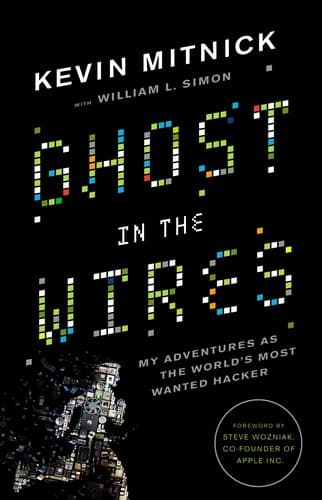
Ghost in the Wires
by Kevin Mitnick · Published 2011
Mitnick's own account of his years as the FBI's most-wanted hacker — the social-engineering episodes are the real education here, more than the technical exploits.
What works
- The social-engineering scenes are a genuinely useful education in how human trust gets exploited
- Fast-paced, cinematic pacing that makes technical material approachable
What doesn't
- Self-serving in places — Mitnick frames his own actions more sympathetically than some of his victims would
- Technical detail is dated; the specific exploits don't map onto modern systems
Summary
Kevin Mitnick spent much of the 1980s and 90s breaking into the networks of Motorola, Nokia, Sun Microsystems, Novell, Pacific Bell and others, and became the most publicly notorious hacker of his era — pursued by the FBI, arrested in 1995, and held for nearly five years including eight months in solitary confinement, reportedly because a prosecutor persuaded a judge he could start a nuclear war by whistling into a payphone. Ghost in the Wires is his own account of that period, written after his release and after he had rebuilt a career as a security consultant.
The book's most useful surprise is how rarely the intrusions were technical. Mitnick's primary method was social engineering: calling a company's employee, presenting himself convincingly as an internal colleague, and simply asking for what he wanted. He researched organizational structure and internal jargon obsessively so that his pretexts would survive scrutiny — knowing a real manager's name, the right department, the right internal system, so that a request sounded routine rather than suspicious. Source code for mobile phone firmware was frequently obtained not by breaking encryption but by persuading someone to send it.
Running underneath is a long cat-and-mouse narrative: identity changes, cloned mobile phones to defeat tracing, monitoring the very investigators pursuing him, and years living under assumed names before he was finally located through cellular signal triangulation. Mitnick maintains throughout that his motivation was curiosity and the challenge rather than money — he says he never sold what he took or damaged systems — and while that framing is self-serving in places, the operational detail he gives is specific enough to be genuinely instructive.
Key ideas
1. Social engineering beats technical defenses
The book's central lesson is that the fastest route into a hardened network is usually a person. Mitnick repeatedly bypassed firewalls, access controls and authentication by convincing an employee to hand him a password, install something, or read out a token — because organizations invest heavily in technical controls and comparatively little in whether a plausible-sounding caller is who they claim to be.
People are the weakest link. You can have the best technology, firewalls, intrusion-detection systems, biometric devices — and somebody can call an unsuspecting employee.
What makes the account valuable rather than merely anecdotal is the granularity: he describes the preparation, the specific phrasing, the way an unusual request is normalized by embedding it in routine details, and how a small confirmed fact makes the next, larger ask credible.
2. Pretexting is research, not improvisation
The successful calls in the book are never improvised. Mitnick would collect internal phone directories, learn department structures, note the names of managers, and absorb the company's internal vocabulary — project codenames, system names, the way employees actually refer to processes — before ever making contact. By the time he called, he could speak like an insider because he had done the work of becoming one on paper.
This is the part most relevant to defenders. It means the exploitable asset isn't only credentials — it's organizational information that seems harmless in isolation, and that most companies publish or disclose without much thought.
3. Escalating trust in small increments
A recurring pattern is that Mitnick rarely asked for the valuable thing first. He would obtain a trivial, non-sensitive piece of information from one person, use it to establish credibility with a second, and use that credibility to make a larger request — each step individually reasonable, the chain as a whole devastating.
The defensive implication is uncomfortable: no single employee in the chain necessarily did anything obviously wrong, which is why training that focuses on "don't give out passwords" catches so little of this.
4. The gap between the legend and the record
Mitnick spends real energy on the disparity between what he was accused of and what he says he did — the claims about nuclear launch capability, the damage figures companies reported to prosecutors, the length of pre-trial detention. His argument is that the myth was substantially manufactured and that the punishment tracked the myth rather than the offense.
Read critically, this section is both the book's most important context and its least neutral. The specific inflation he documents is well attested; the framing that he was essentially a harmless curious explorer is his own, and his victims' accounts differ.
Who it's for
- Anyone responsible for security awareness training — this is the most vivid available material on why technical controls alone don't hold.
- Developers and admins who assume attackers come through the network — the book is a sustained argument that they often come through the phone.
- Readers who want the history of 1990s hacker culture from the inside — the period detail is genuinely first-hand.
- Anyone interested in how a criminal case gets shaped by press coverage — the legal chapters are a case study in that.
FAQ
Is this a technical book?
Not really. It's a memoir with technical detail woven in, pitched at a general audience — you don't need a background in networking or telephony to follow it, and it won't teach you modern security practice.
How much of the hacking was actually social engineering?
By Mitnick's own account, the large majority. He used technical exploits where convenient, but the recurring pattern throughout the book is a phone call to a person rather than an attack on a system.
Should I read this or The Art of Deception?
The Art of Deception is the structured, instructional treatment of social engineering and is more useful if you want a framework for defense. Ghost in the Wires is the narrative of how he actually did it, which is more memorable and better at conveying why it works.
Is his version of events disputed?
Yes, in parts. Journalist John Markoff's reporting and the account by Tsutomu Shimomura, who helped track him, differ significantly from Mitnick's on both motive and impact. Mitnick's criticism that press coverage inflated his capabilities is well supported; his self-characterization as harmless is contested.
What's the book's main weakness?
It has exactly one narrator, and he is the accused. The technique-level detail is credible and checkable, but the moral framing — that no real harm was done — is asserted rather than demonstrated, and the people on the other side of these intrusions get very little voice.
Was this useful?
Counts appear once there are 5 votes.