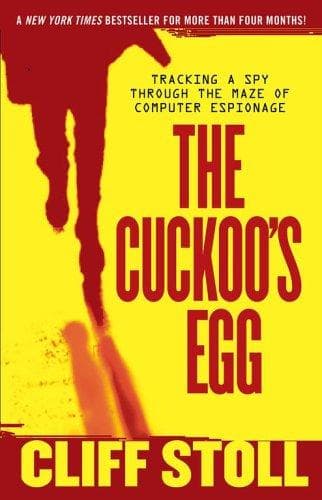
The Cuckoo's Egg
by Clifford Stoll · Published 1989
A real astronomer accidentally becomes a real spy hunter over a 75-cent accounting discrepancy — reads like a thriller and is also one of the earliest first-hand accounts of network security investigation.
What works
- Genuinely suspenseful despite being a work of nonfiction about Unix logs
- An accessible, human entry point into how early network intrusion detection actually worked
What doesn't
- The technology (dial-up modems, mainframe logs) is entirely of its era — no direct operational lessons for modern infosec
- Stoll's discursive, personal asides (his personal life, his politics) won't be to every reader's taste
Summary
Clifford Stoll was an astronomer who had run out of grant money and been reassigned to manage computers at Lawrence Berkeley Laboratory. In his second day on the job in 1986 he was handed a trivial task: reconcile a 75-cent discrepancy in the lab's computer accounting system. Someone had used nine seconds of computer time without a matching billing account. Rather than write it off, Stoll went looking for the cause — and found an unauthorized user with system privileges who had no business being there.
What follows is a ten-month pursuit. Stoll rigged printers to every incoming line so that each keystroke the intruder typed was recorded on paper, slept on the floor of the machine room to catch logins as they happened, and slowly built a picture of someone methodically using Berkeley's systems as a staging point to reach military and defense contractor networks across the United States. The intruder was searching for documents about SDI, nuclear weapons, and troop deployments, and was getting into systems largely by exploiting default passwords and a known hole in the GNU Emacs movemail utility.
The other half of the book is Stoll's attempt to get anyone in authority to care. The FBI told him a 75-cent loss wasn't worth their time; the CIA, NSA, Air Force OSI and eventually German authorities each wanted the information but not the responsibility. The trail ended in Hanover, West Germany, with a group selling stolen material to the KGB. Along the way the book documents the near-total absence, in the 1980s, of any legal, institutional, or technical framework for handling a computer intrusion.
Key ideas
1. Accounting discrepancies as an intrusion signal
The investigation begins because Stoll refused to treat a rounding error as noise. The lab ran two independent accounting systems, and a 75-cent gap between them meant someone had used resources without an authorized account — a fact that only surfaced because the two systems could be cross-checked against each other.
I'd been a rookie, and I'd learned a lesson: a 75-cent discrepancy is a real thing, and real things have causes.
The generalizable lesson survives the obsolete technology: intrusions rarely announce themselves, and the useful signal is usually a small inconsistency between two records that should agree. That reasoning still underlies modern detection work, even though the specific artifacts have changed entirely.
2. Patience and observation over immediate remediation
Stoll's decisive choice was not to lock the intruder out. Closing the account would have ended the incident and taught him nothing; instead he left access open, instrumented it completely, and watched. The printer logs became a full transcript of the attacker's methods, targets, and skill level, which is what eventually made attribution possible.
The trade-off is real and the book doesn't hide it — leaving a live intruder in a network connected to military systems was a genuine risk that Stoll's superiors had to be repeatedly persuaded to accept. Modern incident response wrestles with exactly the same containment-versus-intelligence tension.
3. The honeypot
With the intruder repeatedly searching for SDI-related material and never finding much, Stoll and his colleagues fabricated a fictitious "SDInet" project — a set of invented bureaucratic documents about a classified network, dull enough to be plausible and voluminous enough to take a long time to read. The intruder took the bait and stayed connected long enough for the phone trace to complete.
This is one of the earliest documented uses of what is now standard practice, and its logic hasn't changed: the bait has to be boring, credible, and slow to consume.
4. The institutional vacuum
The most dated and most striking element is how little existed to handle any of this. There was no CERT, no established reporting path, no agency that clearly owned the problem, and no law under which a small financial loss justified federal attention. Stoll spent months being passed between organizations that each wanted his findings and none of which would take ownership.
The incident was a direct contributor to that changing — the Morris worm the following year, plus cases like this one, produced the institutions and norms that a modern security team takes for granted.
Who it's for
- Anyone working in or curious about security — this is the field's founding narrative, and it's genuinely enjoyable rather than dutiful reading.
- Readers who want a true story that reads like a thriller — the pacing is remarkable given that the subject is Unix logs and phone traces.
- People interested in how institutions respond (or fail to respond) to a new class of problem — half the book is bureaucratic, and that half is the more instructive one.
- Anyone who assumes attacks are always technically sophisticated — the intruder mostly walked in through unchanged default passwords.
FAQ
Is this a true story?
Yes, entirely. Stoll was a real systems administrator at Lawrence Berkeley Laboratory, the intrusion happened in 1986–87, and the investigation led to the arrest of Markus Hess in Hanover, who had been selling material to the KGB. Stoll also published an academic account in Communications of the ACM.
Do I need technical knowledge to read it?
No. Stoll explains Unix concepts as they come up and pitches the book at a general audience — it was a mainstream bestseller, not a technical title.
How did the intruder actually get in?
Mostly through unglamorous means: default and unchanged passwords on systems across the network, plus a known vulnerability in the GNU Emacs movemail utility that allowed privilege escalation. Very little of it required novel technique.
Why didn't the FBI help?
Because in 1986 a 75-cent loss didn't meet any threshold they recognized, and no agency had clear jurisdiction over computer intrusion. The book's account of being passed between the FBI, CIA, NSA and Air Force OSI is one of its more valuable historical records.
What's the book's main weakness?
The extended personal digressions. They're a deliberate part of Stoll's voice, but they dilute the investigation considerably, and a reader primarily interested in the case will find the pacing uneven because of them.
Was this useful?
Counts appear once there are 5 votes.