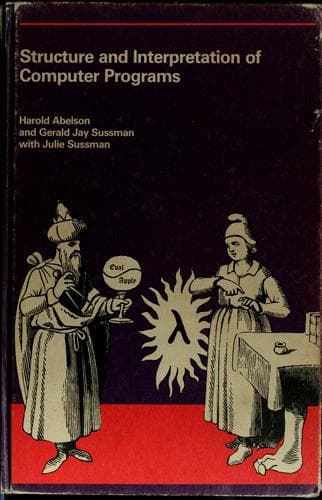
Structure and Interpretation of Computer Programs
by Harold Abelson & Gerald Jay Sussman · Published 1985
The book that shaped how computer science is taught for a generation — building an interpreter, a register machine, and a stream-processing system from scratch teaches more than any framework tutorial.
What works
- Builds real understanding of computation from first principles, not syntax memorization
- The exercises (build your own interpreter, register machine, lazy evaluator) are genuinely formative
What doesn't
- Scheme's unfamiliarity is a real barrier for readers who only know mainstream imperative languages
- Dense and slow going — this is a semester-long text, not a weekend read
Summary
Abelson and Sussman's opening claim sets the tone for everything that follows: the book is not about a programming language, and computer science is not really about computers. It is about the techniques for controlling complexity in large systems, and the language it uses — a small dialect of Scheme, teachable in an afternoon — is chosen precisely because it gets out of the way. There is almost no syntax to learn, so nothing stands between the reader and the actual subject.
That subject is abstraction, approached three times over. First, abstraction over procedures: how to build compound operations, how higher-order procedures let you pass and return functions, and how recursion and iteration differ in the shape of the process they generate rather than in how the code looks. Second, abstraction over data: how to build compound data from nothing but procedures, why the interface between representation and use is the thing that actually matters, and how generic operations let one procedure work across many representations.
The last third is where the book becomes something other than a programming text. Having established that programs are data, the authors have the reader build an interpreter for Scheme in Scheme — the metacircular evaluator — and then keep going: a lazy evaluator, a nondeterministic evaluator, a logic programming language, a register machine, and a compiler. The pedagogical point is that the boundary between "the language" and "a program" is not fundamental. Once you have written an evaluator, a language is just another program you can modify, and that shift in perspective is the real payload of the book.
Key ideas
1. Procedural abstraction and higher-order procedures
The book establishes early that a procedure's name and interface matter more than its body — once sqrt works, its caller should neither know nor care that it uses Newton's method. From there it pushes to procedures that take and return other procedures, which lets a pattern like "sum a series" be captured once and specialized many times rather than rewritten per case.
Programs must be written for people to read, and only incidentally for machines to execute.
This idea is now ordinary in any language with first-class functions, but the book's treatment is unusually clear about why it matters: a higher-order procedure names a pattern of computation, and naming a pattern is what makes it available for reuse and reasoning.
2. Recursion, iteration, and the shape of a process
One of the book's sharpest distinctions is between a recursive procedure and a recursive process. A procedure that calls itself may still generate an iterative process — constant space, no growing chain of deferred operations — if the recursive call is in tail position. The point is that reading the source tells you less than you think; what matters is the shape of the computation it unfolds at runtime.
This reframes performance reasoning away from folklore ("recursion is slow") toward something checkable: does this procedure accumulate deferred work, or does it carry its state forward in its arguments? That question transfers to any language, whether or not it optimizes tail calls.
3. Data as procedures, and the meaning of "representation"
The book constructs pairs — the fundamental compound data structure — out of nothing but a closure, showing that "data" and "procedure" are not distinct categories at the foundations. The purpose isn't to suggest anyone should implement lists this way, but to make a stronger point: what a data structure is matters far less than the interface it presents, because everything above the interface is independent of the choice underneath.
This leads to data-directed programming and generic operations — dispatching on type so that the same operation works across representations added later, without modifying existing code. It is essentially the open/closed principle, arrived at from first principles decades before it was branded.
4. The metacircular evaluator
The book's centerpiece is writing a Scheme interpreter in Scheme. It is short — a few pages — and it makes the evaluation rules explicit: eval dispatches on expression type, apply binds arguments to parameters in a new environment, and the mutual recursion between them is the language.
Having built it, the reader can then change it. Making the evaluator lazy turns arguments into promises. Adding backtracking gives a nondeterministic language with an amb operator. Each variation is a small edit to a program the reader now fully understands, which is the most direct possible demonstration that language semantics are a design choice, not a fact of nature.
Who it's for
- Programmers who can build things but feel they don't understand what's underneath — this is the book that closes that gap more thoroughly than any framework tutorial.
- Anyone who wants to understand how interpreters and compilers actually work — you build several, rather than reading about them.
- Self-taught developers looking for the theoretical grounding a CS degree provides — this was that curriculum at MIT for two decades.
- Readers who enjoy hard exercises — the problems are the course, not decoration, and skipping them removes most of the value.
FAQ
Do I need to know Scheme or Lisp beforehand?
No — the language is introduced from scratch and its entire syntax fits in a few pages, which is exactly why it was chosen. The unfamiliarity of prefix notation and parentheses wears off within a chapter; the difficulty of the book lies in the ideas, not the language.
Is this still relevant, given it's from 1985?
Yes, because it teaches almost nothing that can expire. Abstraction, recursion, interpretation and state are properties of computation itself, not of a technology cycle. What has dated is the hardware context and some numeric examples, not the substance.
How does this compare to a modern practical programming book?
They aim at different things. A modern practical book makes you productive in a specific stack quickly; SICP changes how you think about programs in general and gives you almost no immediately marketable skill. Most people benefit from both, in that order of urgency but the opposite order of durability.
Is MIT still teaching from it?
No — MIT replaced it with a Python-based introductory course in 2008, on the reasoning that modern engineering practice involves composing large existing libraries rather than building systems from primitives. That's a legitimate argument about curriculum, not a claim that the book's content became wrong.
What's the book's main weakness?
Its pace and difficulty make it easy to abandon, and it offers little scaffolding for a reader who stalls — there is no gentle on-ramp and no shortcut through the exercises, which is precisely where most of its value is stored.
Was this useful?
Counts appear once there are 5 votes.