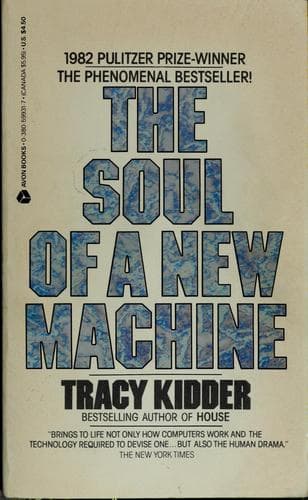
The Soul of a New Machine
by Tracy Kidder · Published 1981
A Pulitzer-winning account of an engineering team racing to build a new minicomputer — still the best portrait of what crunch, ego, and obsession actually feel like inside a hardware team.
What works
- Captures the psychology of engineering crunch culture with more honesty than most modern startup writing
- Genuinely well-reported — Kidder spent a year embedded with the team
What doesn't
- The specific hardware (Eclipse/MV minicomputers) is now historical trivia; readers need patience with dated technical detail
- Glorifies burnout culture more than it critiques it, which reads differently in 2026 than in 1981
Summary
In 1978 Data General was losing ground to DEC, whose VAX had defined what a 32-bit minicomputer should be. The company's response was split across two teams: an official, well-resourced project in North Carolina, and a smaller group in Massachusetts led by Tom West that was, at least initially, building a hedge — a machine that would be backward-compatible with Data General's existing line and could ship faster. Tracy Kidder embedded with West's group for roughly a year, and The Soul of a New Machine is what he came back with.
The book won a Pulitzer, and the reason isn't the hardware. Kidder treats the design of the Eagle machine as a way into a much older subject: what makes people give a project years of their lives for no obvious external reward. The engineers he follows are mostly very young — new graduates recruited into a group nicknamed the "Hardy Boys" (hardware) and "Microkids" (microcode) — and they are working punishing hours on a machine their own company is only half-committed to, under a manager who is explicit that he is not going to protect them from that.
Kidder's central concept for this is "signing up": the moment an engineer accepts a piece of the project as their own and, in doing so, accepts that its success is now personally theirs. West cultivates it deliberately. The book is honest that this is a form of manipulation — the reward for signing up is mostly the work itself, plus the chance to do it again — and it neither fully endorses nor fully condemns the arrangement, which is a large part of why it still reads well four decades later.
Key ideas
1. "Signing up" as the core motivational mechanic
The engineers on the Eagle project were not primarily motivated by money, titles, or equity — there was very little of any of that on offer. What West offered instead was ownership of a hard problem and the implicit promise that if you solved it, you would be trusted with the next one. Kidder shows this working: people take on a subsystem, and from that point the schedule stops being something imposed on them and becomes something they're defending.
He'd say, "Don't tell me how you're going to do it, tell me when you'll have it done."
The book is clear-eyed about the asymmetry. The company gets a machine; the engineer gets the experience and, quite often, burnout and a resignation letter shortly after shipping. Kidder reports the number who left soon after the Eagle was finished without editorializing much, and the fact lands harder for it.
2. Tom West as a deliberately constructed manager
West is the book's most fully drawn figure, and much of what he does is a performance he has decided is useful. He maintains distance from his own team, lets rumors about his intentions circulate, and shields the project's true status from both his engineers and management when he judges that useful. Kidder shows him breaking into a competitor's VAX to examine it, and describes the conclusion he draws — not that the VAX was badly engineered, but that its structure revealed how DEC as an organization was structured.
What makes the portrait durable is that Kidder doesn't resolve whether West was admirable. He was effective, he got the machine built, and the people who worked for him were both damaged and formed by it. That refusal to settle the question is more useful than a verdict would be.
3. Debugging as the real work
One of the book's most technically valuable threads is how much of the project is not design but debugging — engineers spending months chasing intermittent faults through logic analyzers, finding races that appear only under specific timing conditions, and building the machine's diagnostic tooling before the machine itself can be trusted. Kidder gives this the same narrative weight as the architectural decisions.
This is an unusually honest depiction of engineering work. The design phase is short and exciting; the long middle is a grind of finding out why something that should work doesn't, and the project's real schedule risk lives almost entirely in that middle.
4. The politics of an internal skunkworks
Eagle was not the company's favored project. It survived by being small, by under-promising, and by West's willingness to let executives believe whatever was most convenient at a given moment. Kidder shows how much of getting the machine built was organizational maneuvering rather than technical work — securing headcount, managing perception, and keeping the official North Carolina project from absorbing resources.
Anyone who has worked on a project that wasn't the company's priority will recognize the pattern: the technical challenge is often the easier half, and the harder half is remaining alive long enough to finish.
Who it's for
- Engineers who want to understand why they keep signing up for hard projects — the book names that mechanism more precisely than most modern writing on motivation.
- Engineering managers — West is a case study in a management style that works and costs, presented without a tidy moral.
- Anyone interested in the human side of technical work — this is narrative journalism first, technology second.
- Readers of startup and tech culture writing — most of the tropes now familiar from Silicon Valley writing appear here, decades earlier and more honestly rendered.
FAQ
Do I need to understand computer hardware to follow it?
No. Kidder explains the necessary concepts — microcode, the difference between 16-bit and 32-bit addressing, why backward compatibility constrained the design — in plain terms for a general audience, and the technical detail is never the point of a scene.
Is the Eagle machine itself important?
Not really, and that's somewhat the point. The Eclipse MV/8000 sold reasonably well and is now a museum object; the book endures because the human dynamics it captured are still recognizable in engineering teams today.
How does this compare to modern startup books?
It's better reported and less self-serving than most, because Kidder was an outside journalist embedded for a year rather than a participant writing his own story afterwards. There's no thesis being sold and no founder's reputation being managed.
Is "signing up" a good thing or a bad thing?
The book deliberately doesn't answer that. It shows the mechanism producing extraordinary work and real personal cost simultaneously, and leaves the evaluation to the reader — which is why it's still argued about.
What's the book's main weakness?
It tilts toward glorifying the crunch it documents. The costs are visible in the reporting, but the tone treats the sacrifice as fundamentally noble, which is a framing the industry has since had reason to question more sharply than Kidder does.
Was this useful?
Counts appear once there are 5 votes.