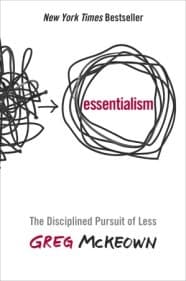
Essentialism
by Greg McKeown · Published 2014
'The disciplined pursuit of less' is a genuinely different argument from typical productivity advice — not doing more efficiently, but systematically doing less, chosen more deliberately. The clearest existing case against reflexive busyness.
What works
- Genuinely distinct thesis from most productivity books — it's about elimination, not optimization
- The 'trade-off' framing (explicitly choosing what NOT to do) is a directly usable decision tool
What doesn't
- Easier to agree with in the abstract than to apply in jobs/organizations that structurally reward busyness
- Some chapters repeat the core thesis across multiple business anecdotes with diminishing new insight
Summary
Greg McKeown's argument starts with a distinction most productivity writing never makes. The usual promise is to help you accomplish more, faster. His is the opposite: to help you accomplish considerably less, chosen far more deliberately.
He calls the alternative the "undisciplined pursuit of more" — the state of being stretched thin across many commitments, none of them examined, most of them accepted by default. The essentialist response is not better time management but systematic elimination.
The book's organizing story is McKeown attending a work meeting hours after his daughter was born, because he felt he could not decline. Nothing was gained by his attendance; the point is that he never actually made a decision, he simply defaulted to the expectation.
The structure follows three stages: explore (evaluate far more options but commit to almost none), eliminate (cut what does not clear a deliberately high bar), and execute (build systems so the remaining few things happen without friction).
Key ideas
1. If it isn't a clear yes, it's a no
McKeown's decision rule is the book's most usable single idea. Rather than asking whether something is worth doing, ask whether it is an unambiguous yes — and treat anything less as a decline.
His stricter version is the "90 percent rule": score an option against your most important criterion, and if it scores below 90, reject it. This deliberately eliminates the entire middle range where most obligations live.
The insight is that mediocre options are the real problem, not bad ones. Bad options are easy to refuse; it is the reasonable, mildly attractive commitments that accumulate until nothing important gets serious attention.
2. Trade-offs are real whether or not you acknowledge them
McKeown argues the central non-essentialist error is believing you can do it all — not as a stated belief, but as a working assumption revealed by behaviour.
His framing is that trade-offs are not something to be minimized or escaped but something to be made deliberately. The question is not "how do I fit both in?" but "which problem do I want?"
The Southwest Airlines case is his central example: a business that grew by explicitly declining to do things competitors did — no meals, no assigned seating, no hub-and-spoke network — and treated those refusals as strategy rather than limitation.
3. Saying no requires separating decision from relationship
The chapters on declining are the most practically detailed, because McKeown recognizes the actual difficulty is social rather than analytical.
His core move is separating the decision from the relationship: refusing a request is not rejecting a person, and most people conflate the two. He offers concrete alternatives to a flat no — the slow yes, the counter-offer, saying what you would have to drop in order to accept.
The observation that landed hardest for most readers is that the short-term discomfort of declining is almost always smaller than the sustained cost of an unwanted commitment. We accept because refusal is uncomfortable now, and pay for months.
4. Sunk cost and the endowment effect keep dead commitments alive
McKeown addresses why elimination is hard even when the answer is obvious, and the mechanisms are the usual behavioural ones applied to obligations rather than purchases.
His inversion of the endowment effect is the useful reframe: rather than asking how much you'd give up to keep a commitment, ask what you would pay to acquire it if you did not already have it. Most ongoing obligations fail that test immediately.
He is direct that this applies to projects, roles and relationships that once made sense and no longer do, and that continuing them because of investment already made is the most common form of the error.
5. Execution means removing friction, not adding effort
The final section argues that once the essential few are identified, the work is designing conditions so they happen automatically rather than requiring willpower each time.
This covers buffers — building slack into estimates because things reliably take longer — and identifying the single constraint that slows everything else, rather than optimizing steps that are not the bottleneck.
He also argues for routine as the mechanism that makes essential work automatic, which is where the book overlaps most with habit literature, though he treats it as a means rather than the subject.
Who it's for
- Anyone busy but not progressing — the diagnosis of undisciplined pursuit of more is aimed exactly here.
- People who agree to things reflexively — the chapters on declining are the most practical part.
- Anyone facing too many good options — the 90 percent rule is built for precisely that problem.
- Readers who found productivity books unhelpful — this argues the opposite of most of them.
FAQ
How is this different from other productivity books?
Most are about doing more efficiently; this is about doing less deliberately. The unit of improvement is what you remove, not how fast you move through what remains.
What if I can't decline things at work?
That's the book's main blind spot. McKeown assumes more autonomy than many readers have. The trade-off framing still helps in negotiating priorities upward, but the wholesale elimination advice often isn't available.
What's the single most useful idea?
"If it isn't a clear yes, it's a no." It's immediately applicable, requires no system, and targets the middling commitments that cause most of the problem.
Is it repetitive?
Somewhat. The thesis is clear early and later chapters largely supply more examples of it. The first half carries most of the value.
How does it compare to Deep Work?
They're complementary. Newport is about the quality of attention during focused work; McKeown is about deciding what deserves that attention at all. Essentialism comes logically first.
Was this useful?
Counts appear once there are 5 votes.