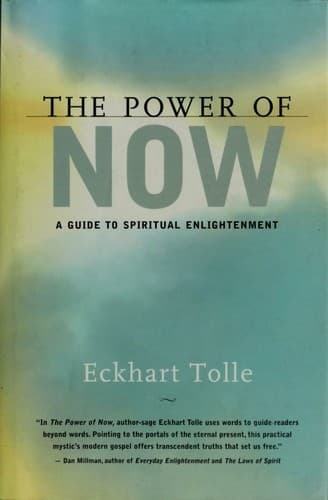
The Power of Now
by Eckhart Tolle · Published 1997
Its central practice — noticing the gap between the observing mind and the compulsive thinking mind — is a genuinely useful mindfulness technique wrapped in spiritual language that will read as either profound or vague depending on the reader.
What works
- The core practice (noticing you are not your thoughts) is a genuinely useful entry point into mindfulness for readers new to it
- Short, meditative chapters make it easy to return to specific passages
What doesn't
- Written in a question-and-answer spiritual-teacher format that some readers find illuminating and others find circular or vague
- Makes almost no reference to the actual clinical mindfulness/CBT research that validates similar practices — it's presented as revelation, not evidence-based technique
Summary
Eckhart Tolle opens with an autobiographical account: severe depression through his twenties, culminating one night in the thought "I cannot live with myself any longer," followed by the realization that this sentence contains two entities — an "I" and a "self" it cannot live with. If there are two, which one is he?
That question generates the entire book. Tolle's claim is that most people are identified with a compulsive stream of thinking they mistake for themselves, and that noticing the difference between the thinking and the awareness observing it is the beginning of relief.
He calls the false self the ego and the accumulated residue of past emotional pain the pain-body — a formulation that recurs throughout. Both are sustained, in his account, by psychological time: the mind's habit of relocating attention into memory or anticipation and treating the present as a corridor to somewhere else.
The book is written as questions and answers, in short meditative sections, in the voice of a spiritual teacher responding to a student. It is not structured as an argument and does not proceed by evidence, which is central to how readers respond to it.
Key ideas
1. You are not your thoughts
The core practice is the most valuable thing in the book, and it is simple: observe your thinking without participating in it. Notice a thought arriving, register it as a thought, and do not follow it.
Tolle's argument is that the ability to observe thinking proves you are not identical with it — the observer and the observed cannot be the same thing. Whatever one makes of the metaphysics, the practical effect is real and immediate.
This is essentially the decentering technique used in mindfulness-based cognitive therapy, where it has substantial clinical support for preventing depressive relapse. Tolle arrives at it independently and describes it well; he simply does not connect it to any of that literature.
2. Psychological time versus clock time
Tolle distinguishes between practical use of past and future — remembering an appointment, planning a route — and psychological time, meaning identification with memory and anticipation as the location of your life.
His observation is that anxiety requires a future to be projected into and that most regret requires a past to be maintained. Neither is available in direct present experience, which is why attention to the present interrupts both.
He is not arguing against planning, and says so explicitly. The distinction is between using time as a tool and living inside it as a substitute for the present.
3. The pain-body
Tolle's term for accumulated unresolved emotional pain, which he describes as behaving almost like an autonomous entity — dormant for periods, then activated, seeking situations that will feed it more of the same emotion.
The mechanism he describes is recognizable regardless of the framing: emotional patterns that reactivate under familiar triggers, generate thoughts consistent with themselves, and reproduce the conditions that sustain them. Anyone who has watched an argument escalate past its subject knows the phenomenon.
His prescribed response is observation rather than resistance — noticing the pain-body activating, without either suppressing it or being carried by it. It is the same decentering move applied to emotion instead of thought.
4. Surrender as acceptance of what already is
Tolle uses "surrender" in a specific and easily misread sense: accepting the present moment as it actually is, rather than resisting the fact of it.
His claim is not passivity — he is explicit that you can accept a situation completely and then act to change it. What he targets is the additional suffering created by internal argument with circumstances that are already the case.
His formulation is that you have three genuine options in any unwanted situation: leave it, change it, or accept it fully. Remaining in a situation while internally refusing it is the one choice that guarantees suffering, and it is the one most people default to.
5. The style is the whole disagreement
How much value a reader gets depends almost entirely on tolerance for the register, and this is worth saying plainly rather than treating as a matter of taste.
The book asserts rather than argues. Claims arrive as revelation, delivered with total confidence and no supporting evidence, and terms are frequently defined circularly. Readers who find this profound and readers who find it vague are reading the same sentences accurately and responding to them differently.
The practice underneath is sound and independently validated. The presentation is a spiritual teaching, and no amount of goodwill converts it into an argument.
Who it's for
- Readers new to mindfulness — the central practice is a genuinely useful entry point.
- Anyone caught in rumination — the observer technique addresses exactly that pattern.
- Readers comfortable with spiritual language — the framing will help rather than obstruct.
- People who want short passages to return to — the meditative structure suits rereading.
FAQ
Is it a religious book?
It isn't tied to one tradition, but it is spiritual rather than secular. Tolle borrows from Buddhism, Christian mysticism and Advaita, and makes claims about consciousness that go well past psychology.
Can I use the technique without the philosophy?
Yes, and many readers do. Observing thought without identifying with it works independently of anything Tolle claims about the nature of consciousness.
Why do reactions differ so sharply?
Because the style is the substance. Assertion without argument reads as authority to some and as evasion to others, and both responses are reasonable given what's on the page.
Is it useful for anxiety or depression?
The underlying practice has clinical support for both, but this book is not a treatment and does not present itself as one. For a diagnosed condition, use it alongside proper care rather than instead of it.
What should I read after it?
Kabat-Zinn's Full Catastrophe Living for the clinical version, or Sam Harris's Waking Up for the same territory handled by someone hostile to spiritual framing.
Was this useful?
Counts appear once there are 5 votes.