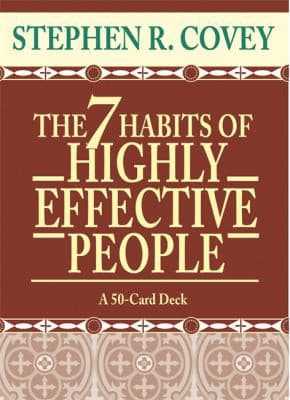
The 7 Habits of Highly Effective People
by Stephen R. Covey · Published 1989
The foundational modern self-help text almost everything since has built on, borrowed from, or reacted against — 'Begin with the end in mind' and the Circle of Influence remain genuinely load-bearing ideas.
What works
- Circle of Concern vs. Circle of Influence is a genuinely durable, widely-applicable mental model
- Structured as a coherent progression (private victory before public victory), not a loose list of tips
What doesn't
- The prose is dense and repetitive by modern self-help standards — the ideas could be conveyed in a third of the length
- Some framing leans on a specific values system (Covey's own) presented as more universal than it is
Summary
Stephen Covey opens with a distinction that frames everything after it. Surveying two centuries of American success literature, he argues that writing before roughly 1920 concerned the character ethic — integrity, humility, fidelity, courage — while everything after concerned the personality ethic: technique, image, and the management of impressions.
His claim is that the shift was a mistake, and that technique layered over defective character produces short-term results and long-term failure. The seven habits are his attempt to work in the older tradition with a modern structure.
The habits are arranged as a deliberate progression rather than a list. The first three — be proactive, begin with the end in mind, put first things first — move a person from dependence to independence. The next three — think win-win, seek first to understand, synergize — move from independence to interdependence. The seventh, sharpen the saw, maintains the other six.
The ordering carries the argument. Covey's position is that the public habits cannot be faked without the private ones — that you cannot genuinely listen to understand, or negotiate for mutual benefit, if you have not first established your own priorities and integrity.
Key ideas
1. Circle of Concern versus Circle of Influence
The most durable idea in the book, and the one most likely to be useful even to someone who reads nothing else of it.
Covey distinguishes between everything you care about (the Circle of Concern) and the subset you can actually affect (the Circle of Influence). Proactive people spend their energy inside the smaller circle, and it tends to grow. Reactive people spend theirs on the outer band — complaining about conditions, other people, the economy — and their influence contracts.
The model is simple enough to apply immediately and general enough to survive any context. It is also the clearest expression of the book's underlying claim: that the response to circumstance, rather than the circumstance, is where agency lives.
2. Begin with the end in mind
The second habit asks you to define the outcome before starting, and Covey's device for it is confronting: imagine your own funeral, and what you would want a colleague, a friend and a family member to say.
The exercise is designed to expose the gap between stated priorities and actual allocation of time. Most people discover their calendar does not reflect what they would want said about them.
From this he derives the personal mission statement — a written articulation of principles used as a decision filter. This is the part readers most often skip, and it is genuinely the mechanism by which the rest is supposed to operate.
3. The time-management matrix
The third habit contains the book's most reproduced diagram: activities sorted by urgency and importance into four quadrants.
Covey's argument is that most people live in Quadrant I (urgent and important — crises) and Quadrant III (urgent but not important — interruptions, most email), while effectiveness comes from Quadrant II: important but not urgent. Planning, prevention, relationship building, learning.
The insight is that Quadrant II never announces itself. Nothing forces you to do it, which is why it gets displaced by anything with a deadline, and why it has to be scheduled deliberately or it does not happen at all.
4. Seek first to understand, then to be understood
The fifth habit is the strongest of the interpersonal three. Covey's observation is that most people listen with the intention of replying rather than understanding — waiting for a gap, preparing a response, filtering what they hear through their own frame.
His alternative, empathic listening, means restating the other person's position until they agree you have it right, before making your own case at all.
He is specific about why this is not merely polite: people will not seriously consider your position while they believe theirs has not been heard. Understanding first is a precondition for being understood, not a courtesy extended before it.
5. The character-ethic claim, and its limits
The framing argument — that technique without character fails — is what distinguishes the book from the productivity genre it helped create, and it is largely convincing.
But it is also where Covey's own commitments become load-bearing. The principles he calls universal are drawn from a particular tradition, and the book presents them as self-evident natural laws rather than as one defensible value system among several.
This does not invalidate the practical models, which work independently of the metaphysics. It does mean a reader should notice when a claim is being supported by argument and when it is being asserted as obvious.
Who it's for
- Anyone who has read a lot of productivity books without a frame — this is the source most of them descend from.
- Readers who want principles rather than tactics — the emphasis on character over technique is the whole point.
- Managers and team leads — the interdependence habits are aimed squarely at working with other people.
- Anyone whose calendar doesn't match their stated priorities — Quadrant II is the diagnosis.
FAQ
Is it still relevant given how much has been written since?
Yes, largely because so much since has been derived from it. Reading it clarifies where the standard vocabulary of productivity writing came from, and the core models have not been improved on.
Which habit matters most?
Habit 1's Circle of Influence and Habit 3's quadrant matrix are the two most people find immediately useful. Habit 5 on listening is the most valuable if you work closely with others.
Is it a religious book?
Not explicitly, though Covey's values inform it throughout and he was open about his own faith. The frameworks are usable without sharing his commitments; the universalist framing is what to read critically.
Should I read the summary instead?
You'll get the diagrams and miss the argument. That may be an acceptable trade given the length, but the sequencing — private victory before public victory — is the actual thesis and doesn't survive compression.
How does it compare to Atomic Habits?
They operate at different levels. Clear is about mechanism — how behaviour changes. Covey is about direction — what to point behaviour at. They complement each other more than they compete.
Was this useful?
Counts appear once there are 5 votes.