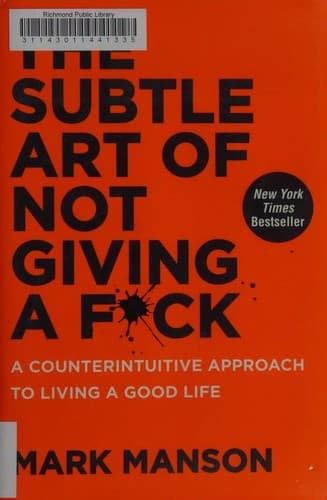
The Subtle Art of Not Giving a F*ck
by Mark Manson · Published 2016
A deliberately anti-positivity counterweight to standard self-help — the core argument (choose your struggles deliberately, since some suffering is unavoidable) is genuinely more honest than most books in the category, under the profanity and swagger.
What works
- Refreshingly honest and unsentimental compared to standard positive-thinking self-help
- The 'choose your struggle' framing is a genuinely useful decision filter for where to direct effort
What doesn't
- The deliberately crude tone/title is a barrier for some readers and can undercut the more substantive arguments underneath it
- Some chapters lean heavily on Manson's own anecdotes rather than research, more memoir-adjacent than evidence-based
Summary
Mark Manson's premise is that the self-help genre has a structural problem: telling people to be positive about everything implies that negative feelings are failures, which adds a second layer of distress on top of the first. You feel bad, then you feel bad about feeling bad.
His alternative is not pessimism but selectivity. Attention and emotional energy are finite, and the question is not how to care less in general but what specifically deserves the supply. Most people, on his account, spend it on things that will not matter and have never consciously chosen the allocation.
The book's central move is what he calls choosing your struggle. Everyone wants the rewards — the fitness, the business, the relationship — but the rewards are inseparable from a specific ongoing difficulty. The useful question is therefore not "what do I want?" but "what pain am I willing to sustain?"
From there he works through values, responsibility, failure, rejection and mortality. The tone is deliberately blunt and profane, which is both the book's marketing and, for a substantial number of readers, the reason they never get to the argument.
Key ideas
1. The feedback loop from hell
Manson's sharpest early observation is that anxiety about negative emotion compounds it. You are anxious, then anxious about being anxious; angry, then guilty about anger; sad, then ashamed of sadness.
His diagnosis is that a culture insisting on constant positivity manufactures this loop, because it frames ordinary negative states as personal failures rather than as normal.
The escape is accepting negative experience as unremarkable rather than as a problem to be solved. It's a straightforward point, and stating it in this register reaches readers who would not pick up a book on acceptance-based therapy despite the considerable overlap.
2. Choose your struggle, not your outcome
This is the book's most transferable idea. Everyone would like to be in excellent physical condition; far fewer want the daily reality of training, dietary restriction and soreness that produces it.
Manson argues that wanting the outcome is meaningless because it is universal and costless. What actually predicts where you end up is which ongoing difficulty you are willing to accept as a permanent feature of your life.
As a decision filter it's genuinely useful: it converts vague aspiration into a concrete question with a testable answer, and it explains why people fail at goals they sincerely hold — they wanted the result, not the process.
3. Responsibility is separate from fault
Manson distinguishes between being at fault for a situation and being responsible for responding to it, and argues that conflating the two keeps people stuck.
Many circumstances are genuinely not your fault — illness, other people's behaviour, accidents of birth. None of that changes the fact that you are the only one who will handle the consequences.
He is careful, mostly, not to let this collapse into victim-blaming: the claim is not that you caused your problems but that responsibility for what happens next is unavoidable regardless of cause. It's the same distinction Stoicism makes, delivered in a register that reaches a different audience.
4. Values determine everything downstream
The chapter on values is the book's structural centre. Manson argues that problems are usually not caused by circumstances but by the criteria used to evaluate them.
He separates good values — reality-based, internally controlled, socially constructive, such as honesty or curiosity — from bad ones that depend on things outside your control, such as popularity, always feeling good, or being right.
The test is whether the value can be pursued regardless of external outcome. "Being liked by everyone" fails, because it is decided by other people. "Being honest" passes, because it is decided by you.
5. Mortality as the final filter
The closing chapter, drawing on the death of Manson's friend, is the most serious writing in the book and the least profane.
His argument is that awareness of death is the ultimate clarifier of what deserves attention — most of what occupies daily anxiety fails the test immediately.
He also uses it against the pursuit of legacy, arguing that constructing a permanent monument to yourself is another way of refusing the fact of impermanence rather than accepting it.
Who it's for
- Anyone tired of relentlessly positive self-help — this is the deliberate counterweight, and it's honest.
- Readers stuck between too many goals — "choose your struggle" is the filter that resolves it.
- People who feel bad about feeling bad — the feedback-loop chapter alone may be worth it.
- Readers who want bluntness — the lack of sentimentality is the appeal for many.
FAQ
Is it actually about not caring?
No — the title is deliberately misleading. It argues for caring intensely about a small number of well-chosen things and withdrawing attention from the rest. Indifference is the opposite of the point.
Is the profanity constant?
It's frequent, especially early on, and it thins out as the book gets more serious. If it grates in the first chapter, it does improve, but it never disappears.
Is there anything new here?
The ideas draw heavily on Stoicism, Buddhism and acceptance-based therapy. The contribution is packaging rather than discovery — it reaches readers who would not open a book on any of those.
Is it well supported?
Unevenly. Some chapters reference psychological research; others rest on personal experience presented with more confidence than the evidence warrants. Read it as a persuasive essay.
Who should skip it?
Anyone who finds the tone alienating — the substance is available elsewhere in gentler form — and anyone who wants a structured programme rather than a change of perspective.
Was this useful?
Counts appear once there are 5 votes.