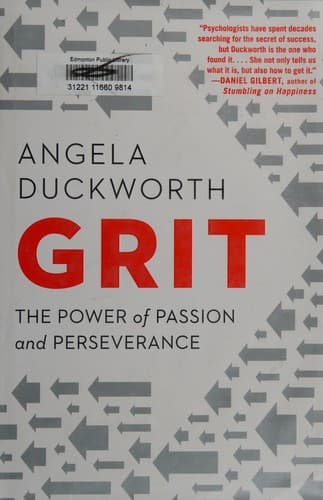
Grit
by Angela Duckworth · Published 2016
Duckworth's own research (the grit scale, the West Point and National Spelling Bee studies) makes a genuinely evidence-based case for passion-plus-perseverance over raw talent — more rigorous than most books in this genre, though the concept has since faced serious replication scrutiny.
What works
- Backed by Duckworth's own published, peer-reviewed research rather than borrowed anecdote
- The deliberate-practice and interest-development chapters give concrete, actionable structure, not just 'try harder'
What doesn't
- Later meta-analyses found grit's predictive power for success is smaller than the book's framing suggests
- Risks reading as blaming individual perseverance for outcomes that are often heavily structural/circumstantial
Summary
Angela Duckworth's question came from noticing, as a teacher and later as a researcher, that the highest achievers in demanding environments were often not the most talented. She built a research career around identifying what else predicted who stayed.
Her answer is grit: passion and perseverance for long-term goals, sustained over years rather than weeks. She developed a self-report scale to measure it and applied it in settings with hard outcome measures — West Point cadets and who survived the brutal summer selection, National Spelling Bee finalists, teachers in difficult schools, salespeople.
The first half argues that grit predicts persistence better than talent does, and offers a model: talent times effort equals skill, skill times effort equals achievement, meaning effort counts twice. The second half turns practical, covering interest, deliberate practice, purpose and hope as the components that can be developed.
The book is unusually well grounded for the genre — it rests on Duckworth's own peer-reviewed work rather than borrowed anecdote. It is also the case that the concept has been challenged since publication in ways a current reader should know about.
Key ideas
1. Effort counts twice
Duckworth's central formula is deliberately simple. Talent determines how quickly skill improves given effort; skill then has to be applied, again with effort, to produce achievement. Effort therefore enters the equation twice while talent enters once.
The formula is not meant as measurable science, and she says so. Its purpose is to counter the intuition that talent and effort are alternative explanations, when the model treats talent as a rate and effort as what converts it into anything.
The related observation — that we say we admire effort while actually being drawn to apparent naturalness — is supported by her studies showing people rate "naturals" more favourably than "strivers" even when explicitly claiming to value hard work.
2. Interest has to be developed, not discovered
The chapter on interest is the strongest practical section, because it attacks a common misconception: that passion is found, fully formed, and then pursued.
Duckworth's account of how experts describe their beginnings is much messier. Initial interest is usually mild and unfocused; it deepens through exposure, small successes, and encouragement, over years. What looks like a calling in retrospect was rarely experienced as one at the time.
This matters practically because "find your passion" is bad advice that leaves people waiting for certainty. The alternative — sample broadly, then commit long enough for depth to develop — is actionable in a way the former is not.
3. Deliberate practice is specific, uncomfortable work
Drawing on Anders Ericsson's research, Duckworth distinguishes deliberate practice from ordinary repetition. It involves a stretch goal beyond current ability, full concentration, immediate feedback, and repetition focused on the weakest component.
Her point is that gritty people do not simply do more hours; they do harder hours. The spelling bee study is her clearest evidence — the strongest finishers spent more time on solitary, effortful drilling rather than the more enjoyable forms of preparation.
She is honest that deliberate practice does not feel good while it happens. The experience is effortful and frequently unpleasant, and the enjoyment is in having done it rather than in doing it.
4. Purpose sustains what interest alone cannot
Duckworth argues that grit at the highest levels combines personal interest with a belief that the work serves others. Interest gets you started; purpose is what keeps people going through the long unrewarding stretches.
Her research indicates that grittier people are more likely to describe their work as contributing beyond themselves, and that this connection is often built deliberately rather than being intrinsic to the job.
She pairs this with hope — specifically the belief that effort can improve the future, which connects the framework directly to Dweck's growth mindset work.
5. The replication problem, stated plainly
Since publication, grit's status has weakened, and this is the most important context for a reader today.
Meta-analyses have found grit's predictive power for success considerably smaller than the book's framing implies, and — more damagingly — that grit correlates so strongly with conscientiousness, a long-established personality trait, that it may not be measuring anything new.
The perseverance sub-component appears to carry most of the predictive weight, while the passion component contributes little. That is a substantial revision to a book built on the pairing of the two.
Who it's for
- Anyone who abandons projects at the first difficulty — the deliberate-practice and interest chapters are directly useful.
- Parents and teachers — the material on developing rather than identifying interest is the book's best contribution.
- Readers who want evidence rather than anecdote — this is better sourced than most of the genre, replication caveats included.
- Anyone told they lack talent — the reframing toward effort is empirically defensible even at the reduced effect size.
FAQ
Is grit a real, distinct trait?
Contested. It's measurable and correlates with outcomes, but critics argue it overlaps so heavily with conscientiousness that it may be a repackaging rather than a discovery. The perseverance half is better supported than the passion half.
Given that, is the book worth reading?
Yes, mainly for the practical chapters. The advice on developing interest and structuring deliberate practice stands independently of whether grit is a distinct construct.
Can grit be increased?
Duckworth argues yes, through interest development, deliberate practice, purpose and hope. Evidence for interventions producing durable change is weaker than the book implies, which is a common pattern for this kind of research.
Does it ignore circumstance?
Not entirely, but it underweights it. Framing achievement as a function of individual persistence can obscure how much outcomes depend on resources and access, and that's the most substantive criticism of the book.
How does it relate to Mindset?
Closely — Duckworth draws on Dweck directly, and hope in her framework is essentially growth mindset. Both books have also faced comparable replication scrutiny, which is worth noting when reading either.
Was this useful?
Counts appear once there are 5 votes.