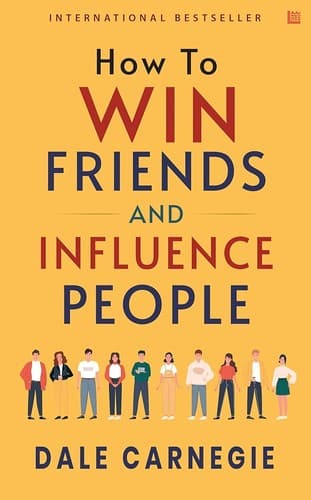
How to Win Friends and Influence People
by Dale Carnegie · Published 1936
Nearly a century old and still the template every interpersonal-skills book since has copied — the core advice (genuine interest in others, remembering names, avoiding direct criticism) is simple because it's correct, not because it's shallow.
What works
- The core principles are simple, durable, and hold up because they describe real human psychology, not a trend
- Anecdote-driven structure makes the advice memorable and easy to apply immediately
What doesn't
- Some techniques, read uncharitably, can come across as manipulative rather than genuinely relational if applied mechanically
- 1930s-era examples and gender assumptions need mental translation for a modern reader
Summary
Dale Carnegie wrote this in 1936 out of material he had been teaching in adult evening classes in New York for twenty years. That origin explains its structure: it was tested on students who reported back on what worked before it was ever a book.
It is organized as four parts — fundamental techniques for handling people, six ways to make people like you, twelve ways to win people to your thinking, and nine ways to change people without giving offence — each stated as a short principle followed by anecdotes.
The underlying claim is a single psychological observation applied repeatedly: people are far more interested in themselves than in you, and almost every failure of persuasion comes from ignoring that. Criticism fails because it forces self-justification. Argument fails because winning it costs you the relationship. Attention succeeds because it is scarce.
Almost every interpersonal-skills book since has restated some portion of this, usually without improving on it. The reason it survives is not that the advice is sophisticated but that it is accurate, and that Carnegie states it in a form people actually remember.
Key ideas
1. Criticism produces defence, not change
The first principle — don't criticize, condemn or complain — is the book's foundation, and Carnegie supports it with an argument rather than an assertion.
His examples are deliberately extreme. He quotes notorious criminals describing themselves as misunderstood or hard done by, the point being that even people whose conduct is indefensible construct justifications. If they do, an ordinary colleague certainly will.
The practical consequence is that criticism reliably produces a defensive account rather than a changed behaviour. This is why the later section on changing people leans entirely on indirect methods — beginning with praise, mentioning your own errors first, asking questions rather than issuing instructions.
2. Genuine interest beats being interesting
Carnegie's most repeated observation is that you make more friends in two months by becoming interested in other people than in two years by trying to get people interested in you.
The supporting mechanism is simple: attention is scarce, most people receive very little of it, and someone who supplies it becomes memorable by contrast. Asking questions and listening to the answers is a comparatively rare behaviour.
The name principle sits here too — that a person's name is to them the sweetest sound in any language. Carnegie treats remembering names as effortful work rather than a knack, and describes the systems he used, which is more useful than the aphorism alone.
3. You cannot win an argument
The claim is that the only way to get the best of an argument is to avoid it, because winning is not actually available. If you lose, you lose; if you win, the other person leaves feeling diminished and unconvinced, so you have lost too.
Carnegie's alternative is to look for genuine agreement first, concede where the other person is right, and never open with "you're wrong."
The related principle — if you're wrong, admit it quickly and emphatically — is the sharpest thing in this section. Pre-empting criticism by making it yourself removes the other person's reason to press, and typically produces the opposite response.
4. Let the other person own the idea
A theme running through the third and fourth parts is that people support conclusions they reached themselves and resist conclusions handed to them, regardless of merit.
The recommended technique is to lead with questions rather than statements, so the other person arrives at the point rather than receiving it. Carnegie's example of a salesman letting a client articulate his own objection and answer it is characteristic.
This is also where the book's ethical ambiguity is clearest. The same technique is available to someone genuinely seeking a good outcome and to someone manufacturing consent — and Carnegie's text does not always distinguish them as carefully as it might.
5. Sincerity is load-bearing, and easily discarded
Carnegie repeatedly insists the principles only work when meant. He is explicit that flattery is counterfeit appreciation, that it is recognized as such, and that the distinction is between saying what you actually think and saying what you calculate will land.
The difficulty is that the book is structured as a set of techniques, and techniques can be applied without the disposition they assume. A reader looking for tactics can extract them cleanly and ignore every passage about sincerity.
The strongest reading of Carnegie is that he is describing what genuine interest in other people looks like in practice, for readers who have it but express it badly. The weakest is that it's a manual for appearing to have it.
Who it's for
- Anyone who finds professional relationships difficult — this is the most concrete starting point available.
- People in sales, management or client work — the material on disagreement and persuasion is directly applicable.
- Technically strong people who struggle to be heard — the point about arguments is aimed precisely here.
- Readers who want durable principles — nearly ninety years on, the psychology hasn't dated.
FAQ
Is the advice manipulative?
It can be applied that way, and Carnegie anticipated the objection by insisting the principles fail without sincerity. The techniques are neutral; whether they're manipulation depends on whether you actually want the outcome to be good for the other person.
Is a 1936 book still applicable?
The psychology is — people still prefer talking about themselves, still resist criticism, still defend their positions when attacked. The examples and social assumptions are dated and need translating.
Is it worth reading in full or is a summary enough?
The principles compress to a page, but the anecdotes are what makes them stick and get applied. A summary gives you the list; the book gives you the recall.
What should I read next?
Cialdini's Influence for the research foundation, or Never Split the Difference for negotiation specifically. Both go deeper on mechanisms Carnegie only observes.
What's the single most useful principle?
Admitting your own errors quickly and emphatically. It's counterintuitive, immediately testable, and reliably defuses situations that criticism would escalate.
Was this useful?
Counts appear once there are 5 votes.