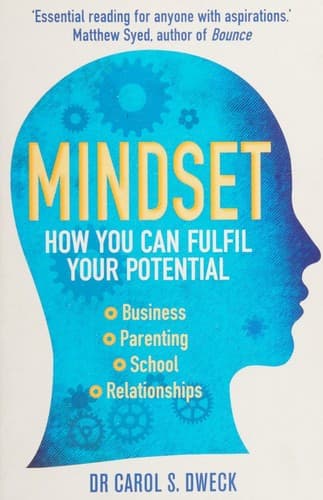
Mindset
by Carol S. Dweck · Published 2006
The fixed vs. growth mindset distinction is genuinely useful and grounded in Dweck's own research career — though the popularized version has outrun what the underlying replication evidence actually supports.
What works
- The fixed/growth framing is genuinely clarifying for how people relate to failure and effort
- Grounded in Dweck's own decades of published research, not borrowed secondhand theory
What doesn't
- The popular 'growth mindset' movement it spawned has been diluted into shallow praise ('good effort!') that isn't what Dweck actually argues for
- Later large-scale replication attempts found smaller effect sizes than the original studies suggested
Summary
Mindset is built on a distinction Carol Dweck spent three decades researching: whether people treat ability as something fixed or something growable. In a fixed mindset, intelligence is a quantity you were issued at birth, and every situation becomes a test that reveals how much you got. In a growth mindset, ability is something practice builds, and the same situation becomes a chance to build it.
Dweck's argument is that this is not a personality preference but an implicit theory about the nature of ability itself — and that the theory determines almost everything downstream: which tasks you pick, how long you persist when something gets hard, and above all what you take failure to mean. If ability is fixed, failure is a verdict about your ceiling and avoiding it is rational. If ability is growable, failure is just data.
Much of the book applies that frame across domains: school, sport, business, leadership, relationships. These sections are not of even quality. The education and sport chapters sit closest to Dweck's own research and are the strongest; the relationships chapter leans considerably more on anecdote than on data.
What makes reading it today different is that "growth mindset" escaped the book and became an educational movement — and got diluted along the way. Dweck eventually had to write against the popularized version of her own argument. The book is best read with that gap in view.
Key ideas
1. A mindset is an implicit theory, not a mood
The most common misreading is that growth mindset means positive thinking. Dweck rejects this directly. What she describes is an epistemic belief: what kind of thing is ability? That belief is usually unexamined, and people asked about it directly tend to give the "correct" answer and then behave otherwise.
The real tell shows up at the point of failure, not in what someone professes. A person who treats ability as fixed responds to a bad result by moving toward easier tasks that protect the image of being capable. This is not laziness; it follows a perfectly coherent internal logic. If the ceiling is fixed, additional effort only proves the ceiling was low.
This is where Dweck separates from ordinary self-help. She is not telling you to try harder. She is arguing that the belief which makes effort feel pointless has to change first, or advice to try harder lands on nothing.
2. Praising talent undermines the thing it is trying to build
The best-known research in the book is the praise work. Children praised for being smart after a success went on to choose easier tasks; children praised for effort and strategy chose harder ones.
The mechanism is clean. Praising talent tells a child that the thing being evaluated is them, which turns every difficult task into a risk to their standing. Praising process moves the evaluation onto the work itself, and the risk disappears.
The application runs well past parenting. The same pattern governs feedback at work: "you're brilliant" and "this analysis caught the wrong assumption in the team's model" communicate very different things to the person receiving them, and only one of them survives a subsequent failure.
3. "Yet" — reframing failure as a position rather than a verdict
Dweck puts real weight on a single word: yet. The distance between "I can't do this" and "I can't do this yet" is the distance between a permanent condition and a point on a path.
This is more than a verbal trick, because it operates directly on the implicit theory from the first idea. "Yet" presupposes that a path exists — and if a path exists, effort becomes meaningful rather than incriminating.
In practice the idea earns its keep exactly where bad results are unavoidable: learning a new skill, entering an unfamiliar field, anything you are necessarily bad at when you start. A fixed mindset makes that stretch intolerable, because it converts every early error into evidence against you.
4. Mindset at the level of an organization
One of the book's under-read sections extends the frame to institutions. Dweck argues that companies also hold implicit theories about talent, and that a firm which sorts people into "stars" and everyone else has effectively built a fixed-mindset culture.
The practical consequence is that in such a culture, concealing mistakes becomes the rational move. If your standing depends on your talent label, admitting you don't know something is expensive. The result is an organization that learns bad news late.
This connects directly to the psychological-safety literature on teams, and it is probably the most immediately useful part of the book for anyone who manages people.
5. "False growth mindset" — the correction Dweck wrote herself
The most important thing for a present-day reader is not in the book. Dweck later had to write about what she called false growth mindset: the belief that a growth mindset means praising effort regardless of outcome.
In the diluted version, "good effort!" became a consolation prize for failure — precisely what Dweck does not argue for. Her actual claim is about effort plus strategy and progress. Effort that repeatedly produces nothing is a signal to change approach, not something to be congratulated.
That gap between the book and what was made of it genuinely affects how the book reads. Some of what can feel like cliché in these pages is cliché that was manufactured after the book, out of a misreading of it.
Who it's for
- Anyone entering an unfamiliar field — where being bad at the start is guaranteed and the real problem is tolerating that stretch.
- Managers and team leads — for the organizational chapter and its link to concealed mistakes; the most professionally applicable layer of the book.
- Parents and teachers — the praise studies are the book's most direct and actionable finding.
- Anyone who gives feedback — the talent-versus-process distinction is usable on its own, without reading the whole book.
FAQ
Is a growth mindset just positive thinking?
No, and Dweck rejects the equation explicitly. Positive thinking concerns how you feel about an outcome; a growth mindset is a belief about what ability is — that it changes with practice. You can be genuinely upset about a failure and still treat it as recoverable.
Given the replication debate, is it still worth reading?
Yes, but as a thinking frame rather than a guaranteed intervention. The fixed/growth distinction remains clarifying for understanding how people respond to failure. What has weakened is the claimed magnitude of brief mindset interventions on academic performance, not the distinction itself.
If I've read Atomic Habits or similar, does this add anything?
Yes, because it targets a different layer. Habit books are about designing behaviour; Mindset is about the belief that determines whether attempting change feels worthwhile at all. If you believe ability is fixed, no habit system looks appealing in the first place.
What's the book's main weakness?
Repetition. It has one central idea and restates it across successive domains, and the later chapters — relationships in particular — lean more on anecdote than on the research that gives the education sections their force.
How do I know whether I hold a fixed mindset?
Look at your behaviour after failure, not at the belief you would report. If a bad result sends you back toward things you're already good at, if you avoid serious feedback, or if other people's success registers as a threat, those are far better indicators than any answer you'd give to a direct question.
Was this useful?
Counts appear once there are 5 votes.