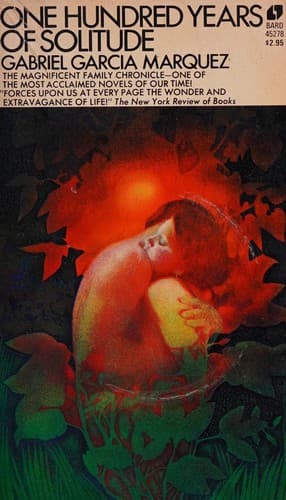
One Hundred Years of Solitude
by Gabriel García Márquez · Published 1967
The novel that made magical realism a global literary movement — seven generations of the Buendía family in the town of Macondo, where the fantastic is narrated with the same flat, matter-of-fact tone as the mundane.
What works
- Genuinely originated a literary mode (magical realism as a mainstream global form) rather than merely exemplifying one
- Rewards rereading — the repeating names and cyclical family patterns build meaning that isn't visible on a first pass
What doesn't
- The repeated character names across generations (multiple José Arcadios, multiple Aurelianos) are a genuine tracking challenge for first-time readers
- Its dense, unbroken narrative style with minimal chapter breaks demands sustained attention few novels ask for
Summary
One Hundred Years of Solitude tells the story of seven generations of the Buendía family in Macondo, a town José Arcadio Buendía founds in a swamp after leaving his village, and which the novel follows from its first isolated years to its erasure.
The famous opening sentence — a colonel facing a firing squad remembering the distant afternoon his father took him to discover ice — establishes the method immediately. The novel moves freely across time, tells you outcomes before causes, and treats a block of ice and a firing squad as equally remarkable.
What people mean by magical realism is on almost every page: a woman ascends into the sky while folding sheets, a plague of insomnia erases the town's memory so that objects must be labelled, rain falls for four years, a man is followed everywhere by yellow butterflies. None of it is presented as strange. The narration reports miracles and grocery lists in the same register, which is the entire technique.
Underneath is a serious history of Latin America — colonial arrival, civil wars between Liberals and Conservatives, foreign fruit companies, and a massacre of striking workers that the official record denies ever happened. The fantastic elements sit alongside that history rather than displacing it.
Key ideas
1. The flat tone is the invention
Magical realism is often described as "mixing fantasy with reality," which misses what García Márquez actually does. The technique is tonal: the extraordinary is narrated with total matter-of-factness, and the ordinary is narrated with wonder.
Ice is a marvel. A woman rising into the sky is a domestic inconvenience — the family's main concern is losing the sheets she was folding. That inversion, held consistently for four hundred pages, is what makes the mode work rather than collapse into whimsy.
He attributed the voice to his grandmother, who told him impossible things with a completely straight face. The reader accepts the impossible because no one in the book pauses to be surprised by it.
2. The repeating names are the argument
The Buendías reuse a small set of names across generations — José Arcadios, Aurelianos, Remedios, Amarantas — and the novel makes tracking them genuinely difficult.
This is deliberate, not carelessness. The names carry temperaments: the José Arcadios are impulsive and physical, the Aurelianos withdrawn and solitary. The family repeats not just names but patterns, including the incestuous attraction that haunts them from the founding couple onward.
The confusion the reader experiences is the same confusion the family lives inside — a house where the same person seems to keep recurring, and where nobody can tell whether they are living their own life or an ancestor's.
3. Time is circular, and the ending seals it
The novel's structure is a spiral rather than a line. Events recur with variations; Úrsula, who lives longest, repeatedly observes that time is going in a circle and that the house keeps producing the same people.
The ending is the most audacious formal move: the last Buendía deciphers Melquíades' manuscripts and finds they contain the complete history of the family, written in advance, and that he is reading the account of himself reading it. The town is destroyed as he finishes.
The line about races condemned to one hundred years of solitude having no second chance on earth closes both the family's history and the book that has been that history. It is a genuinely earned effect and among the most discussed endings in the form.
4. Solitude is the inherited condition
Every Buendía is alone in a specific, distinct way. Colonel Aureliano Buendía fights thirty-two civil wars, loses every one, and ends making tiny gold fishes, melting them down and making them again. José Arcadio Buendía dies tied to a tree, speaking Latin nobody understands.
The novel's proposition is that this isolation is heritable — not a circumstance but a family trait, transmitted like the name. Characters marry, have children, wage wars and build fortunes, and remain fundamentally unreachable.
The gold fishes are the sharpest image of it: enormous energy expended on a perfectly closed loop that produces nothing and reaches no one.
5. The banana massacre and the erasure of history
The novel's most politically direct section concerns a foreign fruit company, a workers' strike, and soldiers who machine-gun thousands of people gathered in the square. José Arcadio Segundo survives among the bodies on a train carrying them to the sea.
When he returns, everyone tells him nothing happened. The official version — that there was no massacre, that the workers went home — becomes the accepted truth, and he is treated as insane.
This is based on the 1928 Ciénaga massacre of United Fruit Company workers in Colombia, and it is where the novel's method becomes pointed: in a book where the impossible is routinely true, the one thing nobody will believe is the thing that actually happened.
Who it's for
- Readers who want to understand magical realism at its source — this is where the mode became a global form.
- Anyone interested in Latin American history — colonialism, civil war and foreign extraction are all here in compressed form.
- Readers who enjoy formally ambitious novels — the ending's structural move is worth the whole book.
- Rereaders — it is built to reward a second pass more than most novels.
FAQ
Do I need to keep track of every character?
No, and trying to will make it worse. Follow the family's patterns rather than individuals — knowing that an Aureliano will be solitary and a José Arcadio impulsive gets you further than memorizing which is which. Use the family tree when you need it.
Is it hard to read?
The sentences are not difficult, but the density is. Long paragraphs, few chapter breaks, and constant time-shifts mean it resists being read in short fragments. It goes much better in longer sittings.
Is the magic supposed to be literal?
Within the novel, yes — it is reported as fact and no character questions it. Reading the magic as metaphor to be decoded works against the technique, which depends on the fantastic and the mundane holding equal status.
Is the banana massacre real?
It's based on the 1928 killing of striking United Fruit Company workers in Ciénaga, Colombia. Casualty figures remain disputed, which is precisely the point the novel makes about which events get to be remembered.
Should I read it more than once?
If you like it at all, yes. The repeating names and cyclical patterns build meaning that isn't visible on a first pass, and the ending reframes everything before it — a second reading is genuinely a different book.
Was this useful?
Counts appear once there are 5 votes.