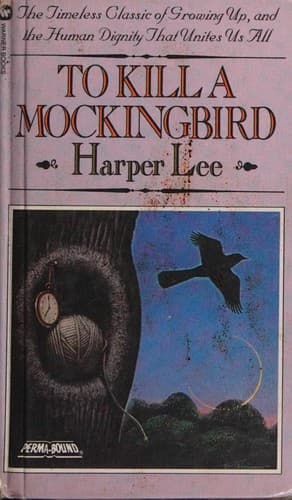
To Kill a Mockingbird
by Harper Lee · Published 1960
A child's-eye view of a wrongful rape accusation and trial in the Jim Crow South — its moral clarity about injustice made it a staple of school curricula, though that same clarity is also its most common critique.
What works
- Genuinely moving moral clarity, delivered through Scout's naive, observant child's perspective
- Atticus Finch remains one of American literature's most durable models of principled conduct under pressure
What doesn't
- Told through a white narrator's lens on Black suffering — a limitation later critics (including in Lee's own posthumously published Go Set a Watchman) have pushed back on
- Its moral binary (Atticus as unambiguous hero) has been criticized as a comforting simplification of how racism and complicity actually work
Summary
To Kill a Mockingbird is narrated by Scout Finch, remembering three years of childhood in Maycomb, Alabama, during the Depression. For a long stretch it barely looks like a novel about racial injustice at all: it is about a brother and sister, a summer friend, a schoolteacher who disapproves of children who can already read, and an unseen neighbour they are determined to lure outdoors.
The trial arrives in the second half. Scout's father, Atticus, is appointed to defend Tom Robinson, a Black man accused of raping a white woman. Atticus demonstrates in open court that the injuries are inconsistent with Tom's disabled arm and consistent with the accuser's father. The jury convicts anyway, and Tom is later shot attempting to escape custody.
Harper Lee's structural decision is to filter all of this through a child who does not fully understand what she is watching. Scout reports the mechanics of the town — who speaks to whom, which insults get repeated at school — without interpreting them, and the reader assembles the meaning she cannot.
It won the Pulitzer, sold in enormous quantities, and became a fixture of school curricula. It has also, in recent decades, become the subject of a serious critical argument about whose story it is and what its moral clarity leaves out — and reading it now means reading both the novel and that argument.
Key ideas
1. The child's perspective does the structural work
Scout's narration is the book's central technique. She reports what she sees precisely and misreads its significance, which lets Lee show the town's racial order operating without a narrator explaining it.
The device is at its strongest at the jailhouse, where a lynch mob confronts Atticus and Scout defuses it by recognizing a classmate's father and asking politely about his entailment. She has no idea what she has interrupted. The reader does, and the gap between those two states is where the scene's force sits.
It also lets the book work on very different audiences. A young reader follows a story about a father and a frightening neighbour; an adult reader sees an anatomy of how ordinary people participate in an unjust system.
2. Atticus as a model of conduct under pressure
Atticus's durability as a figure comes less from his courtroom performance than from what he does outside it. He takes a case he is certain to lose, explains to his children why losing is not a reason to decline, and absorbs the town's hostility without either retaliating or dramatizing it.
His formulation — that you never really understand a person until you climb into his skin and walk around in it — is the book's ethical core, and the novel applies it consistently, including to people it finds repellent.
The scene most often cited is not the trial but the aftermath: Bob Ewell spits in his face, and Atticus does nothing, later explaining that if taking that spared a child a beating, it was worth it. The measure of principle here is what it costs privately, not what it wins publicly.
3. The mockingbird is a moral category, not a symbol to decode
The title's rule — that it is a sin to kill a mockingbird, because they do nothing but sing — maps onto Tom Robinson and onto Boo Radley, both harmless and both destroyed or nearly destroyed by other people's fear.
What makes it more than a tidy motif is the ending's application of it. When Boo kills Bob Ewell defending the children, the sheriff decides to record it as an accident, and Scout says exposing him would be "sort of like shootin' a mockingbird."
That resolution is deliberately uneasy. The novel has spent its length arguing for the law's proper application and then endorses a quiet decision to circumvent it for a sympathetic person — a tension the book raises and does not resolve.
4. The trial is a demonstration of futility, not of justice
Atticus wins the argument comprehensively. The evidence is unambiguous, and everyone in the courtroom can follow it. The jury convicts anyway, because the verdict was never going to be determined by evidence.
Lee is precise about this. The point is not that the system malfunctioned but that it functioned exactly as designed, and that a competent, decent lawyer operating entirely in good faith cannot alter that outcome from inside it.
This is the strongest thing in the novel and also what sets up its sharpest criticism: having established that the system is the problem, the book's emotional resolution centres on a white man's integrity rather than on the Black man who was killed.
5. The novel is about white conscience more than Black experience
Tom Robinson has very little presence as a person. He appears in the trial, is convicted, and dies offstage, reported. Calpurnia, the Finch family's cook, is warmly drawn but exists largely in relation to the children.
The emotional arc belongs to Scout and Atticus — what they learn, what it costs them, how they hold up. That is a legitimate subject, but it is a different subject from the injustice the plot turns on.
Lee's own posthumously published Go Set a Watchman, which depicts an older Atticus holding segregationist views, complicated the question further, whatever its status as a draft or a sequel.
Who it's for
- Younger readers meeting serious moral questions in fiction — the reason it holds its curriculum place, and the reason it works there.
- Anyone interested in narrative technique — the naive narrator is executed about as well as it has been done.
- Readers who want a study of principle under social pressure — Atticus outside the courtroom is the more interesting Atticus.
- Anyone reading it alongside its critics — the novel and the argument about it are now genuinely inseparable.
FAQ
Why is it so often assigned in schools?
Because it makes serious moral questions legible to young readers without simplifying the outcome — the good lawyer loses. The child narrator gives access at almost any reading level while leaving substantial depth for an adult.
Is it still worth reading given the criticism?
Yes, and reading it with the criticism is better than either alone. The critique is not that the novel is bad but that it is limited in a specific way — a white lens on Black suffering — and knowing that produces a sharper reading rather than a dismissal.
Should I read Go Set a Watchman?
Only if you want the complication. It is closer to an early draft than a true sequel, and its portrait of an older, segregationist Atticus is genuinely destabilizing. It's a scholarly curiosity, not a continuation.
Is the trial based on a real case?
Not directly, but it draws on the atmosphere of cases like the Scottsboro trials of the 1930s, in which Black defendants were convicted on evidence that did not support the charges. Lee grew up in Alabama during that period.
What's the strongest criticism of the book?
That it makes injustice comfortable to contemplate. By centring a virtuous white protagonist, it offers readers a position of moral safety inside a story about a system those readers may benefit from — which is close to the opposite of what the trial's outcome argues.
Was this useful?
Counts appear once there are 5 votes.