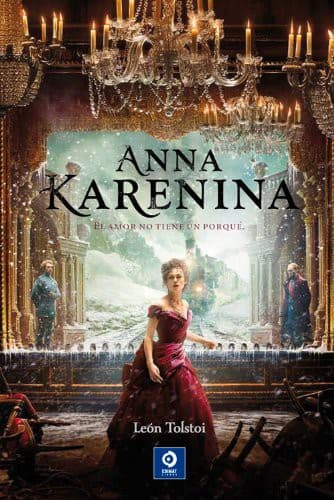
Anna Karenina
by Leo Tolstoy · Published 1878
Tolstoy's dual narrative — Anna's ruinous affair against Levin's slow, unglamorous search for a meaningful life — is as psychologically precise about marriage and desire today as it was in 1878.
What works
- Psychological interiority (especially Anna's) that remains startlingly modern in its precision, well over a century later
- The Levin storyline, often underrated next to Anna's, is a genuinely moving portrait of finding meaning outside romantic/social status
What doesn't
- Its length and cast of Russian aristocratic characters (with patronymics and nicknames) are a real barrier to entry
- Some of the agricultural and political digressions in Levin's sections test the patience of readers here mainly for the central tragedy
Summary
Anna Karenina opens with the most quoted first line in the novel form and then spends eight hundred pages complicating it. Happy families may be alike, but Tolstoy's real interest is in how a marriage becomes unhappy from the inside, one small evasion at a time, long before anything dramatic occurs.
Anna is married to Karenin, a senior official twenty years her elder, respected and emotionally unreachable. She meets Vronsky, a cavalry officer, and the affair that follows is not a sudden fall but a slow accumulation of decisions she keeps declining to name. Tolstoy's precision is in the gap between what Anna tells herself and what she is doing.
Running alongside is Konstantin Levin, a landowner who is bad at society, awkward in conversation, obsessed with agricultural reform, and looking for a reason to think life means anything. His plot has almost no drama: he proposes and is refused, works his estate, marries, has a child, and nearly loses his mind over the fact that he will die.
The novel is built so that these two lines comment on each other. Anna pursues passion and is destroyed by a society that permits her lover the same behaviour without cost. Levin pursues nothing glamorous and arrives somewhere. Reading only for Anna gets you a tragedy; reading both gets you Tolstoy's actual argument.
Key ideas
1. The interiority is the achievement
What still startles readers is how much access Tolstoy grants to how a mind actually moves — the way Anna reasons her way toward what she has already decided, notices she is doing it, and continues.
He does this for minor characters too, and often for a single paragraph. A man's momentary vanity, a hostess's calculation about seating, Levin's brother's resentment — each rendered with the same seriousness, then dropped.
The most famous technical instance is the sequence before Anna's death, where her perception fragments into overheard phrases and half-thoughts. It reads as a stream-of-consciousness passage decades before the technique was named, and it is not a stylistic experiment: it is the endpoint of a mind that has run out of ways to narrate itself.
2. Society punishes the woman and absolves the man
The affair is an open secret, and the response to it is precisely asymmetrical. Vronsky's career suffers a setback and his social life continues. Anna is excluded totally — the decisive scene is her appearance at the opera, where she is cut in public and made to understand there is no way back.
Tolstoy is exact about the mechanism. It is not that society disapproves of adultery; it disapproves of a woman who refuses to conduct it discreetly. Anna's unforgivable act is honesty — she leaves, openly, rather than maintaining the arrangement everyone else maintains.
Her separation from her son is the cruelty the novel returns to. Karenin's ability to withhold the child is legal and absolute, and Tolstoy lets it sit as the concrete cost rather than an abstraction about reputation.
3. Levin's plot is the answer, not the padding
Readers here for Anna often treat Levin as an obstacle. But the novel's structure only makes sense with him: he is what a life looks like when it is not organized around passion or status.
His crisis is genuinely philosophical. Having got everything he wanted — the estate, Kitty, a son — he finds it has not resolved the question of why any of it matters, and he begins hiding rope from himself because he is afraid of what he might do.
His resolution arrives not through argument but from a peasant's offhand remark about living for the soul rather than for need. Tolstoy declines to make it philosophically airtight, and that refusal is deliberate: the novel's position is that this kind of meaning is not reached by reasoning.
4. Marriage is examined at ordinary resolution
Alongside Anna's catastrophe and Levin's search sit several marriages rendered at unglamorous, day-to-day scale — Dolly managing an unfaithful husband and too many children, Kitty and Levin negotiating early married life with more friction than either expected.
The famous jam-making and household-accounts scenes are the novel doing its most underrated work. Tolstoy takes domestic detail seriously as a subject, which is precisely why the book's account of marriage feels true rather than schematic.
Dolly's decision to stay with Stiva, and her later ambivalence when she visits Anna and briefly envies her freedom, is one of the most honest things in the novel about what women's choices actually cost either way.
5. The train is the novel's structural signature
Anna and Vronsky meet at a railway station where a worker has just been killed under a train. Anna calls it a bad omen. The novel ends where the pattern closes.
Tolstoy uses the railway as the era's marker of modernity intruding on Russian life — foreign, mechanical, indifferent — and ties it to Anna throughout, in her dreams and in her travel between the two worlds she is trying to hold together.
It is heavy symbolism by contemporary standards, but it is executed without commentary, and it gives the book a shape that a purely psychological novel would lack.
Who it's for
- Anyone who wants the best available novel about marriage — examined at every scale from adultery to household accounts.
- Readers of literary psychology — the interior rendering set a standard later novelists worked from.
- Anyone facing a meaning-of-life problem — Levin's crisis is treated with complete seriousness and no cheap resolution.
- Readers with time for a long book — the length is used, not padded, but it is genuinely long.
FAQ
Is it hard to read?
The prose isn't difficult — Tolstoy's sentences are clear and unornamented. The difficulty is scale and bookkeeping: many characters, many names per character, and subplots that run for hundreds of pages before rejoining.
Which translation should I use?
Pevear and Volokhonsky is the common modern recommendation for fidelity; Maude is the traditional choice and reads more smoothly in English. Both are respectable — the meaningful thing is picking one and not switching.
Do I need to care about Russian agriculture?
No, but Levin's estate work is doing real thematic work — it's his substitute for the meaning others seek in status or passion. You can read those sections faster without skipping them entirely.
Is Anna meant to be sympathetic?
Tolstoy is famously ambivalent. He gives her the fullest interior life in the novel and clearly understands her, while structuring the plot as a moral tragedy. Most readers find their sympathy shifts more than once.
How does it compare to War and Peace?
Anna Karenina is tighter, more domestic, and more psychological; War and Peace is broader, historical and more essayistic. If you want interiority and marriage, start here. If you want history and scope, start there.
Was this useful?
Counts appear once there are 5 votes.