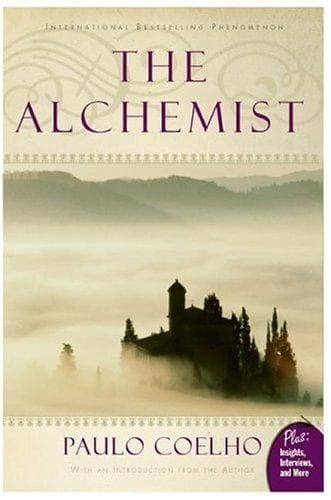
The Alchemist
by Paulo Coelho · Published 1988
A short fable about a shepherd pursuing his 'Personal Legend' that became one of the best-selling novels in history — its simplicity is exactly what makes it either inspiring or thin, depending entirely on what a reader wants from fiction.
What works
- Genuinely accessible and quick — a real entry point for readers intimidated by longer literary fiction
- The 'Personal Legend' framing has resonated across an unusually wide range of cultures and languages, worth understanding as a cultural phenomenon alone
What doesn't
- As literary fiction, the prose and characterization are intentionally simple to the point of thinness — this is a fable, not a novel of psychological depth
- The philosophy ('when you want something, all the universe conspires to help you achieve it') is comforting but not rigorously examined or complicated within the text
Summary
The Alchemist follows Santiago, an Andalusian shepherd who dreams twice of treasure buried at the Egyptian pyramids and sets out to find it. He meets a king who names the idea of a "Personal Legend" — the thing you were put here to do — sells his flock, crosses to Africa, is robbed immediately, works a year in a crystal shop, joins a caravan across the desert, falls in love, meets an alchemist, and reaches the pyramids.
What he finds there is a joke at his own expense, and the book's best structural move: the treasure was buried where he started, and the journey was the mechanism by which he learned enough to recognize it. The fable is circular by design.
Coelho is not writing a novel in the conventional sense and does not pretend to be. This is a fable, closer to a parable or a folk tale, and its characters are functions — the king, the merchant, the Englishman, the alchemist — rather than psychological studies. The prose is deliberately plain and the pacing is brisk.
It has sold in the tens of millions across dozens of languages, which makes it a cultural fact independent of its literary merits. Understanding why it travelled so far is arguably as interesting as the book itself, and the answer is bound up with the same simplicity that its critics object to.
Key ideas
1. The Personal Legend, and what it does for a reader
The central concept is that each person has a specific purpose, discoverable, and that abandoning it is the real failure. Coelho stages it as a choice repeatedly available and repeatedly declined by most people.
The crystal merchant is the book's sharpest illustration. He has dreamed of Mecca his whole life and will never go, because having the dream unfulfilled gives him something to live toward, while achieving it would leave him with nothing. He is not a villain; he is the most recognizable person in the book.
This is the idea's real function: not as a metaphysical claim about destiny but as a frame that makes deferral visible. Most readers recognize the merchant, and that recognition is what the book is actually selling.
2. The circular structure is the strongest thing in it
Sending Santiago across a continent to find treasure buried under the tree where he began is an old device, but Coelho executes it cleanly, and it carries the book's one genuinely earned argument.
The point is not that the journey was pointless. Santiago could not have found the treasure at the start, because he lacked what the journey gave him — he had to learn the language of the desert, meet the alchemist, and be robbed twice before the location meant anything.
Read that way, the ending redeems a fair amount of what precedes it. The episodes are not obstacles delaying a reward; they are the content of the transformation the reward depends on.
3. The philosophy is affirmative, and not examined
The book's most quoted line — that when you want something, all the universe conspires to help you achieve it — is also its most contested, and the text never tests it.
Nothing in the story is allowed to contradict it. Santiago is robbed and it turns out fine; he is delayed and the delay is instructive; he risks his life and survives. A world constructed so that pursuit is always rewarded is not evidence for the claim, because the claim was built into the construction.
This is the fair core of the literary criticism. A fable is entitled to a governing rule, but a rule that is never pressured produces reassurance rather than insight, and readers looking for the latter will find the book thin.
4. Fear of failure versus fear of success
One of the more durable observations is that people are less afraid of failing than of getting what they asked for — because arriving removes the excuse and exposes you to the question of what now.
This is what the crystal merchant is really about, and it is a genuinely useful psychological point that survives extraction from the book's cosmology. You do not need to believe the universe conspires in order to notice that you have been holding a goal at a comfortable distance.
It's the observation most worth taking away, and it doesn't depend on accepting anything else in the book.
5. Its reach is a phenomenon in itself
Very few novels cross this many languages and cultures. The reason appears to be the same feature critics identify as a weakness: it is so unspecific that almost any reader can occupy it.
Santiago has minimal interiority; the settings are sketched; the moral vocabulary borrows from several traditions without committing to any. That vagueness is a literary shortcoming and a distribution advantage at the same time.
Worth reading for that reason alone if you're interested in why some books travel and better books don't.
Who it's for
- Readers intimidated by longer literary fiction — genuinely accessible and quick, and a real entry point rather than a compromise.
- Anyone at a decision point about work or direction — the crystal merchant alone is worth the couple of hours.
- People curious about the book as a cultural phenomenon — its reach across languages is remarkable and worth understanding on its own.
- Readers who want a fable rather than a novel — taken on those terms, it does what it sets out to do.
FAQ
Is it a novel or a self-help book?
Formally a fable, and it functions as inspirational literature. It has a narrative and characters, but they operate as vehicles for a lesson rather than as ends in themselves, which is why literary readers and self-help readers reach such different verdicts.
Why do opinions on it diverge so sharply?
Because its simplicity is simultaneously the appeal and the flaw. If you want a clear, portable frame for thinking about deferred ambition, that simplicity is a feature. If you want density, ambiguity or characters who surprise you, the identical quality reads as emptiness.
How long does it take to read?
A few hours. It's short, the prose is plain, and the structure is linear — one of the lowest-commitment books on any "most influential" list.
What's the single most useful idea in it?
The crystal merchant: that an unpursued dream can be more comfortable to hold than a pursued one, because it can never be lost. That observation stands on its own without the surrounding cosmology.
Is the philosophy actually sound?
As a description of how the world works, no — the story is built so that pursuit always pays, which is not how outcomes distribute. As a prompt to examine what you've been deferring and why, it's genuinely useful. The distinction matters.
Was this useful?
Counts appear once there are 5 votes.