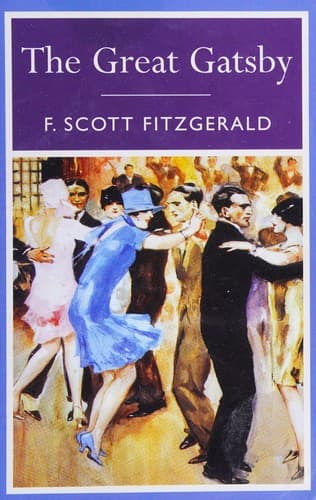
The Great Gatsby
by F. Scott Fitzgerald · Published 1925
A short, precisely constructed novel about the corrosion behind the American Dream's glamour — Gatsby's obsessive reinvention and Nick's unreliable narration reward attention far beyond the book's length.
What works
- Extraordinarily tight prose — almost no wasted sentence across its short length
- Nick Carraway's unreliable narration rewards close, critical reading rather than a straight surface interpretation
What doesn't
- Its brevity leaves several characters (Daisy especially) thin as psychological studies compared to their symbolic weight
- The 1920s social/racial context requires a reader to supply historical framing the text itself doesn't provide
Summary
The Great Gatsby runs to fewer than fifty thousand words and is narrated by a man who tells you on the first page that he is inclined to reserve judgement, then spends the novel judging everyone. Nick Carraway moves to Long Island in the summer of 1922, rents a small house beside an enormous one, and gradually learns that his neighbour throws vast parties for a single purpose: to be noticed by a woman across the bay.
That woman is Daisy Buchanan, Nick's cousin, married to Tom — old money, casually brutal, conducting an affair he barely troubles to hide. Jay Gatsby has spent five years and an unexplained fortune constructing a version of himself he believes she will accept. The novel's engine is not whether he wins her, but the growing evidence that the thing he wants cannot exist, because it is located in the past.
Fitzgerald keeps the plot small and the implication large. A careless drive, a misidentified car and a confrontation in a hot hotel room are enough to destroy several lives, and the speed of that collapse is the point: the wealthy characters survive it and the others do not. Tom and Daisy, in the line the novel is most remembered for, retreat back into their money and let other people clean up.
What keeps it in every syllabus is that the surface reading — a tragic romance about a man who loved too much — is available and wrong. Almost every detail Nick reports undercuts it, and the novel is engineered so that a second reading is a different book from the first.
Key ideas
1. Nick is not a reliable narrator, and the novel knows it
Nick opens by claiming a rare tolerance and closes by admitting he is "one of the few honest people" he has known — a self-assessment no genuinely modest narrator makes. He is inside the story, financially adjacent to it, and clearly in some way in love with Gatsby's version of himself.
This matters because everything you learn about Gatsby arrives through him, often second- or third-hand, and often contradicting itself. Gatsby is an Oxford man, or is not. He killed a man, or did not. The rumours are never settled, because Nick is reconstructing a person he has decided in advance to admire.
Reading the novel as though Nick were a camera flattens it. Reading him as a participant with a stake — a bond salesman who found the summer romantic and the aftermath unbearable — is what makes the last page land.
2. The Dream is not betrayed; it is the problem
The usual classroom framing is that Gatsby represents a pure aspiration corrupted by a shallow world. The novel is harder than that. What Gatsby wants is not success — he already has money — but for Daisy to say she never loved Tom, erasing five years so the past can be re-entered.
Fitzgerald makes the ambition itself the error. Nick tells Gatsby you can't repeat the past and gets the reply, "Can't repeat the past? Why of course you can!" — which the novel treats not as inspiring but as the precise moment his project is revealed as impossible.
The famous closing image of boats borne back ceaselessly into the past generalizes this from one man to a national habit. It is not a lament for a dream that failed; it is a description of a dream that was always oriented backwards.
3. Old money and new money are different species
The geography does the argument. East Egg holds inherited wealth; West Egg holds the newly rich; the valley of ashes between them holds the people whose labour produced both. Gatsby's mansion, his shirts, his parties are all slightly too much, and everyone at the parties knows it while drinking his liquor.
Tom's cruelty is possible because his position is not contingent. Gatsby's position is entirely contingent, which is why it can be dismantled in a single conversation once Tom decides to investigate where the money came from.
The novel is consequently as much about class immobility as about romance. Gatsby accumulates every external marker of the class he wants to enter and is still, to Tom, "Mr. Nobody from Nowhere."
4. The compression of the prose is the craft
Fitzgerald's sentences carry an unusual amount per word, and the book's brevity is a function of that density rather than of slightness. Characters are established in a clause; Tom's "cruel body," the Buchanans' habit of drifting "unrestfully wherever people played polo and were rich together."
It rewards slow reading in a way most short novels do not, because the symbolic freight — the green light, the eyes on the billboard, the ash heaps — is placed rather than explained. Fitzgerald almost never tells you what something means.
This is also why it survives being taught. There is genuinely more in the sentences than a first pass extracts.
5. Daisy carries more symbolic weight than the text gives her interiority
Daisy is the object of the novel's central desire and gets remarkably little inner life. Her most quoted line — hoping her daughter will be "a beautiful little fool" — is a flash of real self-knowledge about women's position in her world, and the novel does not develop it.
Whether that is a flaw or a demonstration depends on how much credit you extend. She can be read as deliberately hollow, because Gatsby loves a projection rather than a person, and the reader is placed in his position.
But that defence only goes so far. The novel is short, and the shortness costs its women more than its men.
Who it's for
- Anyone who read it at school and disliked it — the surface romance is the least interesting reading available, and the book is different when the narrator is treated as a suspect.
- Readers who want maximum return per page — few novels this short repay attention this heavily.
- Anyone interested in class and mobility — the argument about how impermeable inherited status is has aged unusually well.
- Writers studying compression — the sentence-level economy is the most transferable thing in the book.
FAQ
Is it worth re-reading if I studied it at school?
Yes, more than almost any other assigned novel. School readings usually treat Nick as a neutral narrator and Gatsby as a romantic hero, and the book actively resists both. Re-reading with attention to what Nick omits and how he flatters himself produces a substantially different novel.
Why is it considered great when so little happens?
Because the value is at sentence level and in structure, not in plot. The events are deliberately small so that the implications — about class, self-invention and the direction American aspiration points — carry the weight instead.
Is Gatsby meant to be admirable?
The novel is genuinely ambivalent, which is the source of most disagreement about it. Nick admires him and says so; the same pages show a man who built a fortune through unexplained means to win back a married woman by erasing her history. Both readings are supported, and the tension is deliberate.
What's the main criticism of it?
That its women, and Daisy in particular, function more as symbols than as people. Defenders argue this reproduces Gatsby's own distorted view; critics reply that the novel never sufficiently steps outside that view to complicate it.
Do I need historical background before reading it?
Not to follow the story, but yes to read it well. A short primer on Prohibition, new versus inherited wealth in the 1920s, and the era's racial politics will make several scenes legible that otherwise pass as background colour.
Was this useful?
Counts appear once there are 5 votes.