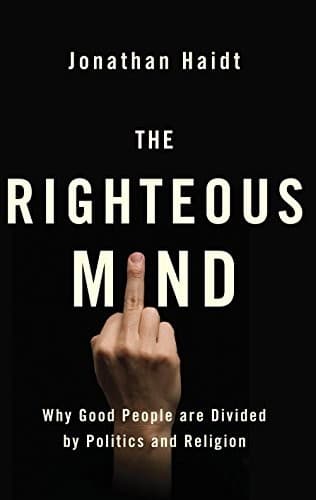
The Righteous Mind
by Jonathan Haidt · Published 2012
The best available explanation of why good people disagree so fundamentally about politics and religion — the moral foundations framework is genuinely illuminating even for readers who reject Haidt's own political conclusions.
What works
- The elephant-and-rider metaphor for intuition vs. reasoning is genuinely useful and widely applicable
- Moral Foundations Theory gives real, testable structure to why left/right disagree, rather than assuming one side is simply wrong
What doesn't
- Haidt's own political framing occasionally colors the 'neutral' presentation, especially in later chapters
- The evolutionary-psychology arguments underpinning group selection are more contested in the field than the book lets on
Summary
Jonathan Haidt sets out to explain why decent, intelligent people hold political and religious views that strike each other as not merely wrong but incomprehensible. His answer is that moral judgment is primarily intuitive rather than reasoned, and that people differ in which moral intuitions they weight — so disagreements that look like failures of logic are usually differences in underlying moral foundations.
The book has three parts, each stating one principle. The first is that intuitions come first and strategic reasoning second: Haidt's metaphor is a rider on an elephant, where the elephant (intuition) determines direction and the rider (reasoning) mostly generates post-hoc justifications. Evidence comes from studies where people condemn scenarios confidently and then fail to produce any reason — what he calls moral dumbfounding.
The second part introduces Moral Foundations Theory: six innate psychological systems on which cultures build moralities — care/harm, fairness/cheating, loyalty/betrayal, authority/subversion, sanctity/degradation, and liberty/oppression. Haidt's central empirical claim is that political liberals rely primarily on care and fairness while conservatives draw more evenly on all six, which is why each side finds the other's arguments not just unpersuasive but morally illegible. The third part argues that human nature is largely selfish but partly "groupish" — that we have genuine capacities for hive-like cooperation, and that religion and politics both function as coalition-building technologies.
Key ideas
1. The elephant and the rider
Haidt's controlling metaphor holds that moral judgment happens fast and automatically, and that conscious reasoning arrives afterward to construct a defense. The rider is not the elephant's driver but its press secretary — skilled at explanation, largely unable to steer.
Intuitions come first, strategic reasoning second.
The practical implication is significant and counter-intuitive: presenting better arguments to someone who disagrees with you mostly generates better counter-arguments, because you are addressing the rider. Changing minds requires reaching the elephant — through relationship, affection, or reframing — before the argument can land.
2. Moral Foundations Theory
The six foundations are the book's most testable contribution and the one with the most subsequent research behind it. Haidt's data, drawn from surveys across many countries, consistently shows the same asymmetry: liberals score high on care and fairness and low on loyalty, authority and sanctity, while conservatives show a flatter profile across all six.
What makes this useful rather than merely descriptive is a further finding: when asked to fill out the questionnaire as their political opponents would, conservatives predict liberals' answers reasonably well, while liberals systematically misjudge conservatives — mostly because the foundations they don't use themselves are ones they struggle to model at all.
3. Morality binds and blinds
Haidt argues that shared moral systems are group-binding technologies — they suppress free-riding and enable large-scale cooperation among non-relatives, which is a genuine achievement. The cost is that the same mechanism blinds: once a moral community forms around a set of intuitions, members become largely incapable of perceiving the moral logic of outsiders.
This is his explanation for why political polarization intensifies rather than resolving through debate. The groups are not failing to understand each other's arguments; they are operating on partly non-overlapping moral vocabularies.
4. Groupishness and multilevel selection
The book's most contested section argues that humans are "90 percent chimp, 10 percent bee" — mostly self-interested but with real capacity for self-transcendence into group identity, which Haidt attributes partly to group-level selection. He uses this to explain religion functionally, as a mechanism for binding communities rather than as a set of factual claims.
Group selection remains genuinely disputed among evolutionary biologists, and Haidt presents the case more confidently than the field's consensus supports.
Who it's for
- Anyone baffled by how people they respect hold opposing political views — this is the most useful available explanation.
- People who work across ideological divides — journalists, mediators, organizers, managers of mixed teams.
- Readers interested in moral psychology — the foundations framework is the field's most influential recent contribution.
- Anyone who has tried to change someone's mind with facts and failed — the elephant/rider model explains exactly why.
FAQ
Does the book take a political side?
It tries not to, and largely succeeds in its descriptive claims, but Haidt's argument that conservatives use a broader moral palette reads as a defense of conservatism to some and as condescension to others. He's transparent about his own liberal starting point and how it changed.
What is moral dumbfounding?
The experimental finding that people maintain confident moral condemnations after every reason they offer has been eliminated — they know it's wrong but cannot say why. Haidt uses it as direct evidence that the judgment preceded the reasoning.
Can you actually change someone's moral views?
Rarely through argument alone. Haidt's model implies that shifts come through relationship, exposure and trust — reaching the elephant — and that arguments are useful mainly after that groundwork, not instead of it.
Is Moral Foundations Theory scientifically accepted?
The descriptive findings replicate well and the framework is widely used. The stronger claim that the foundations are innate modules is more contested, with critics arguing the questionnaire may capture learned political culture rather than evolved psychology.
What's the book's main weakness?
It states its most speculative material — group selection, the innateness of the foundations — in the same confident register as its best-supported findings, which makes the parts a reader should hold loosely hard to distinguish from the parts they can rely on.
Was this useful?
Counts appear once there are 5 votes.