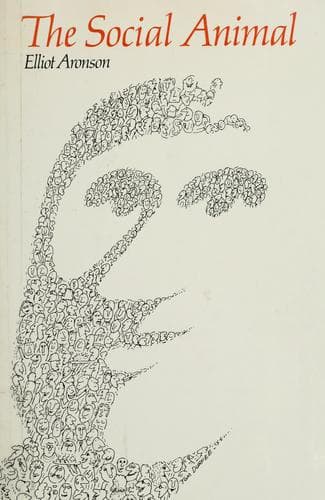
The Social Animal
by Elliot Aronson · Published 1972
A social-psychology textbook that reads more like a well-argued essay collection — conformity, persuasion, prejudice, and aggression, grounded in the actual classic experiments (Milgram, Asch, Zimbardo) rather than paraphrased secondhand.
What works
- Written by someone who ran or closely knew the classic experiments (Aronson worked with Festinger), not a secondhand popularizer
- Genuinely readable for a textbook — used in intro psychology courses for a reason
What doesn't
- Several of the foundational studies discussed (Milgram, Zimbardo, Asch) have faced serious methodological and ethical re-examination since
- As a textbook, it's more comprehensive-survey than argument-driven — less of a single thesis than some other books here
Summary
Elliot Aronson wrote The Social Animal in 1972 because he wanted a social psychology text that read like an argument rather than a survey. It became a standard introductory text and stayed in print through many editions, largely because it does not sound like a textbook.
Its authority comes from proximity. Aronson studied under Leon Festinger, the originator of cognitive dissonance theory, and ran significant experiments himself — the jigsaw classroom, work on the effects of initiation severity on group liking. He is describing a field he helped build.
The organization is thematic: conformity, mass communication and propaganda, social cognition, self-justification, aggression, prejudice, attraction, and finally the applications of social psychology to real problems.
The through-line is that behaviour is determined by situations far more than most people believe. Aronson returns repeatedly to the fundamental attribution error — our tendency to explain others' behaviour by character while explaining our own by circumstance — and most of the book is an accumulation of evidence for how much the situation does.
Key ideas
1. Situations dominate dispositions
The book's central claim, and the one Aronson considers social psychology's most important contribution: ordinary people in particular circumstances do things we would confidently predict they would not.
The classic studies carry this — Milgram's obedience work, Asch's conformity lines, the bystander research following the Kitty Genovese case. In each, situational variables produced behaviour that observers attribute to character.
Aronson's point is not that character is irrelevant but that we systematically underweight circumstance, and that this error has consequences: it makes us complacent about our own susceptibility and unfairly harsh about others' failures.
2. Cognitive dissonance and self-justification
The strongest section, unsurprisingly given Aronson's background. Dissonance theory holds that inconsistency between belief and behaviour is uncomfortable, and that people resolve it by adjusting belief — because the behaviour has already happened.
The counterintuitive results are the memorable ones. People paid a small amount to say something they disagreed with came to believe it more than people paid a large amount, because a large payment supplies an external justification and a small one does not.
Aronson's own severity-of-initiation work sits here: people who endured an unpleasant process to join a group liked the group more afterwards. The effort has to have been worth something, so the group's value adjusts upward.
3. Persuasion depends on route and source, not just content
The chapter on mass communication covers what makes messages effective, and it is the most practically applicable material in the book.
Credibility, attractiveness and perceived similarity of the source matter substantially. So does whether the audience is processing carefully or superficially — a distinction later formalized as the elaboration likelihood model.
Aronson also covers fear appeals, finding they work only when paired with specific actionable instructions. Fear without a route to action produces avoidance rather than behaviour change, which remains one of the more useful findings for anyone writing public health or safety messaging.
4. Prejudice is structural before it is attitudinal
Aronson treats prejudice as produced by competition, categorization and self-justification rather than primarily by ignorance — which shapes what he thinks reduces it.
His answer is the jigsaw classroom, his own intervention: structure a lesson so each student holds a piece of information the others need. Contact alone is insufficient and can worsen matters; interdependence is what changes attitudes, because you cannot succeed without the person you were prejudiced against.
This is the book's clearest instance of theory producing an intervention that was then tested, and it is the strongest argument for taking the field seriously as applied science rather than commentary.
5. What the replication crisis did to this material
A reader today needs the context that the classic studies have not all held up, and this affects the book unevenly.
The Stanford Prison Experiment has been substantially discredited — archival material shows guards were coached toward the behaviour that was reported as emergent. Milgram's work has faced methodological criticism about how compliance was obtained and how results were reported. Asch's conformity effect replicates but is often overstated, with most participants resisting most of the time.
Dissonance research has fared considerably better and remains solid. The situationist thesis survives, but the confident presentation of individual studies as settled facts is the part of the book that has aged least well.
Who it's for
- Anyone wanting a first serious book on social psychology — it remains the most readable introduction.
- Readers interested in persuasion — the mass communication chapter is directly useful.
- Anyone who works with groups — conformity, obedience and interdependence all apply immediately.
- Readers who want an author with standing — Aronson ran the research rather than summarizing it.
FAQ
Is it still accurate given the replication crisis?
Partly. The situationist thesis and dissonance research hold up well. Several individual studies, particularly Zimbardo's, do not. Newer editions address more of this than older ones.
Do I need psychology background?
No. It's written as an introductory text for undergraduates with no prior exposure, and it defines what it needs as it goes.
Which edition should I get?
The most recent you can find. Aronson revised it repeatedly, and later editions handle the methodological criticism of the classic studies considerably better.
How does it compare to Kahneman?
Thinking, Fast and Slow is about individual cognition and judgment; this is about how other people's presence changes behaviour. They cover adjacent but distinct territory.
What's the most useful single chapter?
Self-justification. The dissonance material is the best-supported in the book and explains an enormous amount of everyday behaviour, including your own.
Was this useful?
Counts appear once there are 5 votes.