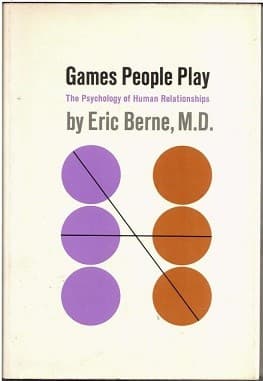
Games People Play
by Eric Berne · Published 1964
The book that made 'transactional analysis' a household concept — the catalogued social 'games' (patterns of dysfunctional interaction) remain recognizable six decades later, even where the theoretical apparatus around them feels dated.
What works
- The named 'games' are still immediately recognizable in real relationships and workplaces today
- Short, structured chapters make it easy to reference a specific pattern
What doesn't
- The underlying Parent/Adult/Child model is more a useful metaphor than a rigorously validated psychological theory
- 1964-era gender and family assumptions show through in several examples
Summary
Eric Berne was a psychiatrist looking for a way to describe what actually happens between people in a form usable without years of analytic training. Games People Play was the result, and it became an unexpected bestseller in 1964, putting "transactional analysis" into general vocabulary.
The theoretical half proposes that everyone operates from three ego states. The Parent reproduces attitudes absorbed from authority figures — critical or nurturing. The Adult processes information and responds to present reality. The Child holds patterns from one's own childhood, both spontaneous and compliant.
A transaction is one exchange between two people, and Berne's analytic move is that each exchange runs between specific ego states. Complementary transactions — Adult to Adult, or Parent to Child where both parties expect it — run smoothly. Crossed transactions, where someone addresses your Adult and your Child replies, are where conversations go wrong.
The second half is a catalogue of "games": repeated sequences of transactions with a concealed motive and a predictable bad ending, which Berne names and dissects. Roughly forty are described, and the naming is what made the book famous.
Key ideas
1. Three ego states as a working vocabulary
The Parent/Adult/Child model's value is that it gives people language for something they already perceive. You can notice that you responded to a colleague's reasonable question with something petulant, and having a name for that makes it discussable.
Berne is clear these are not Freud's superego, ego and id. They are observable behavioural states, identifiable from tone, posture and word choice, and people switch between them constantly.
Its practical use is diagnostic. When an exchange goes badly, asking which state each person was speaking from usually explains it faster than analyzing the content.
2. Crossed transactions explain most conversational failures
Berne's most useful mechanism. If one person speaks Adult to Adult — "do you know where the report is?" — and the other replies Child to Parent — "why do you always assume I've lost things?" — the lines have crossed and communication stops.
The point is that the content was fine. The failure is structural, in which state answered which, and continuing to argue about the report will not resolve it.
The practical response he suggests is to deliberately return to Adult rather than accepting the Parent role you have been offered, which is the fastest available de-escalation in most workplace conflicts.
3. Games have a payoff, which is why they repeat
Berne's definition is precise: a game is a sequence of transactions with a hidden agenda, proceeding to a predictable outcome that both participants unconsciously want.
"Why Don't You — Yes But" is his clearest example. Someone presents a problem; others suggest solutions; each is rejected for a specific reason. The stated aim is help; the actual payoff is confirmation that the problem is unsolvable and the person is therefore not responsible for it.
The unsettling part is that everyone in the game is getting something. The advisers get to demonstrate competence, and the fact that nothing is solved is what allows the game to run again next week.
4. The named games are the durable contribution
The catalogue is what survives, and it survives because the patterns are still immediately recognizable six decades later.
"Now I've Got You, You Son of a Bitch" — waiting for someone to make a mistake so that accumulated anger can be released with justification. "Kick Me" — behaving so as to provoke the rejection you expect, confirming the belief. "See What You Made Me Do" — arranging to be interrupted so that a failure can be attributed elsewhere.
Naming a pattern is what makes it possible to stop. Once you have recognized yourself running "Why Don't You — Yes But," it becomes considerably harder to keep playing it with a straight face.
5. Games substitute for intimacy
Berne's underlying argument is that people play games because they need recognition from others — what he calls strokes — and games are a structured, low-risk way to obtain it.
Genuine intimacy provides more but requires exposure. A game supplies predictable contact with no vulnerability, which is why they are so stable and so hard to abandon.
The book's conclusion is therefore not simply "stop playing games" but that abandoning them requires tolerating the exposure they were protecting you from — which is a considerably more serious claim than the catalogue's tone suggests.
Who it's for
- Anyone stuck in a repeating conflict — the games catalogue often identifies the pattern precisely.
- Managers and team leads — crossed transactions explain a great deal of workplace friction.
- Readers who want vocabulary for social dynamics — the naming is the whole utility.
- Anyone in therapy or coaching — transactional analysis remains a live practice and this is the source text.
FAQ
Is transactional analysis still used?
Yes, in counselling and organizational work, though it sits outside the mainstream evidence-based therapies. Its persistence owes more to practical usefulness than to research support.
Do I need psychology background?
No. Berne wrote deliberately for general readers, which is why the book sold as it did. The vocabulary is defined as it goes.
Is it just clever labels?
Partly, and that's not a small thing. Naming a recurring pattern is often what makes it visible enough to interrupt — the labels do real work even where the theory around them is loose.
Which game is most recognizable?
"Why Don't You — Yes But" is the one most readers identify immediately, usually in themselves. It appears in workplaces, friendships and families with little variation.
What should I read alongside it?
Thomas Harris's I'm OK — You're OK covers transactional analysis more accessibly. For modern evidence-based work on relationship patterns, Gottman's research is a better foundation.
Was this useful?
Counts appear once there are 5 votes.