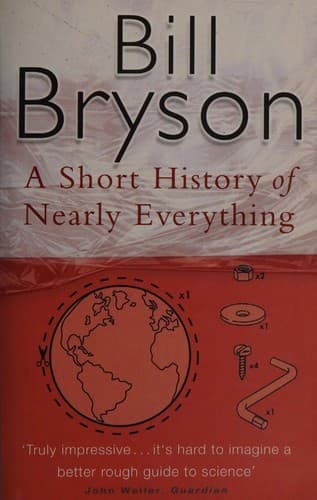
A Short History of Nearly Everything
by Bill Bryson · Published 2003
Bryson's project — explain the history of science, from the Big Bang to human evolution, to someone with no scientific background — succeeds largely because he asks the questions a genuine layperson would actually ask.
What works
- Genuinely accessible without condescending — explains real science to real beginners
- The focus on scientists' actual, often petty and flawed human stories makes the history memorable, not just the facts
What doesn't
- As popular science from 2003, some specific findings (particle physics, genomics) are now outdated
- Breadth over depth by design — no single topic gets more than a chapter's worth of real depth
Summary
Bill Bryson opens by explaining that he wrote this book because he realized, well into adulthood, that he had no idea how anyone knew the things science claims to know — how the Earth's weight was determined, how anyone established its age, what an atom actually is. He had been taught facts and never the process by which they were established.
The book is his attempt to close that gap, and its structure follows the questions a curious non-scientist would actually ask, in roughly the order they'd occur: how the universe began, how big it is, what the Earth is made of, how old it is, how life started, how humans arrived.
Along the way it covers cosmology, particle physics, chemistry, geology, palaeontology, evolutionary biology and cell biology — not systematically, but as needed to answer the running question of how we came to know any of this.
The other half of the book is the scientists. Bryson is at least as interested in the people as the findings, and specifically in how odd, petty, obsessive and frequently unpleasant many of them were. The result is a history of science that is genuinely funny without being unserious about the science.
Key ideas
1. Asking "how do we know?" is the organizing device
The book's distinguishing move is refusing to state findings as bare facts. Every claim comes with the story of how it was established, which turns out to be more interesting and much more memorable than the claim itself.
The measurement of the Earth's weight is the model case. Bryson walks through Henry Cavendish's experiment with lead spheres and a torsion balance in a sealed shed, and the number stops being something to memorize and becomes something someone worked out.
This also quietly teaches what evidence looks like. A reader finishes with a better sense of how scientific claims are supported than most popular science provides, without ever being lectured about method.
2. Scientists were frequently strange, and it mattered
Bryson collects the human material relentlessly. Cavendish was so pathologically shy he communicated with his housekeeper by note. Isaac Newton inserted a needle into his eye socket to investigate optics. Thomas Midgley invented both leaded petrol and CFCs, two of the more damaging products of the twentieth century, and was eventually killed by a mechanical bed of his own design.
The feuds get equal attention — the "Bone Wars" between Cope and Marsh, who raced to name dinosaur species and sabotaged each other's digs, produced a great deal of palaeontology and a great deal of destroyed evidence.
This is not decoration. It supports a real point: science is done by people with ordinary flaws, and progress often depended on accidents, rivalries and stubbornness rather than orderly method.
3. Credit is distributed unfairly, and often late
A recurring theme is discoveries made and ignored. Bryson repeatedly finds people who got there first and were forgotten because they lacked standing, publication skill or the right connections.
Alfred Wegener proposed continental drift in 1912 and was dismissed for decades, partly because he was a meteorologist rather than a geologist. Gregor Mendel's work sat unread for thirty-five years.
The pattern he draws out is that being right is insufficient; the scientific community has to be in a position to hear you, and frequently it isn't.
4. Deep time and scale are made comprehensible
Some of the most effective passages address the problem that the numbers in cosmology and geology are too large to mean anything intuitively.
Bryson handles this with concrete analogies — compressing Earth's history into a single day to show that humans appear in the final seconds, or describing atomic scale in terms of how many atoms are in a full stop.
The recurring point is how recent and how contingent human existence is, and how much of the planet's history happened without anything resembling us. He is careful to present extinction and catastrophe as normal features of the record rather than aberrations.
5. How much remains unknown
Bryson returns often to the limits of current knowledge, and it is one of the book's more valuable habits. He notes how little of the deep ocean has been explored, how much of the microbial world is uncatalogued, how many basic questions in physics remain open.
Popular science frequently presents a settled picture; this book is consistent about which parts are firm, which are best current estimates, and which are frankly unknown.
It closes on extinction and human responsibility, arguing that we are the first species capable of understanding our own effect on the planet, and have so far handled that capability poorly.
Who it's for
- Anyone who found school science dull — this is the standard recommendation for exactly that reader, and it earns it.
- Readers who want the history rather than the textbook — the people and the process are the focus.
- Anyone with a gap between knowing facts and knowing how they were established — that gap is the book's subject.
- Readers who like being entertained while learning — it is genuinely funny throughout.
FAQ
Do I need any science background?
None. It's written for someone who has forgotten or never learned school science, and Bryson is explicit that he was that person when he started.
Is it still accurate?
Broadly, with dated patches. The historical material — who discovered what, and how — remains sound. Specific frontier findings from 2003 in physics and genetics have been superseded.
Is it actually funny?
Yes, and that's a large part of why it works. The humour comes mostly from the scientists' real behaviour rather than from jokes about the material, so it doesn't undercut the science.
How does it compare to Sagan or Dawkins?
Bryson is broader and shallower, and he's a journalist rather than a scientist — which is the point, since he asks beginner questions a practitioner wouldn't think to ask. Sagan and Dawkins go deeper in their own fields.
What's the best thing to take from it?
A sense of how knowledge is actually produced — slowly, by flawed people, with false starts and ignored discoveries. That's more durable than any individual fact in the book.
Was this useful?
Counts appear once there are 5 votes.