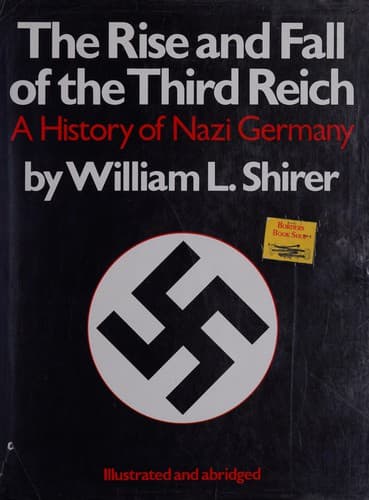
The Rise and Fall of the Third Reich
by William L. Shirer · Published 1960
Written by a journalist who was actually in Berlin through the 1930s, drawing on captured Nazi documents right after the war — still the most detailed single-volume account of how Nazi Germany rose and collapsed, despite its age.
What works
- Eyewitness authority — Shirer was reporting from Germany as the events unfolded, not reconstructing from a distance
- Drew on Nazi government documents captured immediately postwar, before much of the archive was dispersed
What doesn't
- At over 1,200 pages, it's a genuine commitment — not an entry point for a casual reader
- Later historians have refined or revised specific factual and interpretive claims with access to archives Shirer didn't have
Summary
William Shirer was a CBS correspondent in Berlin from 1934 until 1940, broadcasting from Nazi Germany until censorship made the job impossible. He attended the Nuremberg rallies, watched the Reichstag proceedings, and reported the annexation of Austria and the invasion of Poland as they happened.
After the war he gained access to a windfall: the captured records of the German government — Foreign Office files, military high command diaries, Gestapo material, and the enormous documentary record assembled for the Nuremberg trials. Much of it had not been examined, and some was later dispersed among archives in several countries.
The book combines those two things. It runs from the origins of Nazism through Hitler's rise, the consolidation of power, the diplomatic crises of the 1930s, the war itself, the Holocaust, and the regime's collapse — at more than 1,200 pages, with the documentary record quoted at length throughout.
Its enduring value is the combination of a witness who was present and a documentary base assembled before it scattered. Shirer can tell you both what a Nuremberg rally felt like from inside the crowd and what the Foreign Office was recording about the same week.
Key ideas
1. The eyewitness layer is the irreplaceable part
What no later historian can reproduce is Shirer's presence. He describes the atmosphere at the rallies — the lighting, the choreography, the effect on the crowd and on himself — with the specificity of someone who stood in it.
His account of the collective mood at moments of crisis is similarly first-hand: how Berliners actually reacted to the outbreak of war, which was markedly less enthusiastic than the propaganda footage suggests.
He also documents his own working conditions, and the compromises of reporting under censorship, which makes him unusually explicit about what he was and was not able to see at the time.
2. The Weimar collapse is treated as a process, not an accident
The early sections trace how a constitutional republic was dismantled largely through legal means. The Reichstag fire, the Enabling Act, the elimination of rival parties and the Night of the Long Knives are laid out as a sequence in which each step was made possible by the previous one.
Shirer emphasizes the role of conservative elites who believed Hitler could be used and contained — Papen's assurance that they had him boxed in is one of the book's most cited moments.
This material has aged well, because the mechanism is general: the incremental legal dismantling of institutional constraints by people who thought they were managing the situation.
3. The documentary record does the accusing
Shirer's technique is to let the Nazi documents speak. Rather than characterizing intentions, he quotes the minutes, the memoranda and the diaries — the Hossbach Memorandum on war planning, the Wannsee protocol, the field reports.
The chapters on the Holocaust rely on this method heavily, and their force comes from the bureaucratic register of the sources themselves: the language of logistics applied to mass murder is more damning than any adjective he could supply.
He was writing when a good deal of this material was newly available and not yet widely known, which is part of why the book had the impact it did.
4. The regime was less efficient than its image
A consistent theme is that Nazi Germany was administratively chaotic. Overlapping agencies, deliberately duplicated authority, and constant infighting among subordinates competing for Hitler's favour produced a state that was often incoherent.
Shirer traces how this affected the war — contradictory orders, wasted industrial capacity, strategic decisions driven by personal rivalry rather than analysis.
This directly contradicts the popular image of ruthless German efficiency, and later scholarship has broadly supported the point, developing it much further than Shirer takes it.
5. The strategic errors are documented from inside
The war chapters draw on military diaries to show decisions being made and disputed at the time. The decision to invade the Soviet Union, the declaration of war on the United States, the refusal to permit withdrawal at Stalingrad, and the halt order at Dunkirk are all traced through the record of the men involved.
What emerges is a picture of Hitler's increasing personal control over operational decisions and a command structure progressively unable to contradict him.
Shirer's assessment is that the regime's ideological commitments and its leader's psychology were themselves strategic liabilities — a claim later historians have complicated but not overturned.
Who it's for
- Readers who want depth and have the time — nothing else covers this ground in one volume at this level of detail.
- Anyone interested in how a democracy is dismantled legally — the Weimar chapters are the most transferable part.
- Readers who value primary documents — the sources are quoted extensively rather than paraphrased.
- Anyone who wants an eyewitness account — this is a historian who was actually there.
FAQ
Is it out of date?
Partly. The documentary material and eyewitness reporting remain valuable and irreplaceable. The interpretive frame, particularly on long-run German history, has been substantially revised since 1960.
Is it readable given the length?
Yes — Shirer was a working journalist and the prose is clear and propulsive. It's long, but the difficulty is duration rather than density.
What should I read alongside it?
Ian Kershaw's biography of Hitler for the interpretive state of the art, and Richard Evans's Third Reich trilogy for a modern comprehensive account. Shirer complements both rather than competing with them.
Does it cover the Holocaust adequately?
It covers it seriously and with documents, but the historiography of the Holocaust has expanded enormously since. For that subject specifically, later specialist work is essential rather than optional.
Why is it still recommended?
Because the combination cannot be reproduced: a journalist who was present through the 1930s, writing with access to captured records shortly after the war, before parts of the archive were dispersed.
Was this useful?
Counts appear once there are 5 votes.