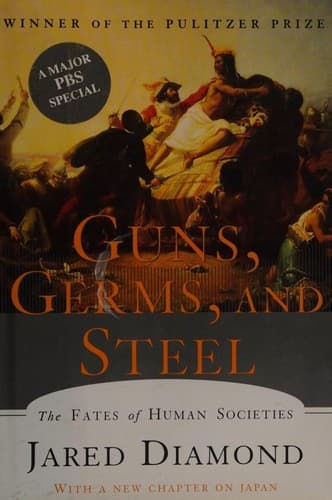
Guns, Germs, and Steel
by Jared Diamond · Published 1997
A Pulitzer-winning attempt to explain why some societies conquered others — geography, domesticable crops and animals, and disease resistance — that reframed the popular understanding of world history away from racial explanations.
What works
- Genuinely reframed a popular audience away from race-based explanations of historical dominance toward environmental ones
- Sweeping, ambitious synthesis across archaeology, biology, and history in accessible prose
What doesn't
- Academic historians and geographers have raised serious objections to the environmental-determinism argument's explanatory sufficiency since publication
- The scope (13,000 years, every continent) necessarily sacrifices depth for breadth in many sections
Summary
Guns, Germs, and Steel starts with a question Jared Diamond says was put to him by a New Guinean politician named Yali: why did Europeans arrive with so much cargo, while New Guineans had so little? The book is a book-length attempt to answer it without any appeal to differences in intelligence or culture between peoples.
Diamond's answer is environmental. Some regions happened to contain plants and animals suitable for domestication, and some did not. The Fertile Crescent had wheat, barley, and large domesticable mammals; the Americas had maize, which took far longer to develop into a productive crop, and almost no domesticable large animals at all.
Agricultural surplus permitted dense populations, which permitted specialization — soldiers, bureaucrats, metalworkers, writers. Living alongside herd animals produced epidemic diseases, and long exposure produced partial resistance. When Europeans reached the Americas, those diseases did more killing than any weapon.
He adds a geographic argument: Eurasia's main axis runs east-west, so crops, animals and technologies could spread across it at similar latitudes, while the Americas and Africa run north-south, crossing climate zones and slowing diffusion. The conclusion is that Eurasian dominance follows from geography and biology, not from anything about the people.
Key ideas
1. The question itself is the achievement
Before assessing the answer, the framing deserves credit. Diamond takes seriously a question that had mostly received racist answers or been avoided, and insists on treating it as an empirical problem with a discoverable cause.
The book's real cultural work was displacing an implicit assumption in popular history — that European dominance reflected something about Europeans — and replacing it with a mechanism that has nothing to do with the people involved.
Whatever the objections to his specific causal chain, this reframing reached an enormous audience and shifted the default popular explanation. That is a genuine and durable contribution.
2. Domesticable species were unevenly distributed, and it mattered enormously
The strongest empirical section concerns domestication. Diamond points out that of the world's large mammal species, very few have ever been successfully domesticated, and the criteria are demanding — diet, growth rate, temperament, breeding behaviour, social structure.
Eurasia had most of the qualifying species. The Americas had llamas and alpacas and little else; Africa's large mammals, despite their abundance, largely fail the criteria — zebras are famously unmanageable, and no one has domesticated a hippopotamus.
The same applies to plants. Wheat and barley were high-yield and easy to cultivate from the start; maize required millennia of selective breeding to become productive. This section is where the argument is most concrete and least disputed.
3. Disease was the decisive weapon, and it was accidental
Diamond's account of epidemic disease is the part most readers remember. Living in dense settlements alongside domesticated herd animals produced crowd diseases — smallpox, measles, influenza — and centuries of exposure produced populations with partial resistance.
Indigenous American populations had neither the animals nor the exposure. The resulting mortality after contact was catastrophic on a scale that makes military history almost beside the point in explaining the conquest.
Diamond is clear that this was not a strategy. The pathogens travelled ahead of the conquistadors, often devastating societies before Europeans arrived in force, which makes the conquest look less like a victory than like an arrival after a collapse.
4. The axis argument
The east-west versus north-south claim is the book's most distinctive geographic idea. Crops adapted to a given day length and climate spread easily along a latitude and poorly across one.
Eurasia's east-west span therefore allowed a package of domesticated species and associated technologies to propagate from the Fertile Crescent to Europe, India and China. The Americas' north-south orientation meant Mesoamerican crops could not simply move into North America, and Africa's meant the Sahara acted as a barrier.
It's an elegant argument and the most frequently cited idea in the book. It is also the one most often flagged as tidier than the evidence strictly supports.
5. Where the argument is contested
Since publication, historians, geographers and anthropologists have raised sustained objections, and a reader should know them.
The main charge is that environmental determinism explains the broad distribution of advantage over ten thousand years but does poorly at explaining specifics — why Europe rather than China, given that China had the same Eurasian package and led technologically for centuries. Diamond's answer, involving Europe's fragmented geography encouraging competition, is generally regarded as the book's weakest link.
Critics also argue the framing underweights contingency, institutions, and human agency, and that treating outcomes as flowing from geography can read as retrospectively inevitable. The book's popular success among non-specialists and its cooler reception among specialists is a real and persistent gap.
Who it's for
- Anyone who has wondered why history broke the way it did — this is the most accessible serious attempt at the question.
- Readers who like cross-disciplinary synthesis — archaeology, biology, linguistics and history are genuinely combined.
- Anyone who encounters race-based explanations of history — this is the standard, well-argued alternative.
- Readers who enjoy arguing with a book — the thesis is clear enough to test, which is a virtue.
FAQ
Is the thesis accepted by historians?
Not broadly. It's widely known and credited with displacing racial explanations in popular understanding, but specialists commonly argue it underweights institutions, contingency and agency. Popular acclaim and academic reception diverge notably here.
Is it worth reading if the argument is contested?
Yes — it's a clearly stated, testable thesis, which is exactly what makes the criticism productive. Reading it alongside its critics is more valuable than reading either alone.
What's the single strongest part?
The domestication chapters. The analysis of which species can be domesticated and why so few qualify is concrete, well evidenced and largely uncontested.
Does it explain why Europe rather than China?
It attempts to, via Europe's fragmented geography encouraging competing states, and this is generally seen as the book's weakest section. China had the same environmental advantages and led technologically for long stretches, which the environmental argument struggles to accommodate.
Is calling it deterministic fair?
Partly. Diamond does allow for other factors, but the book's structure and rhetoric consistently return to environment as the fundamental cause, and readers reasonably come away with a stronger determinism than his caveats formally endorse.
Was this useful?
Counts appear once there are 5 votes.