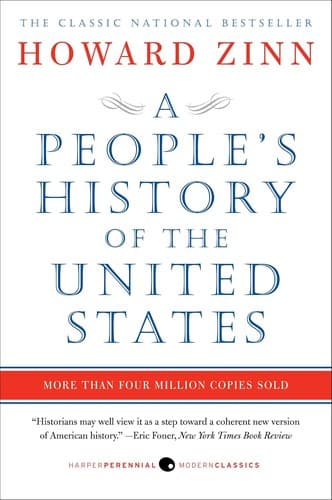
A People's History of the United States
by Howard Zinn · Published 1980
Explicitly a corrective, not a neutral survey — American history told from the perspective of workers, enslaved people, and the colonized rather than the standard 'great men' narrative. Essential precisely because of its stated bias, which it never hides.
What works
- A genuinely necessary counterweight to textbook history that centers presidents and generals
- Extensively sourced with primary documents from workers', women's, and civil rights movements
What doesn't
- Zinn is explicit that this is not a neutral survey — readers should pair it with a more conventional narrative, not treat it as the whole picture
- Some historians have challenged specific factual claims and selective framing in individual chapters
Summary
A People's History of the United States retells American history from the bottom up, and announces its method in the first chapter. Howard Zinn describes Columbus's arrival from the perspective of the Arawak, quotes Columbus's own journals on the islanders' gentleness and on his immediate assessment of their usefulness as slaves, and then states plainly what he is doing and why.
That transparency is the book's organizing principle. Zinn argues that all history is written from a standpoint, that conventional narratives adopt the standpoint of statesmen and generals while presenting themselves as neutral, and that he will instead write from the standpoint of the conquered, the enslaved, the workers and the excluded — and tell you so.
The chapters proceed through the familiar sequence — colonization, revolution, the Constitution, slavery, westward expansion, industrialization, the world wars, the civil rights era, Vietnam — but with the perspective inverted at each point. The Revolution appears partly as an elite consolidation; the Constitution as a document protecting property; the wars as events with domestic dissent that standard accounts minimize.
The sourcing leans heavily on primary documents from below: strike testimony, slave narratives, letters, movement pamphlets, court records. The book's continuing influence comes largely from the fact that these voices are quoted at length rather than summarized.
Key ideas
1. Declaring the standpoint is the argument
Zinn's central methodological claim is that objectivity in history is unattainable and that pretending otherwise is the more dishonest position. Selection is unavoidable; what matters is whether the criteria are stated.
He is therefore explicit that this is a corrective written against a body of work, not a balanced survey. He says so in the text, repeatedly, and tells readers to read other things alongside it.
This is the fairest way to approach the book, and it disposes of the most common criticism before it is made. "It's biased" is not a discovery about this book; it is the book's stated premise. The real question is whether the bias distorts specific claims, which is a narrower and more serious matter.
2. The founding period looks different from below
Zinn's treatment of the Revolution and the Constitution is among the most contested and most influential parts. He presents the Revolution as substantially a transfer of power among elites, in which ordinary colonists supplied the fighting and received considerably less than the rhetoric promised.
He points to the tensions that followed — Shays' Rebellion, the Whiskey Rebellion — as evidence that the new order was resisted from below and that the Constitution was designed partly to contain such resistance.
The property qualifications for voting, the exclusion of women, the accommodation of slavery in the constitutional text and the three-fifths clause are all foregrounded rather than treated as blemishes on an otherwise admirable achievement.
3. Labour history gets the space it usually doesn't
The strongest and least disputed sections concern industrial labour. Zinn devotes substantial attention to events most general histories compress into a sentence: the Lowell mill strikes, Haymarket, Homestead, Pullman, Ludlow, the textile strikes.
The account of the Ludlow massacre — the National Guard firing on a tent colony of striking miners and their families in Colorado in 1914 — is representative of what the book does well. It is documented, it is genuinely significant, and it is almost entirely absent from standard survey narratives.
This is the clearest case for the book's necessity. Whatever one thinks of Zinn's framing, the material is real and has been systematically under-covered.
4. War is examined for domestic dissent
Zinn consistently examines wars from the perspective of those who opposed them or were conscripted into them. The Mexican-American War, the Spanish-American War, the First World War and Vietnam are all treated with attention to opposition movements, draft resistance and the suppression of dissent.
The chapters on the Espionage Act prosecutions and Eugene Debs's imprisonment for an anti-war speech are among the most effective, because the documentary record is unambiguous.
His treatment of the Second World War is where readers most often part company with him. Zinn, a bombardier in that war, questions the moral framing of the Allied bombing campaigns, and readers who accept his method elsewhere frequently find this chapter a step too far.
5. History as a resource for the present
Zinn writes explicitly to be useful to movements. His view is that conventional history teaches passivity by making change look like something granted by leaders, while a people's history shows that rights were won through organized pressure from below.
This is why the book has been adopted by activists and criticized as propaganda in roughly equal measure. It has a purpose beyond understanding, and does not conceal it.
Whether that is a virtue or a defect depends on what you want history to be for — which is, in the end, exactly the question Zinn is trying to raise.
Who it's for
- Anyone whose American history came from a textbook — the counterweight is the point, and it works.
- Readers interested in labour and social movements — this material is covered better here than in most general histories.
- Anyone who wants to see historiography argued openly — Zinn shows his method rather than hiding it.
- Readers who will pair it with something else — which is what the author himself asks you to do.
FAQ
Is the book biased?
Yes, and it says so in the text. Zinn's position is that all history is written from a standpoint and that stating yours is more honest than implying neutrality. Judge it on whether specific claims hold, not on the general charge.
What should I read alongside it?
Any well-regarded conventional survey of American history. Zinn himself recommends reading against him — the book is designed as one side of an argument, and works best when the other side is present.
Is it accurate?
The primary-source material is real and extensively quoted. The contested part is selection and framing: which episodes get chapters, which get sentences, and what is left out. Individual factual disputes exist but are not the main issue.
Why is it so widely assigned and so widely attacked?
Because it does something valuable and does it tendentiously. It restores genuinely neglected material to view while arguing a case, and readers tend to weight those two facts very differently depending on their priors.
Where is it strongest?
The labour history. Strikes, massacres and organizing campaigns that standard surveys compress into a line get sustained, well-documented treatment, and that material is not seriously disputed.
Was this useful?
Counts appear once there are 5 votes.