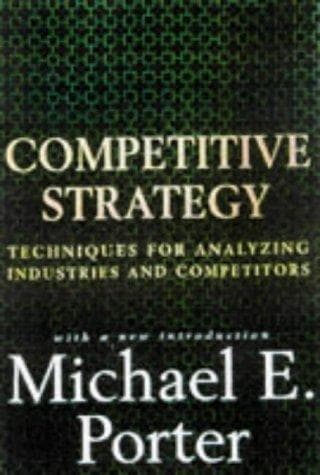
Competitive Strategy
by Michael E. Porter · Published 1980
The academic foundation almost every later strategy book (including several in this list) is reacting to or building on — the Five Forces framework alone changed how industries are analyzed.
What works
- Five Forces remains a legitimately useful first pass at any market analysis
- Rigorous and systematic in a way most later pop-strategy books aren't
What doesn't
- Dense, academic prose — this is a textbook, not an airport read
- Assumes relatively stable industry structures; says less about fast-moving, platform-driven markets
Summary
Michael Porter published Competitive Strategy in 1980, and it did something the strategy literature had not managed before: it gave managers a rigorous, systematic framework for analyzing an industry, derived from industrial organization economics rather than from case anecdote. Almost every strategy book written since is either building on it or reacting against it.
The framework everyone knows is the Five Forces. Porter's argument is that an industry's long-run profitability is determined not by how fiercely its members compete but by five structural forces: the threat of new entrants, the bargaining power of suppliers, the bargaining power of buyers, the threat of substitute products, and the intensity of rivalry among existing competitors. Where all five are strong, the industry is structurally unprofitable regardless of how well any individual firm is run. Where they are weak, even mediocre firms make money.
From that analysis Porter derives three generic strategies a firm can pursue: overall cost leadership, differentiation, or focus on a narrow segment. His controversial claim is that a firm must commit to one — a firm that tries to be both low-cost and differentiated ends up "stuck in the middle," with neither the cost structure to compete on price nor the distinctiveness to command a premium. The rest of the book applies the framework to specific situations: fragmented industries, emerging industries, declining industries, and global competition.
Key ideas
1. The Five Forces
The framework's real contribution is shifting attention from competitors to industry structure. Most managers, asked about competition, think about rivals; Porter's point is that rivals are only one of five forces, and often not the decisive one. A powerful buyer or a viable substitute can compress an industry's margins far more effectively than any competitor.
The essence of strategy formulation is coping with competition.
Used properly, the analysis answers a question most firms never ask: is this industry structurally capable of producing good returns at all? That is a different and prior question to how to win within it.
2. Generic strategies and being stuck in the middle
Porter's three generic strategies are positions a firm can defensibly occupy. Cost leadership means being the lowest-cost producer, which allows profitability at prices competitors cannot match. Differentiation means offering something buyers value enough to pay a premium for. Focus means applying either approach to a narrow segment rather than the broad market.
The "stuck in the middle" warning is the part most often cited and most often disputed. Porter's logic is that the two approaches require incompatible organizational configurations — cost leadership demands tight control and standardization, differentiation demands investment in things that raise cost. Later work, and companies like Toyota, have complicated this considerably, but as a caution against strategic incoherence it remains useful.
3. Barriers to entry determine who captures value
Porter spends considerable effort on the specific mechanisms that keep new entrants out: economies of scale, capital requirements, proprietary technology, switching costs, access to distribution, and regulatory protection. His argument is that these are not incidental features but the primary determinant of whether an industry's profits persist or get competed away.
This is the most directly actionable part of the framework, because barriers can be deliberately built. A strategy that increases switching costs or locks up distribution is doing structural work, not just operational work.
4. Competitor analysis as a systematic exercise
Less famous but genuinely useful is Porter's structured approach to analyzing a specific competitor across four components: their future goals, their current strategy, their assumptions about themselves and the industry, and their capabilities. The assumptions component is the most interesting — a competitor's blind spots are exploitable in ways their capabilities are not.
Who it's for
- Anyone doing serious market or industry analysis — Five Forces remains the standard first pass.
- MBA students and consultants — this is the foundational text the curriculum is built on.
- Founders evaluating which market to enter — the structural-attractiveness question is the right one to ask first.
- Readers who found later strategy books thin — this is the rigorous original most of them simplify.
FAQ
Is Five Forces still useful?
Yes, as a structured first pass at understanding why an industry is or isn't profitable. Its limits show up in markets with unstable boundaries or strong network effects, where a static structural snapshot misses the dynamics that matter.
Should I read this or Good Strategy Bad Strategy?
They answer different questions. Porter tells you how to analyze an industry's structure; Rumelt tells you what makes a strategy document actually a strategy. Porter is analysis, Rumelt is coherence — and you can use Porter's output as input to Rumelt's diagnosis step.
Is "stuck in the middle" still accepted?
It's contested. Companies have achieved both cost advantage and differentiation, particularly through operational innovations Porter's framework didn't anticipate. It survives better as a warning against unfocused strategy than as a hard law.
Do I need economics background?
It helps but isn't required. Porter explains the industrial-organization concepts he uses, though the writing assumes a reader comfortable with abstraction and willing to move slowly.
What's the book's main weakness?
Its static view of industry structure. The framework describes a snapshot well but has little to say about how structures change, which is the dominant question in technology-driven markets where the boundaries themselves keep moving.
Was this useful?
Counts appear once there are 5 votes.