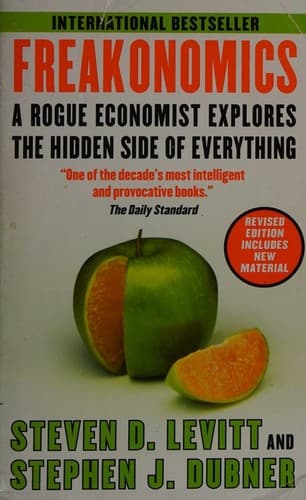
Freakonomics
by Steven D. Levitt & Stephen J. Dubner · Published 2005
Popularized the idea that incentives explain almost everything, using genuinely surprising data-driven arguments — the sumo-wrestling-cheating chapter alone justifies the book.
What works
- Genuinely counter-intuitive findings, not contrarianism for its own sake
- Makes empirical reasoning (correlation vs. causation, incentive analysis) accessible without dumbing it down
What doesn't
- The abortion-crime chapter's core study was later challenged on methodological grounds — read as provocative, not settled
- Structure is a loose collection of essays rather than a single argument
Summary
Steven Levitt is an economist who spent his career applying economic tools to questions economists traditionally ignored, and Stephen Dubner is the journalist who translated that work into a book. Freakonomics has no unifying thesis by design — the authors say so directly — but it does have a consistent method: take a question people think they know the answer to, find data that speaks to it, and follow the data even when it produces an uncomfortable result.
The chapters are essentially independent investigations. Levitt analyzes patterns in Chicago public school test scores to identify teachers who altered answer sheets, examines sumo wrestling tournament results for evidence of match-fixing on bouts where one wrestler's ranking hangs in the balance, and works through the financial records of a Chicago crack-dealing gang to show that most street-level dealers earned below minimum wage while living with their mothers — a result that reframes drug dealing as a tournament labor market rather than a lucrative career.
Underneath the variety, the book teaches a few transferable habits: that incentives explain behavior better than intentions do; that conventional wisdom is often manufactured by people who benefit from it; that experts exploit information asymmetries against the people they serve; and that correlation and causation are different in ways that matter enormously. The book's most controversial chapter argues that legalized abortion in the 1970s contributed substantially to the crime decline of the 1990s — an argument that later drew serious methodological challenges.
Key ideas
1. Incentives explain almost everything
Levitt's organizing principle is that people respond to incentives, including ones nobody designed. The teacher-cheating analysis works because high-stakes testing created an incentive for teachers that the policy's authors never intended; the sumo analysis works because tournament rules make certain matches enormously more valuable to one wrestler than the other.
Economics is, at root, the study of incentives: how people get what they want, or need, especially when other people want or need the same thing.
The generalizable habit is to look at any system and ask what behavior its rules actually reward, rather than what behavior they were meant to encourage — the gap between those two is where most surprising findings live.
2. Experts exploit information asymmetry
The book examines real estate agents, showing that agents keep their own homes on the market longer and sell them for more than comparable client properties. The mechanism is that an agent's marginal commission on a higher price is small relative to the effort of holding out, so their incentive is to close quickly — which diverges from the client's interest.
Levitt generalizes this to any expert with private information, and the argument transfers directly to contexts the book never mentions: contractors, mechanics, financial advisers, and anyone whose expertise you cannot independently verify.
3. Conventional wisdom is often constructed
A recurring theme is that widely believed facts frequently originate with someone who benefits from the belief. Levitt traces several such claims to advocacy organizations and journalists who repeated figures without checking their provenance, and shows how a number, once cited, acquires authority through repetition alone.
The habit this teaches — ask where a statistic came from and who produced it before accepting it — is arguably more valuable than any individual finding in the book.
4. The crime decline chapter
The book's most cited and most contested argument holds that the legalization of abortion in the early 1970s reduced the cohort most at risk of criminal involvement, contributing significantly to the 1990s crime drop. Levitt presents it as an example of following data to an unpopular conclusion.
Readers should know that the underlying paper was subsequently challenged on methodological grounds — economists at the Federal Reserve identified coding errors and specification problems, and the debate over the finding remains unresolved. Read the chapter as a provocative argument in an ongoing dispute rather than as settled.
Who it's for
- Anyone who wants to think more carefully about causation — the book teaches skepticism by demonstration rather than lecture.
- Readers new to economics — it shows the toolkit applied to questions that don't look economic at all.
- People who work with data — the framing of how to find a natural experiment in messy real-world data is genuinely instructive.
- Anyone who enjoys counter-intuitive nonfiction — the chapters are short, self-contained and consistently surprising.
FAQ
Is this really a book about economics?
Only in the sense that it applies economic reasoning — incentives, data, natural experiments — to non-economic questions. There's no conventional economics content, and it won't help you understand inflation or trade.
Is the abortion-crime argument accepted?
No. The original paper drew significant methodological criticism, including identified errors in the analysis, and the question remains genuinely disputed among economists. The book presents it more confidently than its status warrants.
What's the most useful takeaway?
The habit of asking what a system actually incentivizes rather than what it was designed to encourage. That question transfers to workplaces, policies and products, and it reliably surfaces things nobody planned for.
Do I need statistics knowledge?
No — the analysis is explained in plain language and no technical background is assumed. The trade-off is that you can't evaluate the methodology yourself, which matters given that some findings are contested.
What's the book's main weakness?
It presents individual studies with the confidence of established consensus. Each chapter is one researcher's analysis, sometimes disputed, but the writing style doesn't distinguish between the well-supported and the contested.
Was this useful?
Counts appear once there are 5 votes.