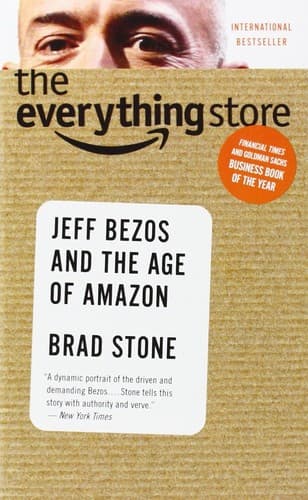
The Everything Store
by Brad Stone · Published 2013
The best outside account of how Amazon actually got built — unauthorized, which is exactly why it's more useful than a founder memoir would be.
What works
- Independently reported — includes the ruthless negotiating tactics and internal conflict a company-sanctioned book would cut
- Traces the compounding logic of Amazon's strategy (reinvest everything, obsess over the customer, play a long game) with real internal detail
What doesn't
- Written in 2013 — misses a decade-plus of AWS dominance, antitrust scrutiny, and labor controversy
- Some early chapters on Bezos's childhood run long relative to their payoff
Summary
Brad Stone's history of Amazon is deliberately unauthorized — Jeff Bezos declined to be interviewed for it, and several senior executives were reportedly discouraged from cooperating — which is part of why it reads less like a corporate hagiography and more like an investigative account. Stone traces the company from its 1994 founding as an online bookstore run out of a Bellevue garage, through its expansion into "everything," to its emergence as one of the most powerful and controversial companies in the world, built largely on Bezos's specific, unusual, and often ruthless management philosophy.
The book's throughline is that Amazon's growth was never accidental or lucky in the way outside observers often assumed during the dot-com crash years, when the company nearly failed and was widely mocked as "Amazon.toast." Stone documents a consistent, deliberate strategic logic across two decades: prioritize long-term market position over short-term profit, reinvest aggressively rather than return cash to shareholders, and treat customer obsession as a genuinely load-bearing operating principle rather than a slogan — one that repeatedly justified decisions (razor-thin margins, brutal negotiating tactics with publishers and suppliers, cannibalizing Amazon's own profitable businesses with cheaper new ones) that looked reckless or even self-destructive in the moment and were vindicated only years later.
Stone also doesn't flinch from the uglier parts of that same story — the notoriously demanding, sometimes abusive internal culture; the "Gazelle Project," an internal codename for aggressive tactics against small publishers; and Bezos's willingness to treat even close colleagues and negotiating partners as adversaries when the company's strategic interest required it. The result is a portrait of a genuinely singular founder whose success and whose costs come from the same underlying temperament.
Key ideas
1. "Get Big Fast" and the logic of unprofitability
Amazon spent years losing money by design, not by accident, prioritizing market share and infrastructure buildout over near-term profitability in a way that baffled and eventually enraged Wall Street analysts through the dot-com crash. Stone frames this as Bezos applying a specific, coherent bet: that e-commerce's real economics — low marginal cost of serving an additional customer once the infrastructure exists — would eventually reward whoever had built the largest, most efficient operation first, and that a company optimizing for near-term profit during the land-grab phase would lose that race permanently.
Bezos wanted Amazon to be the everything store — not the place you had to visit, but the place you never had to leave.
The strategy nearly killed the company during the 2000-2001 crash, when Amazon's stock collapsed and its survival was genuinely in question. Stone's account makes clear this wasn't a foregone conclusion in hindsight — it was a real, high-stakes bet that could easily have failed, and reads with more tension for it.
2. Customer obsession as an operating discipline, not a value statement
Stone documents how "customer obsession" at Amazon functioned less as a soft value and more as a hard operating constraint that regularly overrode other business interests — including Amazon's own short-term profitability and the interests of its suppliers and partners. The most vivid example is Amazon posting negative customer reviews of its own products alongside positive ones, over the strong objection of some executives who thought it would hurt sales, because Bezos insisted a genuinely customer-first company doesn't suppress information that helps the customer make a better decision, even at Amazon's own expense.
This same principle, taken to its more ruthless extreme, is what powered Amazon's negotiating tactics with publishers and suppliers — Bezos's logic was that squeezing a supplier to lower prices for the customer was a legitimate expression of the same obsession, even when it looked, from the supplier's side, like simple leverage abuse.
3. The "two-pizza team" and organizational structure as strategy
Amazon's internal structure — small, autonomous teams (famously, teams small enough to be fed with two pizzas) each owning a specific product or service with real decision-making authority — is presented as a deliberate mechanism for preserving startup-like speed and ownership as the company scaled into tens of thousands of employees. Stone connects this structural choice directly to Amazon's ability to launch and iterate on new lines of business (AWS chief among them) without the bureaucratic drag that slowed comparably-sized competitors.
The chapter on AWS's origin is one of the book's more remarkable threads — an internal infrastructure project that Amazon's own engineers initially built to solve Amazon's problems, which Bezos then pushed to turn into an external product, years before "cloud computing" was a recognized category, and years before most of the company (or the market) understood what they had.
4. A demanding, sometimes brutal internal culture
Stone doesn't romanticize the human cost of Amazon's operating principles. He documents a culture built around Bezos's own exacting, often confrontational standards — famous "Bezos rages" in meetings, a leadership-principles document used aggressively in performance reviews, and a level of internal competitiveness and turnover that several former executives describe in the book as genuinely punishing to work under, even as they credit it with producing the discipline that made the company's execution possible.
The book presents this without fully resolving the tension — Stone's reporting suggests the same demanding culture that burned people out was inseparable from the operational rigor that let Amazon out-execute competitors with more resources, rather than treating one as the "real" cause and the other as incidental.
Who it's for
- Anyone who wants to understand how Amazon's specific strategic logic (reinvestment over profit, customer obsession as hard constraint) actually worked, not just that it worked — the book is unusually specific about the mechanics.
- Readers interested in founder psychology and how a single person's temperament can shape an entire organization's culture, for better and worse — Bezos is the book's real subject as much as Amazon is.
- Business historians and strategists who want a rigorously reported account rather than a company-sanctioned narrative — the unauthorized reporting is a genuine strength, not just a marketing angle.
- Anyone specifically interested in AWS's origin story — the chapter tracing cloud computing's beginnings inside Amazon's own infrastructure needs is one of the most detailed accounts available.
FAQ
Did Jeff Bezos cooperate with or endorse this book?
No — Bezos declined to be interviewed, and Stone reports that several executives were discouraged from speaking with him. The reporting is independently sourced from hundreds of interviews with former and (some, carefully) current employees, which is part of why the book includes material a company-sanctioned history likely wouldn't.
Is this mainly about Amazon the company or Bezos the person?
Both, deliberately intertwined — Stone's argument, made through the reporting rather than stated outright, is that Amazon's specific strategic choices are best understood as extensions of Bezos's own temperament, not as generic "great company" playbook moves any founder could have made.
Does the book explain how AWS actually started?
Yes, in real detail — it traces AWS from an internal infrastructure standardization effort, driven initially by Amazon's own engineering pain points, through the internal argument over whether to sell that infrastructure externally, years before competitors recognized cloud computing as a real market.
How does this compare to Bezos's own public statements about Amazon?
It's considerably less flattering in places — Stone documents internal conflicts, controversial negotiating tactics, and cultural costs that don't typically appear in Bezos's own shareholder letters or public interviews, which is a large part of the book's value over a company-authorized account.
What's the book's main weakness?
Its age. Written in 2013, it can't cover AWS's full dominance, the antitrust scrutiny of the following decade, or the labor-practice controversies that became major news well after publication — a reader wanting the complete Amazon story needs to supplement it with more recent reporting.
Was this useful?
Counts appear once there are 5 votes.