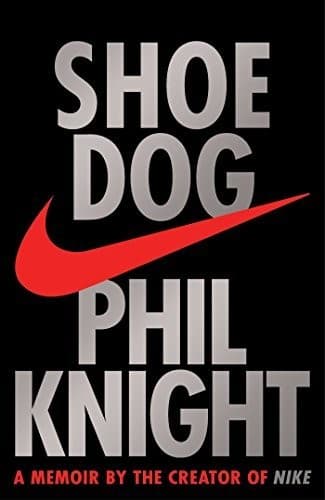
Shoe Dog
by Phil Knight · Published 2016
A founder memoir that actually reads like a memoir — Knight's account of nearly losing Nike a dozen times over is candid about how close-run and unglamorous the whole thing was.
What works
- Genuinely well-written as prose, not a ghostwritten highlight reel
- Honest about luck, cashflow terror, and the years it looked like a failure
What doesn't
- Says little about Nike's later labor-practice controversies — the story stops before that reckoning
- Some readers will want more operational detail and less narrative memoir
Summary
Phil Knight starts the story not with a triumphant origin but with a 1962 solo trip around the world after business school, including a stop in Japan to pitch a scheme he'd written a class paper about: importing well-made, cheap Japanese athletic shoes to compete with the German brands (Adidas, Puma) that dominated the U.S. market. He talks his way into a distribution deal with Onitsuka Tiger on essentially no capital and no real business plan, and the book's first act is the slow, undercapitalized grind of selling shoes out of the trunk of his Plymouth Valiant at track meets around Oregon while working full-time as an accountant to pay rent.
The middle of the book covers the fifteen-plus years between founding Blue Ribbon Sports and the company actually stabilizing as Nike — years Knight is unusually candid were defined far more by nearly running out of cash than by any triumphant growth story. The company was perpetually leveraged to the edge of collapse, banks repeatedly threatened to call its loans, and the entire operation depended on a small, fiercely loyal, often eccentric group of early employees (a one-legged accountant, a track coach turned shoe designer, a lawyer working for stock instead of pay) who stayed through years when the company could barely make payroll.
The book's emotional center is Knight's split relationship with Onitsuka Tiger — the very partner that got Blue Ribbon Sports started, and the partner Knight eventually had to break from, secretly developing what became the Nike brand as a hedge, in a move that led to a bitter lawsuit and years of legal uncertainty over whether the young company would even survive intact. Knight frames the entire book, explicitly, not as a triumphant success story but as an honest account of just how close to failing the whole thing came, repeatedly, for over a decade.
Key ideas
1. The company was chronically, dangerously undercapitalized
Far from Nike being an inevitable success story, Knight describes year after year of a company one bad debt or one delayed shipment away from insolvency. Blue Ribbon Sports grew faster than its cash could support, because Knight kept reinvesting every available dollar into more inventory rather than building a cash cushion — a deliberate, repeated bet that growth mattered more than safety, made by someone who genuinely didn't know if it would work.
I wanted to explain that I hadn't spent an hour of the last twenty-four thinking about money as money, about wealth as an end in itself. I wanted to explain that I've always thought of money as fuel for something else.
This isn't presented as reckless or as secretly-calculated genius — Knight's own retrospective tone is closer to disbelief that it worked, which is part of what distinguishes this memoir from the more polished, inevitability-flavored founder stories that came later.
2. Loyalty to a small, odd founding team over conventional hiring
Knight's earliest hires weren't recruited for résumé pedigree — they were, by his own description, misfits: people other companies wouldn't hire, who became fiercely loyal precisely because Blue Ribbon Sports was willing to take a chance on them when nobody else would. Jeff Johnson, the company's first employee, ran the entire operation out of his house for years on near-nothing pay because he believed in the product before there was any evidence to justify that belief.
Knight's argument, implicit rather than stated as a formula, is that this kind of loyalty compounds in a way a more conventionally staffed, better-resourced competitor couldn't easily replicate — people who stayed through years of near-bankruptcy stayed later through much easier years too, for reasons a higher salary alone couldn't buy.
3. The break from Onitsuka Tiger and the birth of the Nike brand
The relationship that built the company also nearly destroyed it. As Blue Ribbon Sports grew, tension with its Japanese supplier Onitsuka Tiger escalated over control, exclusivity, and Onitsuka's own ambitions to distribute directly in the U.S. — eventually forcing Knight to secretly develop an independent shoe line (which became Nike) as insurance, a decision Onitsuka discovered and responded to with a lawsuit that threatened to end the company before Nike properly existed.
The episode is presented with real moral ambiguity rather than a clean underdog narrative — Knight doesn't fully absolve himself of the deception involved, and the eventual legal victory reads as much like exhausted relief as vindication.
4. The Swoosh, the name, and how little either mattered at the time
One of the book's more disarming threads is how casually some of Nike's now-iconic brand elements were actually decided. The Swoosh logo was commissioned from a design student, Carolyn Davidson, for $35, with Knight's own reaction on first seeing it reportedly lukewarm ("I don't love it, but maybe it'll grow on me"). The name "Nike" itself was chosen under deadline pressure from a shortlist nobody was fully enthusiastic about, after Knight's own preferred name ("Dimension Six") was rejected by the team.
Knight includes these stories deliberately against the grain of how brand mythology usually gets told in retrospect — as evidence that what later looks like inevitable, deliberate brand genius was often just a rushed decision made under real uncertainty.
Who it's for
- Founders in the grinding, undercapitalized early years of a company — the book's honesty about how close to failure Nike came repeatedly is a genuine corrective to survivorship-bias startup mythology.
- Anyone who assumes big brands were built by inevitable, confident master plans — the Swoosh and the name "Nike" stories directly undercut that assumption.
- Readers who want a genuinely well-written memoir, not a business book dressed as one — Knight's prose has real literary craft, distinct from the how-to tone of most founder books.
- Anyone interested in the specific, unglamorous mechanics of early international sourcing and distribution deals — the Onitsuka Tiger relationship is covered in real operational detail.
FAQ
Does the book cover Nike's more recent history and controversies?
No. The narrative largely ends around Nike's 1980 IPO, with only a brief coda beyond that — the sweatshop-labor controversies of the 1990s and Nike's subsequent corporate history aren't covered in any depth.
Is this more a business book or a memoir?
Memoir, deliberately. Knight is explicit that he set out to write something closer to literature than to a business how-to guide, and the prose and structure reflect that — it reads like narrative nonfiction, not a framework-driven business text.
How accurate is the book, given it's Knight's own account?
It's a single, self-authored perspective, and Knight doesn't claim otherwise — some details (dialogue reconstructed from decades-old memory, for instance) are inherently shaped by his own recollection and framing, particularly around the more legally and morally ambiguous episodes like the Onitsuka Tiger split.
What's the most surprising thing in the book for someone who only knows the finished Nike brand?
How improvised and uncertain almost everything was — the Swoosh logo, the company name, the initial distribution deal — none of it reads like the confident, inevitable brand-building story that Nike's later marketing polish might suggest.
What's the book's main weakness?
Its silence on Nike's later labor-practice controversies leaves a significant gap for anyone hoping the book will grapple with the company's full history and impact rather than just its founding era.
Was this useful?
Counts appear once there are 5 votes.