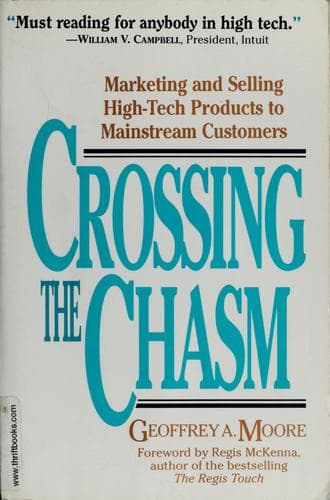
Crossing the Chasm
by Geoffrey A. Moore · Published 1991
The definitive account of why products that win over early adopters often die trying to reach the mainstream — the 'chasm' concept is still the standard vocabulary in B2B tech go-to-market planning.
What works
- The chasm concept correctly diagnoses a failure mode most startups don't see coming
- The 'bowling alley' beachhead-market strategy is a concrete, applicable go-to-market approach
What doesn't
- Written for enterprise B2B hardware/software of the early '90s; consumer and PLG-motion companies need to translate the framework
- Later editions bolt on updated examples somewhat awkwardly onto the original 1991 structure
Summary
Geoffrey Moore's book exists to explain a specific, repeated failure: technology products that win enthusiastic early customers and then stall, often fatally, on the way to a mainstream market. His diagnosis is that the standard technology adoption lifecycle — innovators, early adopters, early majority, late majority, laggards — is usually drawn as a smooth curve, and that this is wrong. There is a discontinuity between early adopters and the early majority, and Moore calls it the chasm.
The chasm exists because those two groups buy for incompatible reasons. Early adopters are visionaries: they buy a technology precisely because it is new and unproven, expecting it to give them a competitive advantage, and they will tolerate incompleteness to get it. The early majority are pragmatists: they buy to solve an existing operational problem, they want proof it works, and — critically — the reference they trust is another pragmatist in their own industry, not a visionary. So a company's early success generates exactly the wrong kind of reference for the customers it needs next.
Moore's prescription is the beachhead strategy. Rather than pursuing the mainstream market broadly, pick one narrowly defined pragmatist segment and dominate it completely — become the obvious, default, market-leading choice for that specific group and use case. Only then use that position as the reference base to move into adjacent segments, an approach he calls the bowling alley. The point of the narrowness is to reach the critical mass of satisfied pragmatist references that a pragmatist requires before buying, which is impossible if resources are spread thin across a broad market.
Key ideas
1. The chasm is a discontinuity, not a slope
The book's central structural claim is that the gap between early adopters and the early majority is qualitatively different from the other transitions on the curve. The other gaps are gradual; this one requires an entirely different sales motion, product completeness level, and reference base. A company that keeps doing what made it successful with visionaries will fail with pragmatists, and the failure looks like inexplicable stalling rather than obvious rejection.
The idea that the visionary is a good reference for the pragmatist is not just wrong — it is dangerously wrong.
2. Visionaries and pragmatists want opposite things
Moore's characterization of the two buyer types is the book's most transferable material. Visionaries want a competitive leap, will fund custom work, tolerate bugs, and are happy to be first. Pragmatists want a proven solution, want to be neither first nor last, care intensely about the whole product ecosystem — support, integrations, training, third-party services — and above all trust references from companies like their own.
Every part of a company must change to serve pragmatists: the sales pitch stops being about possibility and starts being about a specific solved problem; the product must be complete rather than promising; the marketing must demonstrate market leadership rather than novelty.
3. The beachhead and the whole product
The beachhead strategy is counter-intuitive because it means deliberately shrinking the addressable market at the exact moment growth pressure is highest. Moore's justification is arithmetic: pragmatists buy on references from peers, references accumulate only within a segment, and a fixed budget spread across ten segments produces critical mass in none.
Paired with this is the "whole product" concept — pragmatists buy the complete solution to their problem, not the core technology. A product that requires the customer to assemble the missing pieces themselves is a visionary product; making it a pragmatist product means supplying or partnering for everything around it.
4. Positioning for a market you intend to lead
Moore is explicit that pragmatists prefer market leaders, which creates a bootstrapping problem: you must be the leader to win them, and you need them to become leader. The beachhead resolves this by defining the market narrowly enough that leadership is actually achievable — being the clear leader in a small, specific segment is both attainable and sufficient, because that's the market the pragmatist is comparing within.
Who it's for
- B2B founders whose product has enthusiastic early users but stalled growth — this book names that exact situation.
- Product and go-to-market teams choosing a segment — the beachhead logic is directly applicable.
- Anyone confused about why glowing early customer feedback isn't converting into a market — the visionary/pragmatist distinction explains it.
- Investors evaluating whether a company has a real market or an enthusiast base — the framework is a useful diagnostic.
FAQ
Does the chasm apply to consumer products?
The underlying psychology does — mainstream consumers also want proof and social validation rather than novelty — but the mechanics differ considerably. Consumer adoption often runs on social proof at scale rather than industry-peer references, so the beachhead tactics need adapting.
Isn't focusing on one small segment risky?
Moore's argument is the reverse: spreading a limited budget across many segments guarantees you reach critical mass in none, which is the more reliable way to die. The narrowing is a concentration of force, not a reduction in ambition.
How does this relate to product-market fit?
Chasm-crossing is roughly the transition from early-adopter fit to mainstream-market fit. A company can have genuine product-market fit with visionaries and none at all with pragmatists, which is precisely the situation the book describes.
Is the original or a later edition better?
The core argument is identical across editions; later ones swap in more recent examples. If you can find whichever is available, the substance won't differ — the framework, not the case studies, is what you're reading it for.
What's the book's main weakness?
Its model assumes a deliberate, sales-led enterprise motion. It has little to say about products that spread through the users themselves, where the sequencing it recommends can actively work against the growth mechanism.
Was this useful?
Counts appear once there are 5 votes.