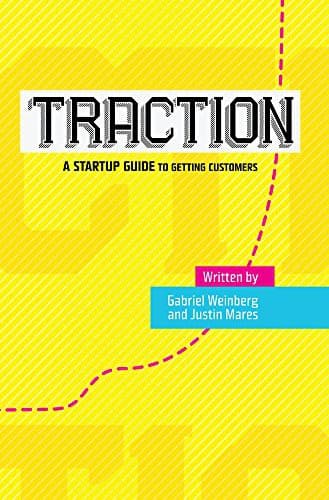
Traction
by Gabriel Weinberg & Justin Mares · Published 2015
The Bullseye Framework — systematically testing 19 traction channels before committing — is the most practical antidote to founders assuming they already know which channel will work.
What works
- The Bullseye Framework forces genuine experimentation instead of betting everything on a founder's gut-feel channel
- Channel-by-channel breakdown (SEO, PR, content, sales, etc.) gives concrete tactics, not just theory
What doesn't
- Some channel-specific tactics (particular ad platforms, PR tactics) are dated to the mid-2010s
- Best suited to venture-backed startups seeking rapid growth; less directly applicable to a bootstrapped small business
Summary
Gabriel Weinberg and Justin Mares start from a specific failure they observed repeatedly: startups die with a working product because nobody found a repeatable way to reach customers. Their claim is that distribution deserves the same rigour founders apply to building, and usually receives almost none.
Their central prescription is that founders should spend roughly half their time on traction from the beginning, in parallel with product work rather than after it. Waiting until the product is finished means discovering distribution problems at the point where runway is shortest.
The book enumerates nineteen traction channels — from SEO, content marketing and paid acquisition through to trade shows, offline ads, engineering as marketing, and community building — with a chapter each covering how the channel works and how to test it cheaply.
Holding it together is the Bullseye Framework, a process for deciding which channel to commit to: brainstorm every channel, rank them into outer, middle and inner rings, run cheap tests on the middle ring, then focus everything on the one that works.
Key ideas
1. The Bullseye Framework
The book's main contribution, and the reason it is still recommended. It is a process for a decision founders usually make by intuition.
The steps are deliberate. Brainstorm a plausible strategy for all nineteen channels, including the ones you consider irrelevant — the exercise is meant to surface options you dismissed without examining. Rank into three rings: promising, possible, long shot. Run cheap, time-boxed tests on the three in the middle ring. Then commit to the single channel showing traction.
The discipline is in the brainstorming step. Most founders test the two or three channels they already believe in, which guarantees they never discover the one that would have worked.
2. Usually one channel dominates
Weinberg and Mares argue that at any given stage, a startup's growth typically comes overwhelmingly from a single channel, not from a balanced portfolio.
This is why the framework converges rather than diversifying. Spreading effort across five channels usually produces five underdeveloped efforts, because each channel has enough depth that reaching competence takes real focus.
They also note that the dominant channel changes as a company grows, and that a channel saturating is a normal event rather than a failure — which means the testing process gets re-run, not abandoned.
3. Test cheaply before committing
The testing discipline is what separates this from channel advice generally. Tests should be small, fast and designed to answer specific questions: roughly what does a customer cost here, how many are available, and are they the right ones?
Their point is that a test is not a small version of a campaign. It is an experiment with a question attached, and it should be designed to be cheap enough that a negative result costs almost nothing.
This directly addresses the sunk-cost pattern in startup marketing, where teams keep investing in a channel because they have already invested in it rather than because it is working.
4. Nineteen channels, including the ones you dismissed
The channel chapters are the reference half of the book, and their value is largely in the unfamiliar ones.
Engineering as marketing — building free tools that attract your audience — is the most distinctive, and Weinberg's own DuckDuckGo used variants of it. Others include existing platforms, business development, affiliate programmes, targeting blogs, unconventional PR, trade shows and offline events.
The reason to read chapters for channels you will never use is that the brainstorming step requires knowing they exist. A founder who has never considered trade shows cannot rank them, and the ranking is where the framework does its work.
5. Set a traction goal and work backwards
They advise defining a specific, numeric traction goal tied to the company's actual next milestone — the users or revenue required to raise, or to reach sustainability — rather than a vague intention to grow.
Everything then gets evaluated against that number. A channel that cannot plausibly deliver the required volume is not worth testing, regardless of how appealing it is otherwise.
This is a useful filter because it eliminates channels that produce real but insufficient results, which are the hardest to abandon precisely because they are not failing.
Who it's for
- Founders before product-market fit — the parallel-effort argument matters most early.
- Technical founders — the channel taxonomy supplies vocabulary for an unfamiliar domain.
- Anyone stuck on one channel — the Bullseye process is designed to break exactly that.
- Early growth hires — it's a shared framework for arguing about where to spend.
FAQ
Is it still relevant given how much tactics have changed?
The framework is; specific tactics vary. Bullseye is a process for making a decision, and it works regardless of which platforms exist. Verify individual tactics against current sources.
Do I read all nineteen channel chapters?
Skim all of them once, read closely the ones your brainstorm surfaces. Skipping the unfamiliar chapters defeats the framework, since you cannot rank an option you do not know exists.
Does it work for bootstrapped businesses?
The framework does. Several channels assume venture-scale budgets, and the traction goals in the examples are calibrated to fundraising milestones rather than profitability.
How does it relate to The Lean Startup?
Complementary. Ries applies experimentation to the product; Weinberg and Mares apply the same discipline to distribution. Traction is the distribution half of that argument.
What's the single most useful part?
The brainstorming step. Being forced to write a plausible strategy for all nineteen channels, including the ones you dismissed, is where most founders find the option they had ruled out without examining.
Was this useful?
Counts appear once there are 5 votes.