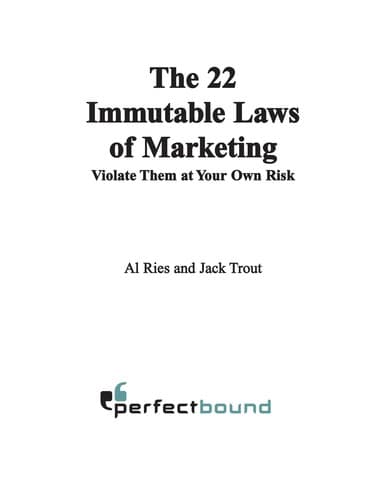
The 22 Immutable Laws of Marketing
by Al Ries & Jack Trout · Published 1993
Half of these 'laws' are genuinely durable positioning principles (the Law of the Category, the Law of the Mind); the other half are dated or contradicted by their own later examples — read selectively.
What works
- The Law of the Category and Law of Focus are genuinely useful, durable positioning lenses
- Short, punchy chapters make it fast to reference for a specific principle
What doesn't
- 'Immutable' has aged poorly — several laws are directly contradicted by successful brands since 1993
- The list format encourages treating marketing as a set of rules rather than a judgment call, which oversimplifies
Summary
Al Ries and Jack Trout distilled two decades of positioning work into twenty-two short chapters, each stating one "law" with a handful of supporting examples. The organizing conviction behind all of them is the one that made the authors' reputation: marketing is a battle of perceptions, not products. The better product does not reliably win; the product that occupies a clearer position in the customer's mind does.
The laws elaborate that thesis from several angles. Some are about category and mental ownership — being first into a category, or creating a new category you can be first in, or owning a single word in the prospect's mind. Some are about focus and sacrifice — that line extensions dilute the meaning of a brand, that trying to be everything to everyone produces a brand that means nothing. Others are about competitive dynamics, including the observation that in mature categories the market tends to settle into a two-horse race.
The book's format is its main strength and its main liability. Each chapter is short, blunt, and quotable, which makes the ideas stick and makes the book usable as a reference. But "immutable" has not aged gracefully — several laws have visible counterexamples among brands that succeeded after 1993 by doing precisely what the book forbids, and the authors' certainty leaves no room for the conditions under which a law might not hold.
Key ideas
1. The Law of Leadership and the Law of the Category
The first law states that it is better to be first than to be better, because the first entrant into a category tends to own it in the customer's mind and later entrants are measured against that reference. The second law is the escape hatch for everyone who wasn't first: if you can't be first in a category, define a new category you can be first in.
Marketing is not a battle of products, it's a battle of perceptions.
Taken together these are the book's most useful pair. The second in particular is a genuinely productive question to ask of any positioning problem — not "how do we beat the leader" but "what category are we the leader of?"
2. The Law of the Mind and the Law of Focus
The Law of the Mind sharpens the first law considerably: it is better to be first in the mind than first in the marketplace. Being technically earliest counts for nothing if a competitor established the mental position first, which is why the authors treat perception rather than chronology as the real terrain.
The Law of Focus follows from it — the most powerful thing a brand can do is own a single word in the prospect's mind. Owning a word requires giving up all the other words, which is the sacrifice most companies refuse to make, and the authors are consistent that refusing it is why most positioning fails.
3. The Law of Line Extension
Ries and Trout consider line extension the single most common and most destructive marketing error: taking a brand that means one specific thing and stretching it across additional products until it means nothing in particular. Their argument is that the short-term revenue from extension is real but the long-term cost — the erosion of the mental position that made the brand valuable — is larger and invisible on the quarter's numbers.
This is the law with the strongest supporting logic and also the one with the most prominent counterexamples, since several very large brands have extended successfully. The useful reading is as a genuine risk that requires justification, not an absolute prohibition.
4. The Law of Duality and the Law of Sacrifice
The Law of Duality observes that mature categories tend to converge on two dominant players, with everyone else fighting over the remainder — a pattern that recurs often enough to be worth planning around. The Law of Sacrifice states the general principle behind several of the others: you have to give something up to get something. Product line, target market, or constant change — a brand that gives up none of these gets no position at all.
Who it's for
- Anyone whose brand tries to say too many things at once — the focus and sacrifice laws diagnose that directly.
- Founders choosing a category to compete in — the Law of the Category is the most actionable idea here.
- Marketers who want a fast, quotable reference — the format makes it easy to look up one principle.
- Anyone considering a brand extension — read the line-extension chapter before deciding, if only to be forced to justify it.
FAQ
Are the laws actually immutable?
No, and this is the fairest criticism of the book. Several have visible counterexamples, particularly the line-extension law. They're better understood as strong default heuristics that need justification to override, not physical constants.
Should I read this or Positioning?
Positioning is the fuller argument with more supporting reasoning; this is the compressed, list-form version. If you want to genuinely understand positioning, read Positioning; if you want a quick reference to specific principles, this is faster.
Which law is most useful in practice?
The Law of the Category — if you can't be first in an existing category, create one you can be first in. It reframes a losing competitive question into a solvable positioning question, and it applies at almost any scale.
Does this apply to personal brands and small businesses?
Yes, and arguably better than to large corporations. Focus and sacrifice are far easier to execute when you're not defending an existing portfolio, and owning one word in a small market is realistically achievable.
What's the book's main weakness?
Its certainty combined with its brevity. Each law is asserted without the conditions under which it holds, so a reader gets a set of rules with no guidance on when they conflict or when the situation is an exception — which is precisely when marketing judgment is actually needed.
Was this useful?
Counts appear once there are 5 votes.