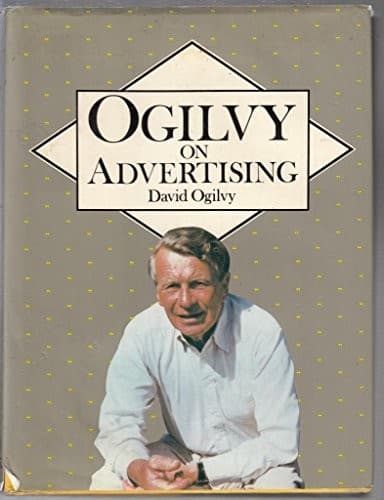
Ogilvy on Advertising
by David Ogilvy · Published 1983
The closest thing advertising has to a founding text — opinionated, occasionally arrogant, but the headline and copywriting principles hold up decades later because they're grounded in what actually sold, not theory.
What works
- Grounded in decades of Ogilvy's own tested, results-driven campaigns rather than abstract theory
- Headline-writing and copy principles remain directly applicable to digital marketing today
What doesn't
- Ogilvy's confident, prescriptive tone occasionally reads as dated or overconfident by modern standards
- Written entirely for print/TV-era advertising — needs translation for digital-native formats
Summary
David Ogilvy wrote this in 1983, near the end of a career in which he built Ogilvy & Mather from nothing into one of the world's largest agencies. The book is unusual for its genre in that it is almost entirely prescriptive: Ogilvy tells you what works, states it flatly, and grounds it in results rather than theory. His authority for doing so comes from an earlier career running Gallup's research operation, which shaped a lifelong conviction that advertising claims should be settled by measurement rather than by whoever argues most confidently in the room.
The central tension the book returns to is between advertising that wins creative awards and advertising that sells. Ogilvy is unambiguous that the second is the only legitimate goal, and much of the book is an attack on agencies and creative directors who had, in his view, forgotten this. His famous formulation — "if it doesn't sell, it isn't creative" — is not a rhetorical flourish but the organizing principle of the whole book.
Structurally it works as a practitioner's manual with chapters on writing headlines and body copy, making television commercials, direct response, corporate advertising, running an agency, and getting hired. The direct-response chapters are the ones that have aged best, because Ogilvy regarded direct response as the only branch of advertising where results were unambiguously measurable — and that discipline is the direct ancestor of modern digital performance marketing.
Key ideas
1. The headline carries most of the value
Ogilvy's most-repeated finding is that roughly five times as many people read the headline as read the body copy — so a weak headline wastes most of what the advertisement cost. His practical rules follow from this: include the benefit, include the brand name where possible, avoid clever wordplay that obscures meaning, and don't set headlines in all capitals because it slows reading.
When you have written your headline, you have spent eighty cents out of your dollar.
These translate almost directly to modern contexts — email subject lines, page titles, ad headlines — because the underlying constraint hasn't changed: most people read the first line and decide there.
2. Research over opinion
Ogilvy's Gallup background produced the book's most durable methodological stance: advertising decisions should be settled by evidence. He documents specific tested findings — that photographs outperform illustrations, that captions under images are read far more than body copy, that certain layout choices measurably change readership — and presents them as facts to be used rather than preferences to be argued about.
This is why the book survives its own era better than its contemporaries. The specific findings may not all replicate, but the posture — test it, don't assert it — is exactly the posture modern performance marketing operates from.
3. Long copy sells, when there is something to say
Ogilvy argues against the assumption that shorter is always better. His position is that people who are genuinely considering a purchase want information, and that copy length should be governed by how much a prospect needs to know rather than by an aesthetic preference for brevity. He backs this with tested campaigns where longer copy outperformed short.
The nuance often lost in the retelling is that this applies to a motivated reader considering a real decision. Ogilvy is not arguing that length is a virtue in itself, which is why the principle transfers well to landing pages and product detail and poorly to display advertising.
4. Brand image as a long-term asset
Ogilvy was among the first to argue systematically that every advertisement contributes to a cumulative brand image, and that inconsistency destroys value built over years. His argument is that advertising should be judged on its contribution to that long-term asset as well as on immediate response — a company changing its positioning every campaign is spending money to erase its own prior spending.
Who it's for
- Anyone writing copy that has to produce a result — the headline and body-copy chapters are still directly usable.
- Performance and direct-response marketers — this is the intellectual origin of the discipline.
- Founders writing their own marketing material — the rules are concrete enough to apply without an agency.
- Anyone interested in advertising history from a primary source — Ogilvy was a participant, not a commentator.
FAQ
Is this still useful given it predates digital advertising?
The principles largely are — headlines, benefit-led copy, evidence over opinion, and brand consistency all transfer cleanly. What doesn't transfer is anything media-specific: production advice for television, media buying, and the mechanics of print layout are historical.
Should I read this or Confessions of an Advertising Man?
Confessions (1963) is more about running an agency and Ogilvy's own career; Ogilvy on Advertising is the more practical craft manual. If you want to write better advertising, this is the one.
Does the "long copy sells" advice apply online?
Selectively. It holds where a reader has already shown intent and wants detail — landing pages, product pages, sales letters. It doesn't hold for interruptive formats where attention is involuntary and brief, which is most social and display advertising.
How does it compare to The Copywriter's Handbook?
Bly's book is more of a working reference with formulas and checklists; Ogilvy's is more opinionated and strategic, closer to a philosophy of the craft. They complement each other well, with Bly the more immediately practical of the two.
What's the book's main weakness?
Its certainty. Ogilvy presents tested findings and personal conviction in the same declarative register, so a reader can't easily tell which claims rest on research and which rest on his taste — and the research that does exist is decades-old print work.
Was this useful?
Counts appear once there are 5 votes.