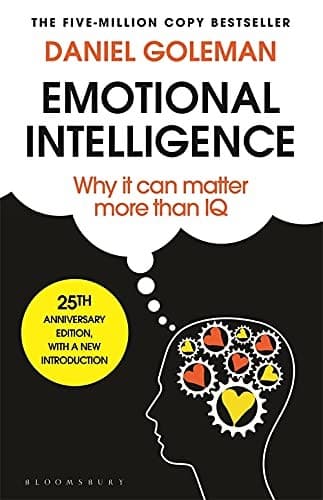
Emotional Intelligence
by Daniel Goleman · Published 1995
The book that put 'EQ' into the popular vocabulary — genuinely valuable at reframing what predicts success beyond IQ, though Goleman's claims about EQ's predictive power outran the research he was citing.
What works
- Genuinely reframed a generation's thinking about what 'intelligence' predicts success
- Practical, relatable examples across parenting, relationships, and workplace behavior
What doesn't
- Goleman's claims about EQ's predictive power for life outcomes outpaced the actual research base at the time
- As a 1995 book, some of the neuroscience it cites has since been refined or superseded
Summary
Daniel Goleman's 1995 book took a concept that existed in academic psychology — emotional intelligence, formalized a few years earlier by Peter Salovey and John Mayer — and made it a mainstream idea. His organizing argument is that IQ is a poor predictor of life outcomes on its own, and that a separate cluster of abilities involving the recognition and management of emotion accounts for a substantial part of what IQ misses.
Goleman divides that cluster into five components: self-awareness (recognizing your own emotions as they occur), self-regulation (managing them rather than being driven by them), motivation (persisting toward goals through setbacks), empathy (recognizing emotion in others), and social skill (managing relationships and influence). He grounds these in the neuroscience available at the time, particularly Joseph LeDoux's work on the amygdala's fast, pre-cortical threat pathway — the basis of Goleman's widely borrowed phrase "amygdala hijack" for emotional reactions that fire before conscious thought can intervene.
The book's second half applies the framework to domains: family life and how children learn emotional regulation from parents, schooling and the case for teaching these skills explicitly, workplaces and leadership, and health. It closes with an argument for emotional literacy as a subject in its own right — a proposal that has since had real influence on school curricula in several countries, which makes this one of the more consequential popular psychology books of its era regardless of how its specific claims have held up.
Key ideas
1. The amygdala hijack
Goleman's most durable contribution to general vocabulary is his popularization of LeDoux's finding that sensory information reaches the amygdala via a fast pathway that bypasses the neocortex. This means an emotional response can begin before the thinking brain has processed what's happening — which explains, mechanistically, the experience of reacting and only afterwards understanding why.
In a very real sense we have two minds, one that thinks and one that feels.
The practical value is that it reframes emotional overreaction as a timing problem rather than a character flaw, and points at the actual intervention: creating a delay between the trigger and the response, since the cortex needs time it doesn't automatically get.
2. Self-awareness as the foundational skill
Goleman treats self-awareness as prior to everything else in the model — you cannot regulate an emotion you haven't noticed. His argument is that people vary widely in how accurately and how quickly they identify their own emotional states, and that this variation predicts a great deal about how well they handle the states themselves.
This is the part of the framework that has held up best and that most later work builds on, including much of the practical material on labeling emotions as a regulation technique.
3. Delayed gratification and the marshmallow study
Goleman draws heavily on Walter Mischel's marshmallow experiments, in which children who could wait for a larger reward were reported to show better outcomes years later. He uses this as evidence that impulse control is both measurable early and consequential over a lifetime.
This section requires the most caution from a modern reader. Later large-scale replications found the effect substantially smaller than originally reported, and much of the apparent predictive power was explained by socioeconomic background rather than by impulse control itself. The underlying point about self-regulation mattering isn't wrong, but the strength Goleman assigns to it here is not supported.
4. Emotional literacy as something teachable
The book's most consequential practical claim is that these skills can be taught explicitly, and that schools are the natural place to do it. Goleman describes programs that teach children to identify emotions, understand others' perspectives, and resolve conflict, reporting improvements in behavior and academic performance.
This argument has had genuine real-world influence — social and emotional learning is now a standard component of curricula in many school systems, a lineage that traces substantially to this book.
Who it's for
- Managers and leaders — the self-regulation and empathy material maps directly onto everyday people problems.
- Parents — the chapters on how children acquire emotional regulation from caregivers are among the book's strongest.
- Anyone who reacts faster than they'd like — the amygdala-hijack framing gives a mechanism and a point of intervention.
- Readers wanting the origin of a term they hear constantly — this is where "EQ" entered general usage.
FAQ
Did Goleman invent the concept of emotional intelligence?
No — Peter Salovey and John Mayer formalized it in academic psychology in 1990. Goleman's contribution was synthesizing it with neuroscience and bringing it to a mass audience, which is why the popular concept is associated with him rather than them.
Is the claim that EQ matters more than IQ true?
Not as stated. The research supports emotional skills mattering for outcomes IQ doesn't capture, but the specific claim that EQ is the more powerful predictor was stronger than the evidence then and has not been supported since.
Can emotional intelligence actually be improved?
The evidence suggests yes, more so than IQ — self-awareness and regulation in particular respond to deliberate practice. That claim is on firmer ground than the book's predictive assertions.
Should I read this or a more recent book?
Read this for the framework and vocabulary, which remain the common reference point. For current evidence on emotion regulation specifically, more recent work is a better guide.
What's the book's main weakness?
It overstates its case. Goleman assembles genuine findings into a claim about predictive power that the underlying studies didn't support, and several of his headline examples — the marshmallow test above all — rest on results that have since been substantially revised.
Was this useful?
Counts appear once there are 5 votes.