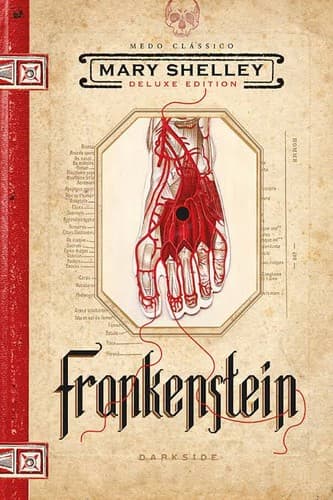
Frankenstein
by Mary Shelley · Published 1818
Written by an 18-year-old and still the founding text of science fiction — a novel about the responsibility a creator owes their creation that remains more relevant with every new technology humans build and abandon.
What works
- Genuinely ahead of its time — Shelley wrote the template for 'scientist creates something they can't control' two centuries before it became a genre staple
- The Creature's own eloquent narration (often cut from film adaptations) is the novel's most philosophically serious section
What doesn't
- Popular culture's monster-movie image of the Creature has almost nothing to do with the actual novel, which is a real barrier to first encountering the text on its own terms
- The nested frame narrative (letters within a narrative within a narrative) can feel structurally clunky to a modern reader
Summary
Mary Shelley was eighteen when she began Frankenstein, during the famously cold summer of 1816 at Lake Geneva, in a ghost-story competition with Byron and Percy Shelley. The two celebrated poets produced nothing that lasted. She produced the founding text of science fiction.
Victor Frankenstein, a student obsessed with the boundary between living and dead matter, assembles a being and animates it. The novel's decisive move happens immediately afterwards: he looks at what he has made, is revolted, and runs out of the room. Everything that follows proceeds from that abandonment rather than from the act of creation.
The Creature teaches himself language and reading by observing a family through a wall, discovers what he is, and asks Victor for one thing — a companion like himself. Victor agrees, begins, then destroys the second creature half-finished. The Creature's response is to systematically remove everyone Victor loves, and the two pursue each other to the Arctic, where the frame narrative that opened the book closes around them.
Its durability comes from the fact that the horror is not the Creature. Shelley wrote a novel in which the monster is articulate, reasons carefully, and makes a moral case the text never fully refutes — while the scientist responds to consequence by fleeing it, repeatedly, until everyone else has paid.
Key ideas
1. The subject is abandonment, not creation
Popular shorthand treats the novel as a warning against playing God. The text is more specific than that. Victor's transgression is not that he creates life; it is that he creates a conscious being and then declines every subsequent obligation to it.
The Creature is born without malice. He is benevolent, curious, and desperate for connection, and becomes violent only after sustained rejection — first by his maker, then by everyone whose face he encounters. Shelley constructs his moral decline as a sequence of causes rather than an essence.
This is what makes the book keep finding new relevance. Every technology built and then released without responsibility for its behaviour re-enacts the same structure, and the novel's question — what does a creator owe the thing they made? — has not become easier to answer.
2. The Creature's own narration is the philosophical core
At the centre of the novel, the Creature takes over the telling for several chapters, and this section is where the book does its most serious thinking. He describes learning language, encountering Paradise Lost, and recognizing himself in Satan rather than Adam — created, then cast out.
His argument to Victor is uncomfortably strong: he did not ask to exist, he was made deliberately and then discarded, and his request for a companion is proportionate. Victor's refusal is grounded in fear about consequences he has not thought through, which is precisely the failing that produced the situation.
Almost every film adaptation cuts this section, replacing an eloquent interlocutor with a grunting figure. That single change inverts the novel's meaning, which is why people who know the films often find the book unrecognizable.
3. Victor is the novel's actual moral problem
Victor is not a mad scientist in the later sense. He is intelligent, well-loved, and continually presented with chances to act correctly. He fails at each one, and the failures are recognizably ordinary — avoidance, self-pity, an inability to say aloud what he has done.
His most consequential silence is at Justine's trial, where a servant is executed for a murder he knows the Creature committed. Speaking would cost him his reputation; staying quiet costs an innocent woman her life. He stays quiet, and narrates his own suffering about it at length.
Shelley gives him the whole outer frame in which to justify himself, and the effect of that generosity is damning: the more he explains, the worse he looks.
4. The frame narrative sets the terms
The novel opens with letters from Robert Walton, an explorer pushing his crew toward the North Pole in pursuit of glory. He finds Victor on the ice, and Victor's story is told into that frame.
This is not decoration. Walton is a second Victor, earlier in the arc — ambitious, isolated, willing to risk other people for discovery. Victor's story functions as a warning delivered to someone still able to turn back, and Walton does turn back, under pressure from his crew.
Reading the frame as filler loses the structure's whole argument, which is that the pattern is general rather than a single man's aberration.
5. Ambition without limit is the era's anxiety, precisely dated
The novel arrives in 1818, amid galvanism experiments applying electricity to corpses and a broader unease about where the sciences were heading. Shelley is not anti-science, and Victor's early enthusiasm is rendered sympathetically.
What the book targets is ambition detached from responsibility for outcomes — the researcher who solves the interesting problem and treats what happens next as someone else's department.
Two centuries on, this remains the most quoted framing in debates about emerging technology, and unusually for such analogies, it is a fair use of the source rather than a misreading of it.
Who it's for
- Anyone working on powerful technology — it is the canonical treatment of responsibility for what you build, and it earns the reputation.
- Readers who only know the films — the novel and the monster-movie tradition share almost nothing beyond a name.
- Anyone interested in the origins of science fiction — this is where the genre's central question starts.
- Readers who like a genuinely arguable moral case — the Creature's argument is stronger than most readers expect going in.
FAQ
Is Frankenstein the monster or the scientist?
Frankenstein is the scientist; the Creature is never named. The persistent confusion is arguably fitting, since the novel's argument is that the maker bears the responsibility — but as a matter of the text, Victor Frankenstein is the man who builds and abandons.
Is it actually the first science fiction novel?
It's the most defensible candidate, and the usual scholarly answer. Earlier fantastical voyages exist, but Shelley's is the first major novel where the wonder comes from a scientific procedure and the story concerns its consequences rather than its marvel.
Is the Creature meant to be sympathetic?
Substantially, yes — and this is the sharpest difference from the films. He is eloquent, self-educated and reasons carefully about his own situation, and the novel gives him space to make his case rather than treating him as a force of nature.
How hard is the prose for a modern reader?
Moderately hard. The sentences are long and the register is early nineteenth-century formal, but the vocabulary is not obscure. The bigger adjustment is pacing — extended reflection where a contemporary novel would cut.
Which edition should I read, 1818 or 1831?
The 1818 text is the more common scholarly preference. Shelley's 1831 revision softens Victor's culpability and adds more fatalistic framing, which blunts precisely the argument that makes the novel interesting.
Was this useful?
Counts appear once there are 5 votes.