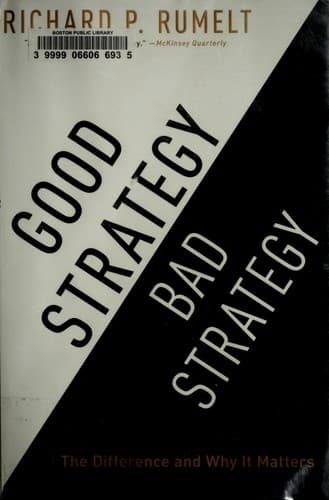
Good Strategy Bad Strategy
by Richard Rumelt · Published 2011
The clearest existing definition of what a strategy actually is — a diagnosis, a guiding policy, and coherent action — and a ruthless catalogue of the fluff that gets mistaken for one.
What works
- Names 'bad strategy' patterns (fluff, dodging the real problem, mistaking goals for strategy) precisely enough to self-diagnose
- Real corporate case studies, not hypotheticals
What doesn't
- Examples skew toward large enterprises; a solo founder has to do translation work
- Repetitive in the middle third once the core framework is established
Summary
Richard Rumelt opens with a provocation: most of what passes for "strategy" in business, government, and even the military isn't strategy at all. It's a wish dressed up in a PowerPoint deck — a target, a slogan, an aspiration for growth or excellence, with no actual account of how to get there. Rumelt calls this "bad strategy," and his central claim is that it isn't a minor failure of execution. It's a category error: mistaking a statement of what you want for a plan of what to do.
Good strategy, by contrast, has a specific internal shape that Rumelt calls the kernel: a diagnosis that names the actual nature of the challenge, a guiding policy for dealing with it, and a set of coherent actions that carry the policy out. The diagnosis is the load-bearing piece. Most bad strategy fails here first — leaders reach for a goal before they've honestly named the obstacle in the way, so the "strategy" that follows is really just the goal restated with more syllables.
The rest of the book is a working demonstration of the kernel against real cases: a strategy consultant's own turnaround work, Nvidia's early positioning against entrenched incumbents, General Electric under Jack Welch, and Rumelt's memorable teardown of a hospital system's "strategic plan" that consisted entirely of ambitions with the word "strategic" bolted onto them. The book's usefulness is less in the framework itself — diagnosis, policy, action is not a complicated idea — and more in the extended, specific catalogue of what bad strategy actually looks like in the wild, so a reader can recognize it in their own organization's planning documents.
Key ideas
1. Bad strategy has a recognizable anatomy
Rumelt names four specific hallmarks of bad strategy, and the specificity is the point — vague warnings against "bad planning" are useless, but a checklist is not. The first is fluff: restating a simple idea in complicated language to create an impression of sophisticated thought where none exists. The second is failure to face the challenge: a strategy that never actually diagnoses the obstacle can't be judged as good or bad, because there's nothing to evaluate it against. The third is mistaking goals for strategy — "increase market share by 20%" is a target, not a plan for hitting it. The fourth is bad strategic objectives: a long list of unprioritized, incoherent goals that don't build on each other or focus resources anywhere in particular.
Bad strategy is not simply the absence of good strategy... it flourishes because it floats above analysis, logic, and choice.
What makes this list genuinely useful rather than just a taxonomy is that all four failure modes share a root cause: avoidance of the hard, specific work of choosing. Fluff, goal-substitution, and unprioritized wish lists are all ways of producing a document that looks like a plan without anyone having to make the uncomfortable trade-offs a real one requires.
2. The kernel: diagnosis, guiding policy, coherent action
A good strategy's structure is simple to state and hard to execute. The diagnosis simplifies a complex, tangled reality into a specific challenge — not by ignoring complexity, but by identifying which aspects of the situation are actually critical. The guiding policy is an overall approach for dealing with that diagnosed challenge — a broad but directional choice, not yet a to-do list. Coherent action is where the policy becomes specific, coordinated steps that reinforce each other rather than working at cross-purposes.
The word Rumelt returns to most is "coherent." A common failure at large organizations isn't a lack of good individual initiatives — it's a portfolio of decent initiatives that don't add up to anything because they weren't designed to reinforce a single diagnosis. Coherence is what turns a list of good ideas into a strategy.
3. The power of a proximate objective
Rumelt argues that ambitious, distant, poorly specified goals are strategically useless — they don't tell anyone what to do differently on Monday morning. A proximate objective, by contrast, is close enough to current reality to be tackled with reasonable confidence, and achieving it changes the position from which the next objective becomes reachable. His example is the U.S. push to put a man on the Moon: broken into a sequence of proximate, solvable engineering objectives, not attempted as one undifferentiated leap.
This idea directly counters a common instinct in ambitious organizations, where leadership sets an inspiring long-range target and assumes the specifics will sort themselves out downstream. Rumelt's argument is that the specifics are the strategy — an inspiring target without a proximate first move is exactly the kind of "bad strategic objective" the book opens by diagnosing.
4. Sources of power: leverage, focus, and using advantage
The book's second half catalogues recurring sources of strategic power — places a good diagnosis tends to point toward. Leverage is finding the point where a small, well-aimed action produces a disproportionate effect, rather than spreading effort evenly across a broad front. Focus is the discipline of concentrating resources on a specific target rather than diffusing them, even when diffusion feels safer. Rumelt is explicit that using existing advantage — technical, positional, reputational — is usually a stronger strategic lever than trying to build an entirely new one from scratch, which is why so many of his case studies involve a company recognizing and exploiting a strength it already had rather than starting from zero.
Who it's for
- Anyone who has sat through a "strategic planning" offsite that produced a slogan and a list of goals — the book gives precise language for naming what went wrong.
- Founders and product leads deciding where to focus limited resources — the leverage and focus chapters are directly applicable to a resource-constrained team.
- Anyone evaluating someone else's strategy document — the four hallmarks of bad strategy function as a genuinely usable diagnostic checklist.
- Students of strategy who want the academic rigor of Porter without the textbook density — Rumelt writes for practitioners, not for an MBA syllabus.
FAQ
Is this the same as Michael Porter's competitive strategy framework?
No — they're complementary, not competing. Porter's Five Forces is an analytical tool for understanding an industry's structure; Rumelt's kernel is about the internal logic a strategy document needs to have to count as a strategy at all. You can use Porter's framework as part of Rumelt's "diagnosis" step.
Does this apply outside of large corporations?
Yes, and arguably more usefully at smaller scale. A startup or small team has fewer resources to waste on fluff and unprioritized goal lists, so the discipline of a real diagnosis and a focused guiding policy matters even more than in a large company that can absorb strategic mistakes.
What's the single most useful idea if I only remember one thing?
The four hallmarks of bad strategy — fluff, failure to face the challenge, mistaking goals for strategy, and bad strategic objectives. That checklist alone is enough to catch most of what passes for strategy in most organizations.
Is the book more theoretical or example-driven?
Heavily example-driven. Rumelt walks through real, named cases (Nvidia, General Electric, a real hospital system's planning document) rather than staying at the level of abstract principle, which is part of why the diagnosis translates so directly to a reader's own organization.
What's the book's main weakness?
It's much better at showing you what bad strategy looks like than at giving you a repeatable process for consistently generating good strategy — the diagnosis step in particular depends on judgment and insight that the book can illustrate but not fully teach.
Was this useful?
Counts appear once there are 5 votes.