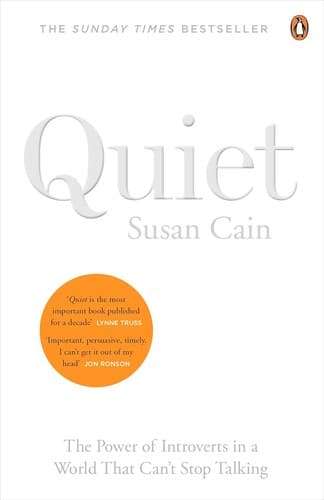
Quiet
by Susan Cain · Published 2012
A rigorous, well-argued case that introversion is a genuine, valuable temperament rather than a deficiency to be trained out — reshaped how workplaces and schools talk about quiet people.
What works
- Genuinely well-researched, drawing on real psychology rather than self-help generalization
- Practical implications for workplace/team design that many companies actually adopted after this book
What doesn't
- The introvert/extrovert framing is somewhat binary; more recent temperament research treats it as more of a spectrum with more dimensions
- Some chapters lean anecdotal (individual case profiles) where the reader may want more data
Summary
Susan Cain's argument begins with a historical claim: Western culture, and American culture in particular, underwent a shift roughly a century ago from what cultural historians call a "culture of character" to a "culture of personality." Being good became less important than being magnetic, and the traits rewarded shifted toward the outwardly expressive. Cain traces this through the rise of sales as a profession, the self-help industry, and eventually corporate and educational structures built around visible participation.
Against that backdrop she argues that introversion — which she carefully distinguishes from shyness — is a legitimate temperament with real advantages, not a deficiency to be corrected. Introversion in her usage is about where a person's energy comes from and what level of stimulation they function best at, not about social anxiety or dislike of people. Roughly a third to a half of the population sits on that side of the spectrum, and Cain's argument is that institutions designed exclusively around the other half waste a great deal of that population's capability.
The evidence spans developmental psychology (Jerome Kagan's longitudinal work on high-reactive infants, which found early temperament partially predicts adult disposition), studies on group brainstorming showing individuals working alone often produce better ideas than groups, and research on deliberate practice suggesting that solitary work is where expertise is actually built. The applied chapters cover open-plan offices, classroom participation grading, leadership styles, and how introvert-extrovert pairs navigate relationships.
Key ideas
1. Introversion is about stimulation, not sociability
Cain's most clarifying move is separating introversion from shyness. Shyness is fear of social judgment; introversion is a preference for lower-stimulation environments. The two often get conflated because they can look similar from outside, but an introvert can be socially confident and simply depleted by prolonged interaction, while a shy person may crave social contact they find frightening.
There's zero correlation between being the best talker and having the best ideas.
This distinction matters practically: the interventions differ completely. Shyness may warrant treatment; introversion warrants environmental accommodation.
2. The Extrovert Ideal and its institutional consequences
Cain uses "the Extrovert Ideal" for the assumption that the ideal self is gregarious, comfortable in the spotlight, and quick to speak. Her argument is that this assumption is embedded in institutional design — open-plan offices, group work as default pedagogy, participation-based grading, hiring processes that reward interview performance — and that these choices are rarely examined because the preference they encode is invisible to the people who share it.
The book's most concrete institutional critique is of open-plan offices and group brainstorming, both of which she argues the research does not support as productivity measures, despite their near-universal adoption.
3. Groups often produce worse ideas than individuals
Cain draws on decades of research finding that brainstorming groups typically generate fewer and lower-quality ideas than the same number of people working alone and pooling results afterwards. The mechanisms include production blocking (only one person can speak at a time), evaluation apprehension, and social loafing.
Her recommendation isn't to abolish collaboration but to restructure it — individual work first, then group evaluation — which preserves the genuine benefits of collective judgment without the losses that unstructured group ideation produces.
4. Free trait theory: acting out of character, within limits
Cain adopts Brian Little's free trait theory, which holds that people can and do act out of character in service of things they care about — an introvert can be a compelling public speaker for a cause that matters to them. The important qualifier is that this is effortful and depleting, and requires what Little calls "restorative niches": planned recovery time.
This is the book's most practically useful framework, because it avoids both essentialism (temperament is destiny) and denial (temperament doesn't matter), and gives a realistic model for operating outside your default.
Who it's for
- Introverts who have been told to be more outgoing — the book's core value for many readers is validation with evidence behind it.
- Managers and team leads — the material on meetings, brainstorming and office design has direct application.
- Parents and teachers — the chapters on quiet children and classroom design are among the strongest.
- Extroverts working with introverts — arguably the more useful audience, since the accommodations described are ones they control.
FAQ
What's the difference between introversion and shyness?
Shyness is fear of negative social judgment; introversion is a preference for lower-stimulation environments. They frequently co-occur but are independent — you can be a socially confident introvert or a shy extrovert who wants contact but fears it.
Can introverts become extroverts?
Not fundamentally, but free trait theory holds that anyone can act outside their temperament for something they care about. The cost is that it's depleting and requires deliberate recovery, which is a more realistic model than either "change yourself" or "you can't."
Does it say extroversion is bad?
No. Cain's argument is that both temperaments have real strengths and that institutions currently optimize almost exclusively for one. The critique is of a monoculture, not of extroverts.
Is the science reliable?
The core findings — Kagan's high-reactivity work, the brainstorming research — are well established. The broader cultural-history argument is more interpretive, and the binary framing is a simplification of how personality research actually models these traits.
What's the book's main weakness?
It argues one side well rather than weighing both. Given that its purpose was to correct an imbalance, that's defensible, but a reader looking for a neutral account of temperament research will find the selection noticeably tilted.
Was this useful?
Counts appear once there are 5 votes.