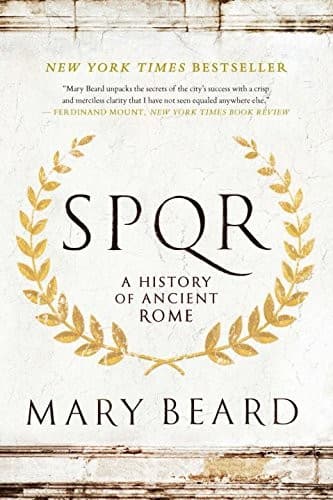
SPQR
by Mary Beard · Published 2015
Beard's history of Rome deliberately foregrounds ordinary Romans and how we actually know what we claim to know — less a chronicle of emperors, more an argument about the limits and uses of ancient evidence.
What works
- Unusually honest about the limits of historical evidence — Beard tells you what we don't actually know, not just what we do
- Balances political/military history with the lived experience of ordinary Romans, freedmen, and slaves
What doesn't
- Ends deliberately at 212 CE, well before Rome's more commonly known later decline — readers wanting the fall of Rome need a different book
- Beard's academic caution and constant caveating can feel like it withholds firm narrative payoff at times
Summary
SPQR covers roughly a thousand years, from the founding myths to 212 CE, when the emperor Caracalla granted citizenship to every free inhabitant of the empire. Mary Beard chooses that endpoint deliberately: it is the moment "Roman" stops meaning a person from a particular city and becomes a legal category spanning three continents.
The book opens not at the beginning but in 63 BCE, with Cicero and the Catiline conspiracy — a choice that lets Beard start where the evidence is richest and work outward in both directions. The early chapters on Romulus and the kings are handled as what they are: stories Romans told themselves about their origins, valuable as evidence of Roman self-understanding rather than as history.
Alongside the familiar political narrative — the Republic, the civil wars, Augustus, the emperors — runs a persistent second thread about ordinary life. Who lived in the apartment blocks, what they ate, what slavery actually involved day to day, what a freedman's social position was, and what the graffiti at Pompeii tells us that the senatorial histories do not.
Running through both is the book's real argument, which is methodological. Beard is continually explicit about how we know what we claim to know, which sources survive, who wrote them, and what they had reason to distort — and she is equally explicit when the honest answer is that we do not know.
Key ideas
1. The evidence problem is the subject, not a preface to it
Most popular Roman history presents a smooth narrative and keeps the scaffolding hidden. Beard leaves it visible throughout, and this is the book's distinguishing feature.
She notes repeatedly that our sources are overwhelmingly written by a tiny elite of adult male citizens, often centuries after the events, with clear political motives. Tacitus and Suetonius on the early emperors are compelling reading and were writing well after the fact, in a genre that rewarded lurid detail.
The result is a history that teaches you to hold claims at appropriate confidence. When Beard says something is uncertain, that is not hedging — it is the actual state of knowledge, and most books simply decline to tell you.
2. Rome had no plan, and the empire was largely accidental
A recurring correction is that Roman expansion was not the execution of a strategy. There was no master plan for world conquest; there was a sequence of local wars, each generating the conditions for the next, driven by an aristocratic culture in which military success was the main route to political standing.
Beard is careful about the mechanics — the way alliances obligated Rome into further conflicts, the way conquest funded the next campaign, the way generals needed victories to compete at home.
This matters because the alternative reading, of Rome as uniquely destined or uniquely competent, is precisely the story Romans told about themselves, and it survives in a lot of popular history. The book is an argument against taking a civilization's self-image as analysis.
3. Ordinary Romans get equal standing
The chapters on daily life are where the book departs furthest from the emperor-focused tradition. Beard reconstructs tenement living, bar culture, the economics of the grain dole, and the position of freedmen — former slaves who could become wealthy while remaining socially marked.
Slavery is treated without euphemism and without turning it into a footnote. It was foundational to the economy, enormous in scale, and Roman manumission practices were unusual — a freed slave became a citizen, which makes Roman slavery structurally different from later Atlantic systems without making it less brutal.
Pompeii's graffiti does a lot of work here, precisely because it is the rare source not written by the elite. It is also, characteristically, where Beard notes how much interpretive weight a handful of scratched walls is being asked to bear.
4. Citizenship was Rome's genuinely unusual institution
Beard identifies the extension of citizenship as the thing that most distinguishes Rome from comparable ancient powers. Athens guarded citizenship jealously; Rome kept widening it, first to Italian allies after a war fought over precisely that question, eventually to the whole empire.
This is why the book ends in 212 CE. Caracalla's edict is the logical conclusion of a centuries-long process, and Beard argues it is a more meaningful endpoint than any battle.
The comparison to modern debates is available without her forcing it. A polity that expands membership rather than defending a narrow definition of it behaves differently, and lasts differently.
5. The emperors matter less than the system
Beard deliberately deflates the biographical approach to imperial history. Whether a given emperor was mad, cruel or capable made less difference to most inhabitants than the administrative machinery that continued regardless.
She notes that the lurid stories about Caligula and Nero come from hostile sources with strong reasons to discredit them, and that the empire's actual functioning — taxation, law, the army, provincial government — was remarkably stable across wildly different personalities at the top.
This is a useful corrective to a genre that often reads as court gossip, though it is also the source of the book's most common complaint: readers who came for the emperors find them decentred.
Who it's for
- Anyone wanting one serious book on Rome — this is the strongest current single-volume option for a general reader.
- Readers who care how history is made — the methodological transparency is genuinely educational beyond the subject.
- Anyone interested in ordinary ancient life — the non-elite material is unusually well handled.
- Readers tired of great-man narratives — the system, not the personalities, is the focus.
FAQ
Do I need prior knowledge of Roman history?
No. Beard writes for a general reader and explains what's needed as she goes. Some familiarity with the broad shape — Republic, then emperors — makes the early chapters easier, but it isn't assumed.
Why does it stop at 212 CE?
Because Caracalla's extension of citizenship to all free inhabitants is, in Beard's argument, the natural conclusion of Rome's most distinctive institution. She treats it as a more meaningful endpoint than the later decline.
Is it dry?
No — the prose is lively and often funny. What it isn't is dramatic in the narrative-history sense, because Beard keeps interrupting the story to examine the evidence behind it.
How does it compare to narrative histories of Rome?
It trades momentum for reliability. A narrative history gives you a compelling sequence of events; SPQR gives you that sequence plus a running account of how much of it we can actually support.
What does the title mean?
Senatus Populusque Romanus — the Senate and People of Rome, the formula stamped on Roman standards and public works. It signals the book's dual focus on the institutions of state and the population beneath them.
Was this useful?
Counts appear once there are 5 votes.