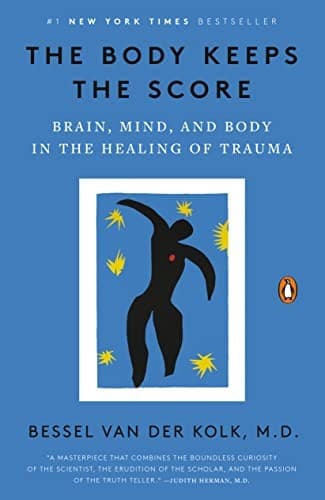
The Body Keeps the Score
by Bessel van der Kolk · Published 2014
The book that moved trauma understanding from 'talk about it' to 'the body stores it' for a mainstream audience — clinically grounded and genuinely changed treatment conversations, not just popular ones.
What works
- Clinically rigorous — draws on van der Kolk's own decades of research and patient work, not pop-psych summary
- Reframed how both clinicians and the general public think about trauma treatment (somatic approaches, not just talk therapy)
What doesn't
- Dense and occasionally repetitive at over 400 pages — could have been tighter
- Some of the specific therapeutic modalities discussed (EMDR, neurofeedback) have mixed evidence bases the book doesn't fully interrogate
Summary
Bessel van der Kolk spent four decades treating trauma survivors — Vietnam veterans, abused children, assault survivors — and this book is his synthesis of what that work, plus the neuroscience that developed alongside it, revealed. His central claim is that trauma is not primarily a memory problem or a story that needs retelling. It is a physiological one: the body's threat-response systems get stuck in configurations that persist long after the danger has passed, and those configurations are largely inaccessible to reasoning about them.
The neuroscience section explains why. Brain imaging of people re-experiencing traumatic memories showed decreased activity in Broca's area — the region responsible for producing speech — alongside heightened limbic activation. Trauma, in other words, tends to shut down exactly the machinery that talk therapy depends on. Van der Kolk uses this to explain a clinical fact he had observed for years: patients could recount what happened to them in complete detail and remain just as symptomatic afterwards.
From there the book argues for treatments that work on the body and the nervous system rather than only on narrative — EMDR, yoga, neurofeedback, theatre programs, and other approaches that engage physical and sensory processing. Van der Kolk is candid that the evidence base varies significantly across these, and the book is at its strongest when it stays with the physiology and its clinical implications rather than advocating for specific modalities.
Key ideas
1. Trauma lives in the body, not just in memory
The book's title states its thesis. Trauma survivors show persistent physiological dysregulation — altered heart rate variability, chronic muscular bracing, hypervigilant startle responses — that continues regardless of how well they understand what happened to them. Van der Kolk's argument is that these are not symptoms of a psychological problem but the problem itself, encoded somatically.
The body keeps the score: if the memory of trauma is encoded in the viscera, in heartbreaking and gut-wrenching emotions, then our maps have to be redrawn.
This reframes recovery. If the nervous system is stuck in a defensive state, then insight alone doesn't unstick it, which explains why so many patients gain understanding without gaining relief.
2. Why talk therapy has limits here
The imaging finding about Broca's area gives a mechanism for something clinicians had long noticed: during flashbacks, the speech-production regions of the brain go quiet. Van der Kolk describes this as "speechless terror" — the experience is not stored as an articulable narrative and cannot straightforwardly be retrieved as one.
His conclusion is not that talking is useless but that it's insufficient on its own, and that a treatment plan built exclusively around verbal processing will fail a substantial number of patients for structural reasons rather than because they resisted it.
3. Developmental trauma and the case for a distinct diagnosis
Van der Kolk argues at length that chronic childhood trauma produces a different clinical picture than single-incident adult trauma — affecting attachment, emotional regulation, self-concept and relationships in ways the PTSD diagnosis doesn't capture. He and colleagues proposed "developmental trauma disorder" as a formal diagnosis; it was not accepted into the DSM, and the book's account of that rejection is one of its more pointed sections.
The practical stake is real: without the diagnosis, children with chronic trauma histories frequently accumulate a series of other labels — ADHD, oppositional defiant disorder, bipolar disorder — and get treated for each in isolation.
4. Body-based and sensory treatments
The final third surveys approaches that engage the body directly: EMDR, yoga for interoceptive awareness, neurofeedback for regulating brain rhythms, and structured theatre programs for adolescents. Van der Kolk reports on clinical trials he ran himself, including one on yoga for PTSD, and is generally careful to distinguish between what has been formally tested and what he has observed clinically.
He is more enthusiastic about some of these than the evidence firmly supports, particularly neurofeedback — a caveat worth carrying into that section.
Who it's for
- Clinicians and therapists — the physiological framing changed how much of the field approaches treatment.
- People with their own trauma history — many readers report that it explained symptoms they had no framework for.
- Anyone supporting a partner, child or friend through trauma — the explanation of why "just talk about it" often fails is genuinely useful.
- Readers interested in the neuroscience of emotion and memory — the imaging material is well explained for non-specialists.
FAQ
Is this book safe to read if I have my own trauma history?
Many people find it clarifying, but the clinical case material is graphic and can be activating. If you're in active treatment, it's worth discussing with your therapist first, and reading it in sections rather than straight through is a common recommendation.
Does it argue talk therapy doesn't work?
No — it argues talk therapy alone is insufficient for many trauma patients, for a specific neurological reason. Van der Kolk's position is that verbal processing should be combined with approaches that address physiological dysregulation, not replaced by them.
How solid is the science?
The core physiological findings — autonomic dysregulation in trauma survivors, the imaging results on speech areas — are well established. The evidence for specific treatments varies considerably: EMDR has substantial trial support, while neurofeedback's is much thinner than the book's enthusiasm suggests.
What is developmental trauma disorder?
A proposed diagnosis for the distinct symptom pattern produced by chronic childhood trauma, as opposed to single-incident PTSD. It was not accepted into the DSM, which van der Kolk argues leaves many traumatized children misdiagnosed with a scattering of unrelated conditions.
What's the book's main weakness?
Its advocacy outruns its evidence in places. The physiological argument is strong and well supported, but van der Kolk presents treatments with quite different levels of validation in a similarly confident register, which makes it hard for a general reader to tell them apart.
Was this useful?
Counts appear once there are 5 votes.