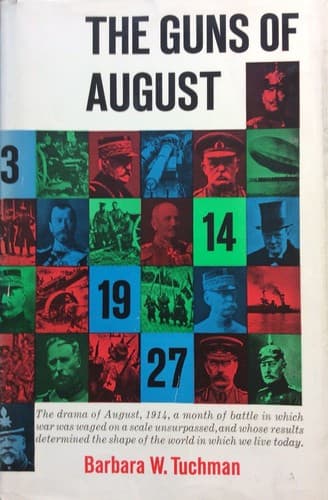
The Guns of August
by Barbara Tuchman · Published 1962
A Pulitzer-winning, minute-by-minute account of the first month of World War I — still the model for how to make the mechanics of miscalculation and alliance-driven escalation genuinely gripping rather than dry.
What works
- Extraordinary narrative craft — makes the mechanics of diplomatic failure and military planning genuinely suspenseful
- Meticulously researched and still cited as a model of narrative military history decades later
What doesn't
- Focuses tightly on the war's opening month; readers wanting the full war need a different, broader book
- Some of Tuchman's specific causal claims about pre-war planning have been revised by more recent archival research
Summary
The Guns of August covers about five weeks. It opens with the funeral of Edward VII in May 1910 — nine reigning monarchs riding together, most of them related, several about to be at war — and ends in early September 1914 with the German advance halted at the Marne and the conflict settling into the trench deadlock that would define it.
Barbara Tuchman's subject is not the war but its opening, and specifically how a continental catastrophe was assembled out of plans, timetables and assumptions that each looked reasonable to the people holding them. The assassination in Sarajevo is barely present. She is interested in the machinery, not the spark.
The first section lays out the plans: Germany's Schlieffen Plan, requiring a rapid sweep through Belgium to defeat France before Russia could mobilize; France's Plan XVII, committed to an offensive into Alsace-Lorraine; Russia's slow mobilization; Britain's ambiguous obligations. Each was rigid, each assumed the others would behave predictably.
The second section is the execution, and it is where the book earns its reputation. Tuchman moves between capitals and field headquarters as decisions get made under time pressure by exhausted men working from incomplete information — and shows a system in which, once mobilization began, almost no one believed they could stop.
Key ideas
1. Rigid plans removed the ability to choose
The book's central argument is that the war's outbreak was driven less by intent than by planning that had eliminated flexibility. Mobilization schedules were built around railway timetables of extraordinary complexity, and altering them was believed to mean chaos.
The most striking illustration is the Kaiser asking whether Germany could mobilize against Russia alone, leaving France out, and being told by Moltke that it was impossible — the plan only existed in one direction, and improvising would produce a disorganized mob rather than an army.
Whether that was strictly true is contested, but the belief was decisive. The men in charge acted as though their own plans were facts of nature, which is a failure mode that generalizes well beyond 1914.
2. Everyone expected it to be short
A conviction Tuchman documents across every capital is that the war would be over in months. Troops expected to be home by Christmas; economists argued modern economies could not sustain a long conflict; general staffs planned for rapid decisive victory.
This assumption shaped everything — the willingness to risk it at all, the absence of preparation for a long war, the refusal to consider that a stalemate was possible.
It was wrong in a specific and instructive way: the planners projected forward from previous wars, particularly the swift Franco-Prussian War of 1870, without accounting for how much defensive firepower had changed in the interval.
3. Belgium turned a European war into a world war
The Schlieffen Plan required violating Belgian neutrality, guaranteed by treaty including by Britain. German planners treated the treaty as a formality — the "scrap of paper" — and assumed Britain would not fight over it.
They were wrong, and the consequences were enormous. Belgian resistance at Liège cost days the timetable could not absorb, and the invasion gave Britain both a legal basis and a moral case for entry, bringing in an empire with global reach.
Tuchman's handling of the atrocities in Belgium is careful — she neither dismisses them as pure propaganda nor accepts the wartime accounts uncritically, which was not the norm when she was writing.
4. The narrative craft is the transferable lesson
Tuchman makes staff planning and railway logistics genuinely suspenseful, and the technique is worth studying independently of the subject.
She works through people rather than abstractions — commanders characterized in a few decisive strokes, given specific habits and specific errors — and she withholds outcomes to preserve tension even when the reader knows the war happened.
Her opening chapter on the funeral is the model: a scene that establishes the entire cast, the relationships between them, and the era about to end, without stating any of it directly. It remains a standard example of how to open a work of history.
5. Individual decisions still mattered
Against the determinism of the timetables, Tuchman shows repeatedly that particular choices by particular exhausted men changed outcomes — Moltke weakening the crucial right wing, Kluck turning early and exposing his flank, Gallieni recognizing the opportunity that became the Marne counterattack.
This tension is the book's most interesting quality. The system constrained the actors severely, and within those constraints their judgement still determined a great deal.
The Marne is where both halves meet: a plan that had almost worked failed on accumulated small deviations, each individually defensible.
Who it's for
- Anyone interested in how catastrophes get built — the mechanics of escalation are the real subject, and they generalize.
- Readers of narrative history — this is a model of the form and still taught as one.
- Anyone in planning or strategy — the failure mode of plans that remove your own options is directly applicable.
- Readers new to WWI — the opening month is the right place to understand why the rest happened.
FAQ
Do I need military knowledge to follow it?
No. Tuchman explains formations, mobilization and strategy as she goes, and her interest is in decisions and personalities rather than tactical detail. Maps in most editions cover the rest.
Why is it still recommended after sixty years?
For the narrative craft, primarily. Later scholarship has refined the causes, but no subsequent account has made the opening month this readable, and it's still cited as a model of how to write history for a general audience.
Is the Kennedy story about it true?
It's well attested that Kennedy read it and referred to its lessons during the Cuban Missile Crisis, reportedly saying he did not want a comparable book written about how his own generation stumbled into war. It's a large part of the book's reputation.
Where should I go next?
Christopher Clark's The Sleepwalkers for a modern account of the causes, or a general single-volume history for the remaining years. Reading Tuchman first and Clark second shows you clearly how the interpretation has moved.
Is it biased toward the Allies?
Mildly, and it shows its date. Tuchman is more sympathetic to the French and British and harder on German planning than a current historian would typically be, though she is not polemical and gives German commanders serious treatment.
Was this useful?
Counts appear once there are 5 votes.