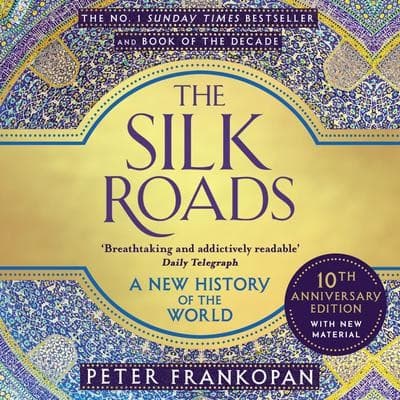
The Silk Roads
by Peter Frankopan · Published 2015
Rewrites world history with Central Asia, not Europe, at the center — genuinely reframes centuries of trade, religion, and conquest as a single connected system rather than isolated regional stories.
What works
- A real corrective to how Western-centric most popular world-history books are — reorients the map itself
- Connects economic, religious, and military history into one coherent through-line rather than separate silos
What doesn't
- The sheer scope (millennia, dozens of civilizations) means individual episodes get compressed treatment
- Dense with names, dates, and geography — a reader unfamiliar with the region's history will need to slow down
Summary
The Silk Roads opens with a claim about geography: that for most of recorded history the centre of the world was not Europe but the band of territory running from the eastern Mediterranean through Persia and Central Asia to China. Peter Frankopan then writes world history from that vantage point rather than the usual one.
The consequences of the shift are immediate. The rise of Islam becomes an event at the centre of the map rather than on its edge. The Mongol empire becomes the largest contiguous land empire in history and a genuine engine of exchange, not a barbarian interruption. The Black Death travels a trade network that already existed. The European "Age of Discovery" becomes an attempt by a peripheral region to reach markets it had been cut out of.
The book runs from antiquity to the present in a single volume, and the later chapters are unexpectedly sharp: the oil politics of the twentieth century, Anglo-Russian competition in Persia and Afghanistan, the Iranian coup of 1953, and the wars in Iraq and Afghanistan all appear as continuations of the same story about who controls the routes and the resources.
Frankopan's argument is that these regions were never peripheral — they were the connective tissue of the pre-modern world, and the period of Western dominance is a recent and possibly temporary rearrangement rather than the natural order.
Key ideas
1. Reorienting the map changes what counts as an event
The book's method is deceptively simple: keep the same historical record, move the vantage point, and see which events become central.
Constantinople stops being the eastern limit of Europe and becomes a western terminus of Asia. The Crusades become a peripheral disturbance from the perspective of the empires they were disturbing. The Silk Roads themselves are shown to have carried not only silk but religions, technologies, diseases and financial instruments in both directions.
This is a genuine corrective rather than a rhetorical trick. Most popular world history is organized around a narrative that arrives at Western Europe, and organizing it differently produces different questions rather than merely different emphasis.
2. Trade routes moved ideas as efficiently as goods
One of Frankopan's most sustained threads is religious transmission. Buddhism moving from India into China, Nestorian Christianity reaching deep into Asia, Islam spreading along commercial networks, Manichaeism appearing across enormous distances — all following merchants rather than armies.
Similarly with technology and finance: paper, gunpowder, banking instruments and mathematical concepts travelled the routes, often being transformed at each stage rather than transmitted intact.
The implication is that the pre-modern world was far more connected than the standard account of isolated civilizations suggests, and that connection — not isolation — is the historical norm.
3. The Mongols as an engine rather than a catastrophe
Frankopan's treatment of the Mongol empire is one of the book's clearest reversals. The conventional Western account emphasizes destruction; he emphasizes what the empire enabled once established.
A single political authority across the routes meant safer travel, standardized weights, functioning postal relays and a period of intense exchange between East and West. The violence of the conquest is not denied, but it is placed alongside the system that followed.
He extends the argument to the Black Death, which travelled precisely because the network worked so well — a genuine cost of connection, and a reminder that integration produces vulnerability along with prosperity.
4. European expansion as a response to exclusion
The section on the Age of Discovery reframes it as an economic problem rather than a burst of curiosity. Western Europe was at the far end of trade networks it did not control, paying intermediary prices for goods from the East.
Portuguese and Spanish voyages become attempts to bypass those intermediaries. The silver of the Americas becomes significant primarily because it gave Europe something China would accept in trade, having previously had little to offer.
This reading makes the subsequent rise of European power look less like the flowering of an inherently dynamic civilization and more like the outcome of a specific and contingent solution to a specific problem.
5. The twentieth century is the same story continued
The modern chapters are where readers most often find the book unexpectedly current. Frankopan treats oil as the successor to the older resource competitions and traces Anglo-Russian rivalry, the carve-up after the Ottoman collapse, and the 1953 removal of Mosaddegh in Iran as continuous with earlier struggles for the same corridor.
The wars in Iraq and Afghanistan appear in the same frame, as does the more recent movement of economic weight back toward Asia.
The book's closing argument — that the centre of gravity is returning to where it sat for most of history — is speculative, and Frankopan presents it as such, but the preceding chapters give it more force than a bare prediction would carry.
Who it's for
- Anyone whose world history is Europe-shaped — this is the most efficient corrective available in one volume.
- Readers interested in Iran, Central Asia and the Middle East — regions treated here as central rather than as context.
- Anyone following the shift of economic weight toward Asia — the historical depth changes how current events read.
- Readers who like connected rather than siloed history — economics, religion and war are handled as one system.
FAQ
Is it actually about the Silk Roads?
Only partly. The routes are the organizing device, but the book is a full world history told from that vantage point, running from antiquity to the twenty-first century. Expect far more than trade.
Do I need background in Asian or Middle Eastern history?
It's written for a general reader, but it moves fast through unfamiliar material. Some prior orientation helps a great deal, and a map is close to essential.
Is it anti-Western?
No — it's decentring rather than hostile. Frankopan treats European expansion seriously as a historical development; he simply declines to treat it as the inevitable destination of world history.
How does it compare to Guns, Germs, and Steel?
Both are single-volume reframings, but Diamond argues a causal thesis about why some societies dominated, while Frankopan largely reorganizes the narrative geographically. Frankopan makes fewer contestable causal claims as a result.
Is the final argument about Asia's return persuasive?
It's the most speculative part, and he presents it as an argument rather than a conclusion. Its force comes from the preceding chapters — if the region really was central for most of history, its return is a reversion rather than a novelty.
Was this useful?
Counts appear once there are 5 votes.