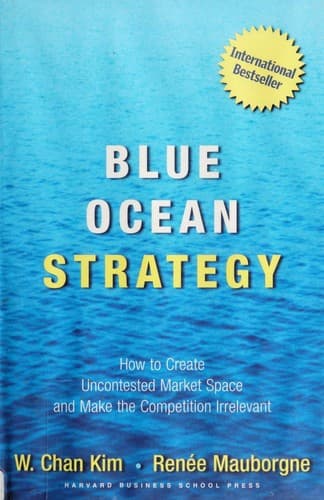
Blue Ocean Strategy
by W. Chan Kim & Renée Mauborgne · Published 2005
A useful, over-cited framework for escaping head-to-head competition by making the competition irrelevant — most valuable for the four-actions grid, not the buzzword.
What works
- The Eliminate-Reduce-Raise-Create grid is a genuinely usable tool, not just a slogan
- Case studies (Cirque du Soleil, Southwest) show the framework applied concretely
What doesn't
- Survivorship bias — no serious accounting of blue-ocean attempts that failed
- The term has been diluted by a decade of consulting-deck overuse since publication
Summary
W. Chan Kim and Renée Mauborgne open with a distinction: a "red ocean" is an existing market where competitors fight over shared, known demand, and where the more competitors fight, the bloodier — hence the color — the water gets. A "blue ocean" is uncontested market space, created rather than found, where the old rules of competition are temporarily irrelevant because there's no established competitor there yet. Their central argument is that sustainable, high-growth performance comes disproportionately from companies that create blue oceans rather than companies that fight more effectively within a red one.
The book's core analytical tool is value innovation — the idea that competing on value and competing on cost aren't actually a trade-off, contrary to the standard strategic assumption that a company must choose to either differentiate (spend more, offer more) or compete on cost (spend less, offer less). A blue-ocean move, by the authors' argument, simultaneously lowers cost by eliminating and reducing factors an industry has long competed on, while raising value by creating and adding factors the industry has never offered. The famous example is Cirque du Soleil, which cut expensive elements standard to traditional circus (animal acts, star performers, multiple show rings) while adding elements no circus had offered (theatrical narrative, artistic music, a more sophisticated adult audience) — arriving at a new category rather than a better version of the old one.
The rest of the book is a toolkit for finding and executing that kind of move deliberately, rather than stumbling into it by accident: a set of analytical frameworks (the strategy canvas, the four actions grid, the six paths framework) meant to make blue-ocean discovery a repeatable process instead of a rare stroke of insight.
Key ideas
1. The Four Actions Framework: Eliminate, Reduce, Raise, Create
This is the book's most directly usable tool. Facing an industry's competitive factors — the things every player in the space competes on — the framework asks four questions: which factors the industry takes for granted should be eliminated entirely; which factors should be reduced well below the industry standard; which factors should be raised well above it; and which factors should be created that the industry has never offered at all.
Value innovation is not about competing but about making the competition irrelevant by changing the playing field of strategy.
The eliminate and create questions are where most of the strategic leverage sits, because they push a team to challenge assumptions competitors treat as fixed, rather than just optimizing along the same competitive dimensions everyone else is already optimizing along.
2. The strategy canvas
The strategy canvas is a simple visual: the industry's key competitive factors along the horizontal axis, and the relative offering level for each competitor plotted along the vertical axis. Most companies in an established industry, plotted this way, produce nearly identical curves — everyone is competing along the same dimensions at roughly the same levels, which is a visual diagnosis of a red ocean. A genuine blue-ocean strategy produces a visibly divergent curve — high on some factors nobody else bothers with, absent entirely on others everyone else assumes are mandatory.
The canvas is deliberately simple to force clarity: a strategy that can't be plotted as one clear curve usually isn't focused enough to be a real strategy, echoing a diagnosis very similar to Rumelt's critique of unfocused, unprioritized planning documents.
3. Non-customers, not just customers
Most market research focuses on existing customers — understanding their needs better to compete more effectively for the same demand. Kim and Mauborgne argue blue-ocean opportunities are found by studying non-customers instead: people who consciously reject the industry's offering, people who use it reluctantly because there's no alternative, and people who've never even considered the industry as relevant to their needs at all. Understanding why these three groups stay away from an entire category, rather than why existing customers prefer one competitor over another, is where genuinely new demand tends to be found.
This reframes market research from a competitive-benchmarking exercise into a demand-creation exercise — the question shifts from "how do we win the customers our rivals also want" to "what would make someone who currently avoids this entire category want it."
4. Overcoming organizational hurdles: tipping point leadership
Kim and Mauborgne acknowledge that even a well-designed blue-ocean strategy fails if an organization can't actually execute the shift, and they borrow from tipping-point thinking to argue that large-scale organizational change doesn't require convincing everyone — it requires concentrating effort on a small number of disproportionately influential people, places, and acts. Rather than a broad, resource-intensive change-management program, the recommendation is to identify the specific bottleneck (a resource constraint, a key skeptical stakeholder, a motivational gap) and apply concentrated effort exactly there.
Who it's for
- Product and strategy teams deciding whether to compete head-on in a crowded category or reposition entirely — the strategy canvas is a genuinely useful diagnostic before either choice.
- Founders looking for a structured way to find a differentiated positioning, not just a slogan for one — the four-actions framework forces specificity a mission statement doesn't.
- Anyone stuck thinking about competitive strategy purely in terms of cost vs. differentiation — the value-innovation argument directly challenges that binary.
- Consultants and internal strategists who need a shared visual language (the canvas) for aligning a leadership team — it's a genuinely effective facilitation tool, independent of the theory behind it.
FAQ
How is "value innovation" different from ordinary innovation?
Ordinary innovation, in the authors' framing, is usually a technology push that may or may not align with what the market actually values. Value innovation is defined specifically as the combination of innovation with utility, price, and cost positioning that creates a leap in value for both the buyer and the company simultaneously — innovation alone isn't the goal, alignment with real demand is.
Does this only apply to consumer products, like the Cirque du Soleil example?
No — the book includes B2B and industrial examples (Southwest Airlines, a construction equipment manufacturer, a wine producer) specifically to show the framework applies across sectors, not just to lifestyle or entertainment products.
Isn't "making the competition irrelevant" just marketing language for differentiation?
The authors would argue no — ordinary differentiation still competes within the industry's existing value curve, just at a different point on it. A genuine blue-ocean move changes which factors are being competed on at all, which is a structurally different move than offering a nicer version of the same thing.
What happens once a blue ocean gets discovered by competitors?
The book acknowledges blue oceans don't stay blue forever — once a move succeeds, imitators arrive and the space gradually reddens. The implied practical lesson, though less developed than the discovery framework, is that value innovation needs to be a repeatable organizational capability, not a one-time move.
What's the book's main weakness?
The near-total absence of serious failure case studies. A reader gets a strong sense of what a successful blue-ocean move looks like in retrospect, but very little sense of how often the same process, applied in good faith, fails to find real demand.
Was this useful?
Counts appear once there are 5 votes.