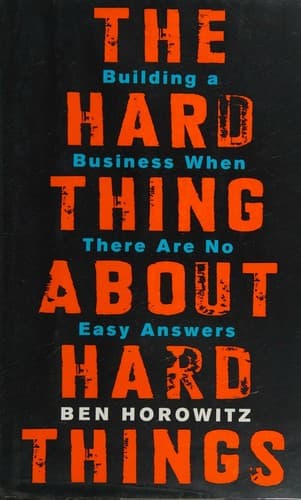
The Hard Thing About Hard Things
by Ben Horowitz · Published 2014
The least sanitized account of running a company under existential pressure — layoffs, near-bankruptcy, firing a friend — written by someone who actually did those things.
What works
- Refreshingly specific about the ugly decisions (layoffs, demotions, firing friends) most business books skip
- 'Wartime vs. peacetime CEO' and other frameworks are genuinely reusable
What doesn't
- Written for a founder/CEO audience specifically — an individual contributor gets less out of most chapters
- Some Silicon Valley-specific war stories have aged into period pieces
Summary
Ben Horowitz's premise is stated almost as a complaint: most business books teach you how to do things right, but almost none of them teach you what to do when everything is going wrong and there's no good option left — only a choice between several bad ones. He calls this "the struggle," and the book is his attempt to write down what he actually did during his own, specifically during the years he spent running Loudcloud and then Opsware through the dot-com crash, a business model pivot, and a near-death cash crisis, before eventually selling the company to HP for $1.6 billion.
The book alternates between two registers. One is memoir — specific, dated, often uncomfortable stories: laying off a third of the company, demoting a loyal friend and co-founder, discovering the company had three weeks of cash left. The other is a series of tactical essays on management mechanics: how to hire an executive, how to fire someone with respect, how to run a one-on-one, when to promote from within versus hire externally. Horowitz is explicit that the memoir chapters exist to earn the right to give the tactical advice — he's not interested in giving guidance he hasn't personally tested under pressure.
The throughline connecting both halves is a rejection of formula. Horowitz repeatedly argues that most management advice assumes a peacetime company — stable, growing, choosing between good options — when the actual defining moments of a company's life are wartime: existential, resource-constrained, and requiring decisions that would be considered dysfunctional in a healthy company but are simply survival in a dying one. The book's value is largely in taking that distinction seriously rather than offering one-size-fits-all leadership advice.
Key ideas
1. Wartime CEO vs. peacetime CEO
Horowitz's most cited framework distinguishes two entirely different modes of leadership, and argues most management literature only really describes the peacetime one. A peacetime CEO focuses on expanding the addressable market, maintains a healthy, low-conflict culture, and encourages broad creativity and process. A wartime CEO tolerates much less deviation from a single, urgently focused plan, cares far less about whether decisions feel fair, and is willing to break rules the company's own culture would normally consider sacred, because the alternative is the company ceasing to exist.
There's no way to prepare for the loneliness, the sleepless nights thinking about hundreds of employees and their families and whether they will have a paycheck.
The point isn't that wartime leadership is "better" — Horowitz is clear it's often abrasive and costly to culture. The point is that applying peacetime leadership instincts during an actual wartime moment (mass layoffs, a pivot under a cash deadline, a near-bankruptcy) gets people fired for the wrong reasons and companies killed for indecision.
2. The mundane specifics of firing well
A large portion of the book is devoted to something most leadership books treat as a footnote: how to actually lay someone off or fire them without destroying their dignity or the company's culture in the process. Horowitz's advice is granular — get to the point immediately rather than making small talk first, give a clear and honest reason, don't let a manager delegate the conversation to HR, and train every manager doing layoffs the same day so the message and process are consistent company-wide.
The specificity here is deliberate. Horowitz's argument is that most executives get this badly wrong not because they're careless but because nobody ever taught them the actual mechanics, and vague advice like "be compassionate" doesn't survive contact with an actual room full of people who are about to lose their income.
3. Take care of the people, the products, and the profits — in that order
This is Horowitz's compressed statement of priority when everything is on fire at once and a leader has to choose what to focus on first. People, because a company that treats its employees badly during a crisis will lose the ones it most needs to keep; products, because without something worth selling there's no company to save; profits, because profit is the outcome of getting the first two right, not something to be engineered directly under pressure.
The ordering matters more than it looks. Horowitz's specific complaint about many struggling executives is that they invert it — chasing short-term revenue numbers at the expense of both the team's trust and the product's actual quality, which produces a company that hits a quarterly number and then collapses anyway.
4. The case for embracing the struggle rather than looking for an exit
Horowitz is unusually candid that there were points during Loudcloud/Opsware where he seriously considered quitting, and describes the psychological weight of carrying a company's survival on shoulders that don't get relief just because the CEO is exhausted. His argument isn't that quitting is always wrong — it's that most CEOs who quit during "the struggle" do so because they've stopped looking for the move that's actually available, not because no move exists.
The chapter's practical advice is narrower than the psychology it describes: keep searching for the smallest available next move rather than the grand solution, because in a genuine crisis the grand solution usually doesn't exist and waiting for one is itself the failure mode.
Who it's for
- First-time founders and CEOs, especially of venture-backed startups — the book's frame of reference (board dynamics, layoffs, cash crunches, executive hiring) is written directly for that seat.
- Anyone who has to make an unpopular, urgent decision and needs permission to prioritize survival over consensus — the wartime/peacetime framework directly names that tension.
- Managers who need concrete, step-by-step guidance on firing someone humanely — few other business books get this specific.
- Readers tired of survivorship-bias business memoirs — Horowitz is unusually willing to describe genuine failure and fear, not just triumph.
FAQ
Do I need to have run a company to get value from this book?
No, but the value shifts. A manager or team lead will get the most concrete, immediately applicable material from the firing, hiring, and one-on-one chapters; the CEO-specific chapters (board dynamics, wartime leadership) are more useful as a window into what that job actually involves than as direct how-to guidance.
Is this a memoir or a management book?
Both, deliberately interleaved. The memoir chapters aren't there for entertainment value — they're the evidence Horowitz uses to earn the right to the tactical advice that follows, which is why the book doesn't separate the two into distinct sections.
How does this compare to more traditional leadership books?
Most traditional leadership books implicitly assume a stable, growing company choosing between good options. This book is explicitly about the opposite situation — no good options, existential stakes — which is the gap Horowitz says most leadership literature leaves unaddressed.
Does the advice still apply to non-venture-backed businesses?
The underlying principles (prioritizing people over short-term optics, being direct in hard conversations, embracing unpopular decisions when survival is at stake) transfer well. The specific mechanics around board management and fundraising are venture-context-specific and less directly applicable to a bootstrapped or traditionally financed business.
What's the book's main weakness?
Its frame of reference is narrow — this is written specifically from and for the CEO's chair in a venture-backed tech company, and readers outside that specific context (individual contributors, non-tech founders, bootstrapped businesses) have to do more translation work than the book itself offers.
Was this useful?
Counts appear once there are 5 votes.